Briefing Papers on Federal Unit Politics of Central Burma | Part 5
This paper is the Part (5) of the briefing paper on federal unit politics in central Burma. Part 1 examined the structural formation of federal units, Part 2 analysed their internal power structures, and Part 3 focused on the human rights frameworks embedded in the interim constitutional arrangements of three federal units in Ah Nyar and Part 4 discussed defence force law in Magway and security landscape. Download the full paper.
Background
Coup de’ tat in 2021 triggered nationwide civil disobedience movement and intensified the existing civil war in Burma. The harsh military crackdowns during February and March of 2021 on the peaceful protesters later transformed the civil disobedience movement into armed resistance. Unexpectedly to the ruling elites and analysts, central Burma, the country’s heartland, rose up to lead the anti-coup resistance movement, which was later joined by several ethnic liberation groups. The National Unity Government of Myanmar (NUG) and resistance groups in Ah Nyar controlled vast majority of rural territories including some urban centres particularly in strategic areas between Sagaing and Kachin, Magway and Chin and Mandalay and northern Shan. The resistance landscape has significantly shifted, since late 2023, towards institutional establishments at sub-national layer. Notably, Ah Nyar has played a significant role in this development. These institutional developments have been driven largely by the sub-national parliaments in Sagaing, Magway, and Mandalay. The parliaments comprise members elected to the respective regional houses in the 2020 general elections. The regions established three branches power independently: legislative, executive and judiciary. The NUG’s support for this development, described by its Acting President as a means “to establish a better system of governance[1],” reflects an effort to accommodate emerging sub-national governing institutions.
Current development
Following the political formations of Federal Units in Sagaing, Magway and Mandalay[2], the administrative transition from the NUG to these sub-national governments is currently underway. The two layers (between the NUG and sub-national governments) are closely coordinating the transition of the respected administrative mechanisms including public welfare services, township and district administrations and taxation. The role of federal unit governments is more obvious than before. They are now central to sub-national level arrangements including humanitarian and development coordination. Sub-national parliaments in Sagaing, Magway and Mandalay are actively advancing law-making, particularly to establish local administrations that are accountable to both the legislative houses and the people. Meanwhile, the transfer of administrative functions at the regional and township levels from the NUG to the Federal Unit Governments is ongoing, with a significant proportion of responsibilities already devolved from the central authority to sub-national governments.
The 3-Ps
The 3-Ps refer to the
- People’s Defence Teams (PDT),
- People’s Security Teams (PST) and
- People’s Administration Team (PAT)
established by the Committee Representing Pyidaungsu Hluttaw (CRPH) and the NUG. They are central to anti-coup resistance movement and grassroots security and administrative establishments spreading across villages, townships and regions particularly in Ah Nyar. Each of the 3-P has different mandate. PDTs are local militias and trained combatants under the command of the Ministry of Defence of the NUG, while PSTs are also armed wings with only law enforcement functions. PSTs are technically the people police force managed by the Ministry of Home Affairs and Immigration (MoHAI) of the NUG. PATs are not armed wing; instead, they perform only administrative functions within the resistance movement, and they are managed by the MoHAI of the NUG. Despite their distinct responsibilities, the 3-Ps are closely inter-connected by functions and cooperative at the grassroots level.
With the establishment of interim constitutional and governing arrangements in Sagaing, Magway, and Mandalay, the institutional relationship between the 3-Ps and the emerging Federal Unit Governments is evolving. This process involves the gradual transition of administrative, security, and law enforcement responsibilities from NUG-centred structures towards sub-national governance arrangements. How these functions are transferred, coordinated, and integrated into the emerging Federal Unit institutions will be important in determining the distribution of authority between the central and sub-national levels of governance in Ah Nyar.
What is the People’s Administration Teams (PATs) mechanism?
The Central Committee for Interim Local Public Administration of the NUG in which the cabinet members from all ministries at the central level directly supervise the PATs through strategic guidance and coordination[3]*. The idea is largely referred to the structure of an extant General Administration Department mechanism under the current Military regime. PATs primarily exist at the township and village/ward levels. And at the district and regional levels, the township’s PATs leaders represent and interact with associated decisionmakers. Therefore, the township and ward/village level PATs play a key role in local governance mechanisms.
Who are the members of Township /village/ward PATs?
Township Level People’s Administration Team
Generally, in most of the townships controlled by the resistance forces, the township People’s administration team is typically composed of around 20 members, led by a Township People’s Administration Officer (Township PaAhPha leader/Chair).
The structure is generally depicted as follow[4]:
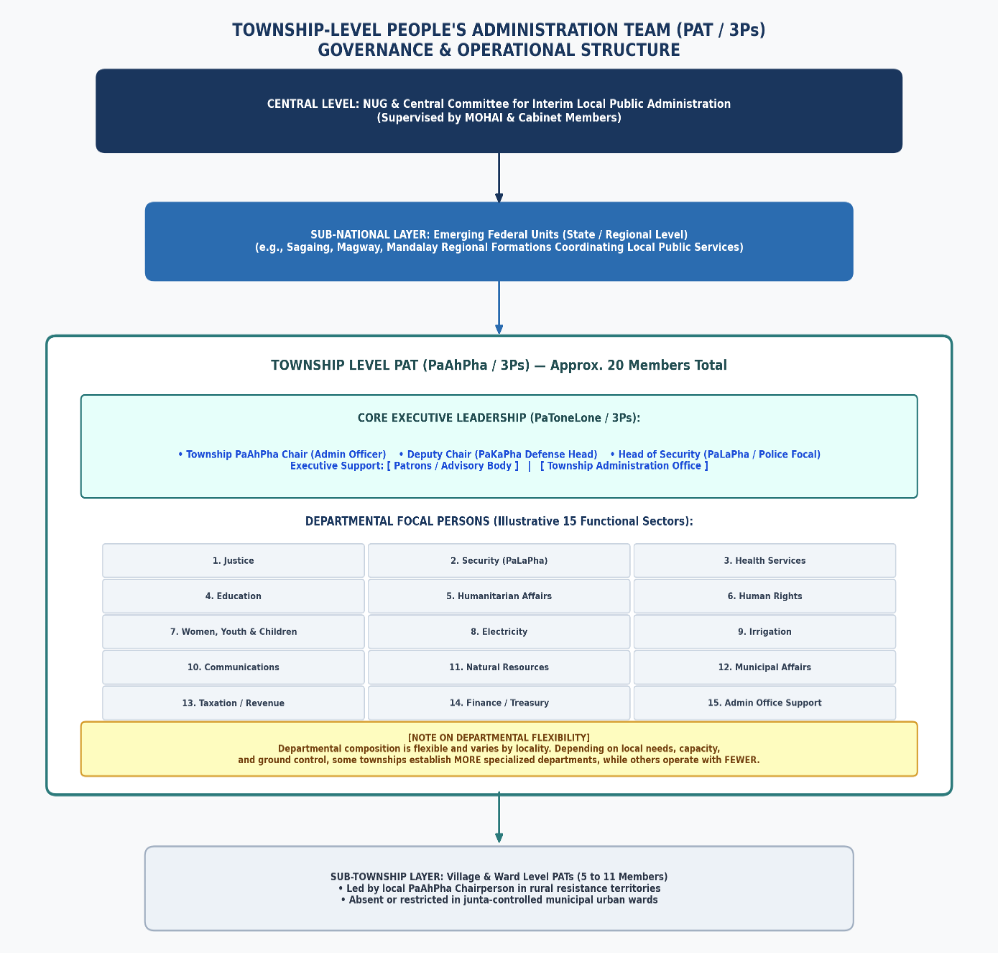
The leaders of PaAhPha (PAT), PaLaPha (PST), and PaKaPha (PDT) are core members of township-level PAT teams. This arrangement reflects the realities of governing in conflict-affected areas, where local administrations face persistent security threats, including military operations, raids, arson attacks, and clashes between armed groups. Under these conditions, the 3-Ps have become a widely used term to describe the closely interconnected administrative, security, and defence structures operating at the grassroots level.
The number of departments within PATs varies across townships, depending on local needs, institutional capacity, and personnel availability. In some townships, limited capacity and staff shortages constrain the establishment and operation of departments. The size and composition of PAT teams therefore also vary which reflects differences in local conditions and the resources available to sustain administrative functions.
Village/Ward Level People’s Administration Teams
Despite the existence of township-level PATs, this does not necessarily mean that village- and ward-level PATs have been established in every village and ward within the township. In general, urban wards and certain villages remain under the influence of the military junta, while resistance forces control the vast majority of the township’s territory. Consequently, PATs are absent from some villages and wards. Moreover, even in areas under resistance control, the PAT mechanism has not been established in every village and ward.
Village- and ward-level People’s Administration Teams typically consist of 5 to 11 members, led by a PaAhPha (PAT) leader. Unlike township-level PATs, where leaders of the PaAhPha (PAT), PaLaPha (PST), and PaKaPha (PDT) commonly form the core team, village- and ward-level structures tend to be more fluid, with the PaAhPha leader often serving as the principal member. Their composition depends largely on community participation and the availability of individuals willing and able to undertake administrative responsibilities.
What kind of primary services do PATs deliver?
While the PATs mechanism at the township and village/ward levels is mandated to provide public services and respond to community needs, the prevailing conflict environment has hindered its capacity to deliver many essential services. Therefore, the PATs leaders and members at the township and village/ward level prioritised their services delivery based on the emergency needs and scope of their outreach. The common basic public services being prioritised could be found in the sector of:
- Healthcare
- Education
- Judicial/Security services
- Emergency response/ Humanitarian Assistance
Other services are provided depending on the department’s focal existence, availability of funding, and the security and stability conditions of the area. **[5]
Endnotes
[1] Centre for Ah Nyar Studies. (2026, February 15). Ah Nyar’s Big Questions in 2026: Where Are We Headed? [Op-ed]. Centre for Ah Nyar Studies. https://ah-nyarstudies.org/ah-nyars-big-questions-in-2026-where-are-we-headed/
[2] Centre for Ah Nyar Studies, Analysis of the Evolving Power Structure of Federal Units in Central Burma, 3 December 2025, https://ah-nyarstudies.org/power-structure-of-federal-units-in-central-burma/
[3] *This is an updated structure before popular emerging federal units at sub-national level. As of 2026 Oct, NUG and federal units are still in transitional periods of handing over this administration structure, especially PATs mechanism. Hence, there have not seen significant changes in the structure yet.
[4] Centre for Ah Nyar Studies, မြို့နယ် ဒေသန္တရအုပ်ချုပ်ရေး အစီရင်ခံစာ [Local Governance Analysis Report], unpublished; internal report, April 2026.
[5] This document draws mainly on findings from the Township-Level Local Governance Analysis Reports (မြို့နယ်အဆင့် ဒေသန္တရအုပ်ချုပ်မှု အစီရင်ခံစာများ) April 2026. conducted in three townships of Sagaing and Magway Regions by Centre of Ah Nyar Studies.
 English
 Myanmar
