
Highlights
|
Timeline of the Incident
| Date | Description of major events |
| 2 June 2026 |
|
| 3-4 June 2026 |
|
| 7 June 2026 |
|
| 8 June 2026 |
|
| 9 June 2026 |
|
| 10 June 2026 |
|
| 11 June 2026 |
|
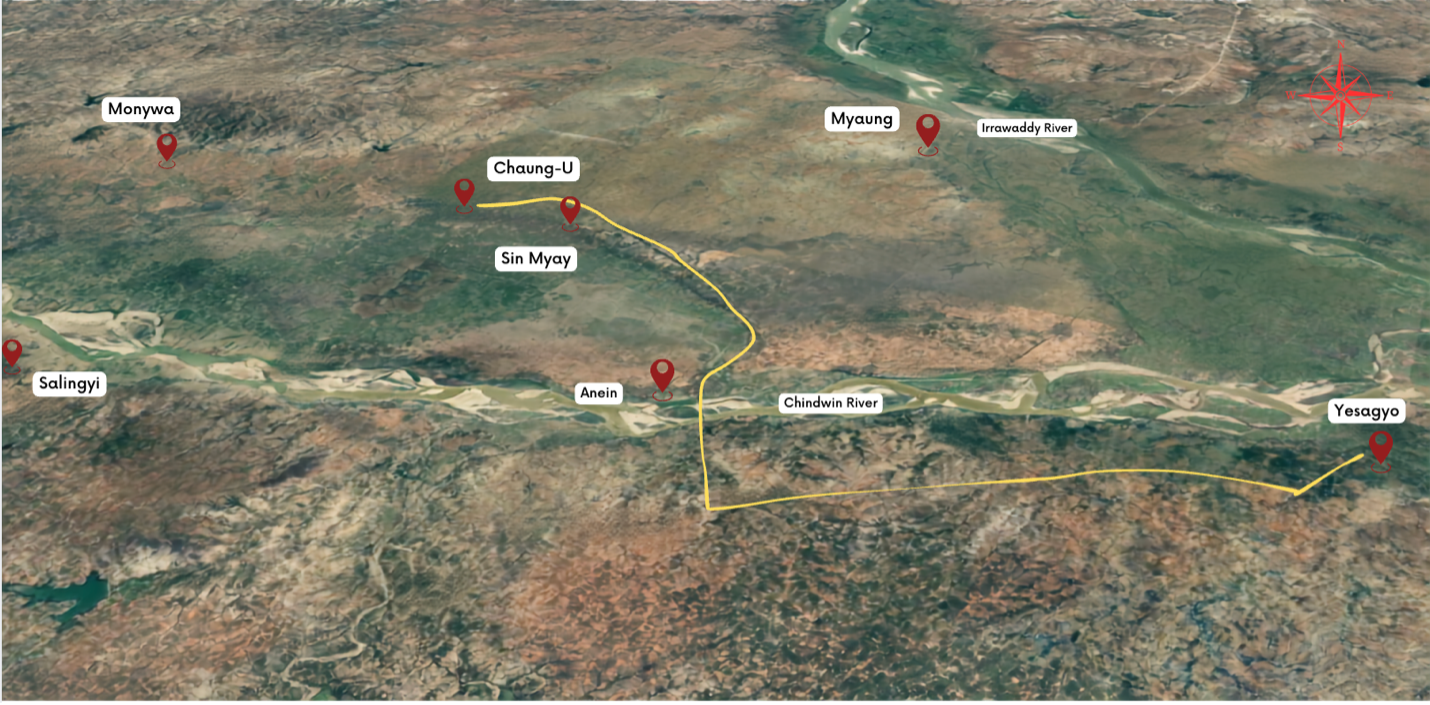
Overview Map of the Incident Area
Civilians at Risk Amid Escalating Military Operations
Chaung U Township of Sagaing is located approximately 12 miles south of Monywa, the headquarters of the Northwestern Regional Military Command. Since the 2021 military coup, Chaung U has been one of the strongholds of the resistance movement in Sagaing. Consequently, the township has long been subjected to military offensives, including aerial bombardments, artillery shelling and ground operations. Previous attacks include the Bon-To massacre on 6 October 2025 in western Chaung U Township. While the Tatmadaw maintains control over the urban wards of Chaung U, areas north of the town, including Khin Mon, the Mya Pa Le fuel station and sections of the Monywa–Mandalay Road, the majority of rural areas remain under the control of locally based resistance forces.
In early June this year, military operations in the area intensified as the Tatmadaw launched renewed offensives across central Burma and strategic transport corridors. According to local sources we interviewed, fighting between Tatmadaw forces and local resistance groups began on 2 June 2026 in the area between Sin Myay and Hman Cho villages. Resistance sources stated that the Tatmadaw initially deployed a military column of approximately 200 troops, resulting in significant casualties during four separate engagements and subsequently reinforced its forces for a renewed offensive.
The military operation had immediate and severe consequences on civilians from five nearby villages. As fighting intensified, residents were forced to flee their homes, while access to the villages and farmland was restricted because of ongoing hostilities. Between 3 and 4 June, local sources reported more than eight aerial attacks involving gyrocopters and motorised paramotors. A local healthcare worker we interviewed told us;
“The gyrocopters and paramotors did not only target resistance positions. They also struck places where displaced families were taking shelter.”
Following the fighting on 2 June 2026, on 7 June, the Tatmadaw forces reportedly reinforced their military column with additional troops from Chaung U Town and launched a renewed offensive supported by drones and aerial assets. According to a report from a local information scout channel, two military trucks departed from the General Administration Department compound in Chaung U Town to reinforce the military column before it re-entered Sin Myay village. Villagers and resistance fighters alleged that drones carrying substances believed to contain chemical agents were used during the operation. Witnesses said that
“Smoke was everywhere. The whole area was covered in it. The resistance fighters and rescue workers had to wear protective gloves in the field”
However, we could not independently verify the use of chemical agents. In the following days, Tatmadaw forces reportedly occupied nearby villages, removed civilian properties and began burning residential homes on 11 June. Approximately 8000 villagers were displaced, particularly from Sin Myay, Hman Cho, Nga Lone Tin and Ywar Taw Lay villages. At least 255 civilian houses were independently identified as being burned down by the Tatmadaw military column. This left a total of 1,049 people homeless, including 546 women, 12 mothers and 7 persons with disabilities.
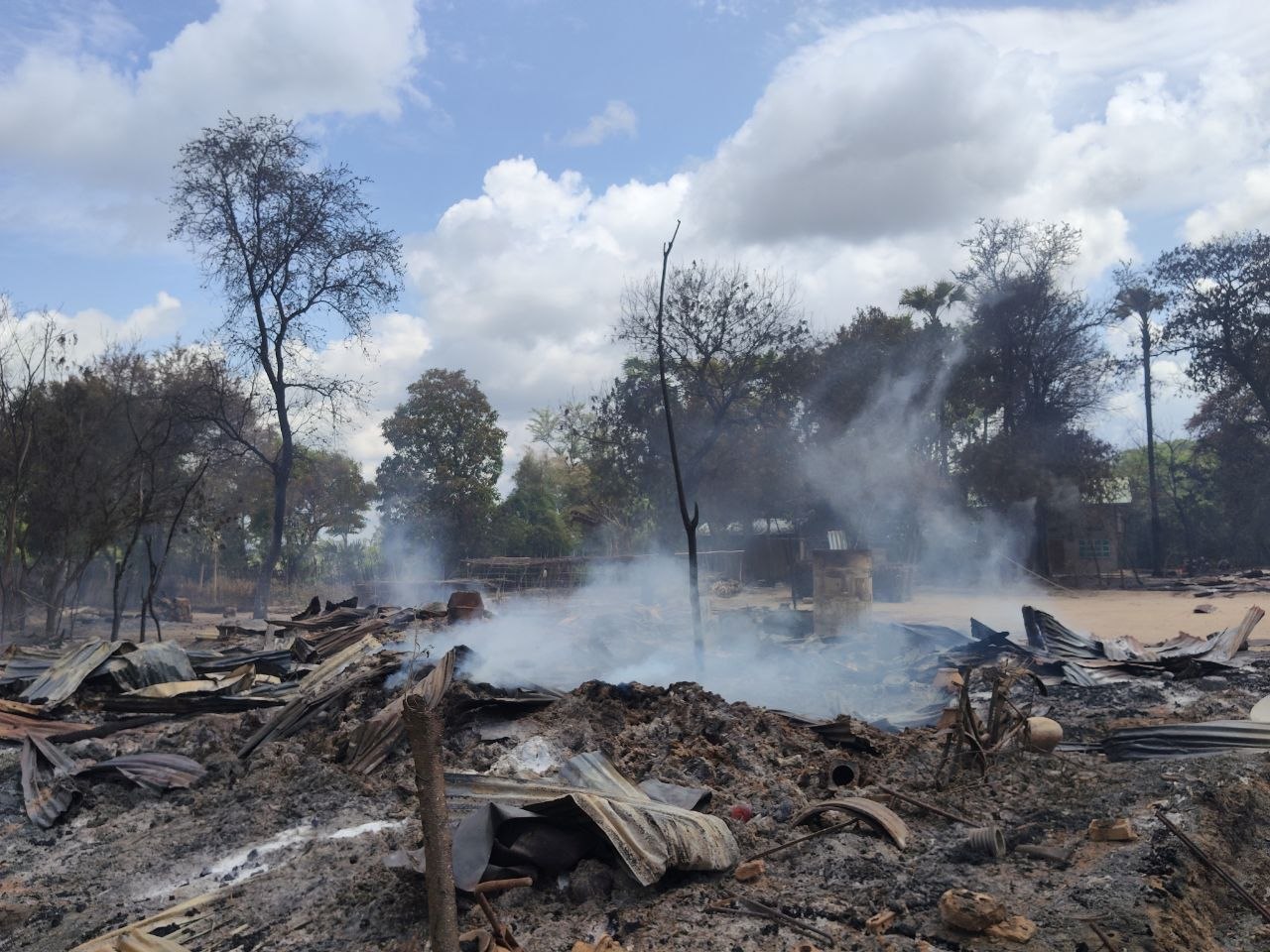
Residential houses destroyed following an arson attack (Source: Centre for Ah Nyar Studies)
In addition, the Buddha statue of at least 200 years old and the monastery were also burned down.
“The pagoda is believed to be sacred and powerful. People say that if you make a wish or a solemn vow there, it will come true. It hurts us so much to see it destroyed. As for those who set it on fire, they will face the consequences one day.”
Villagers fled their homes to nearby monasteries, neighbouring villages and farmland, where they lacked adequate shelter and access to essential supplies, including food and safe drinking water.
“I’m not afraid of dying at once. What frightens me more is the thought of surviving with injuries, as disable person. So, I have to flee since I know the fighting is near our villages. Now, I have temporarily stayed at my relative at the border village between Chaung U and Myaung townships”.
In addition to the destruction of a historic monastery and Buddha statue, which hold significant religious, cultural, and historical value for the local community in Chaung U Township, the Centre for Ah Nyar Studies independently verified that 197 houses in Sin Myay village, 28 houses in Nga Lone Tin village and 30 houses in Hman Cho village were destroyed by fire during the military operation. During the verification process, our researchers examined physical and digital evidence reportedly left behind by Tatmadaw soldiers, including military uniforms and a mobile phone belonging to a local resident. As we observed, a soldier allegedly used the device to post the following message on the resident’s TikTok account,
“[We] will burn Sin Myay village”

A Tatmadaw soldier posted on TikTok stating, “We will burn Sin Myay village” (Source: Centre for Ah Nyar Studies)
Elderly Man Burned Alive After Being Unable to Run
Three civilians and one resistance fighter died in the incident. Two civilian men were killed by artillery shelling at sites where displaced people were sheltering, while an elderly man with disabilities was burned alive in Sin Myay village during the Tatmadaw raid. We verified the identities of those who died in the incident as follows.
| Name | Age (yrs) | Gender | Village | Remark |
| Internal Record | 58 | Male | Nga Lone Tin | Died due to artillery attacks. Had a mental disability. His dead body was found on 12 June 2026. |
| Internal Record | 65 | Male | Sin Myay | Died due to artillery attacks. Lost contact with family members since 12 June 2026 and confirmed his death on 17 June 2026. |
| Internal Record | 70 | Male | Sin Myay | Burnt alive on 14 June 2026. |
| Internal Record | 25 | Male | Sin Myay | Death, Local Resistance Force member. Died on 4 June 2026. |
The victim was a 70-year-old man with a long-term chronic medical condition. He was unable to flee during the military raid because of his illness. His daughter told us,
“My father was ill and unable to speak. He could only make sounds like ‘Wu, Wu, wahh…’. We were in a different place at that time and I couldn’t take him out of the village. I didn’t know whether he was still alive. Later, I heard from some rescue workers that he had been killed.”
On 14 June, she received confirmation from rescue workers and local (resistance) administration that her father had been burned alive in his home.
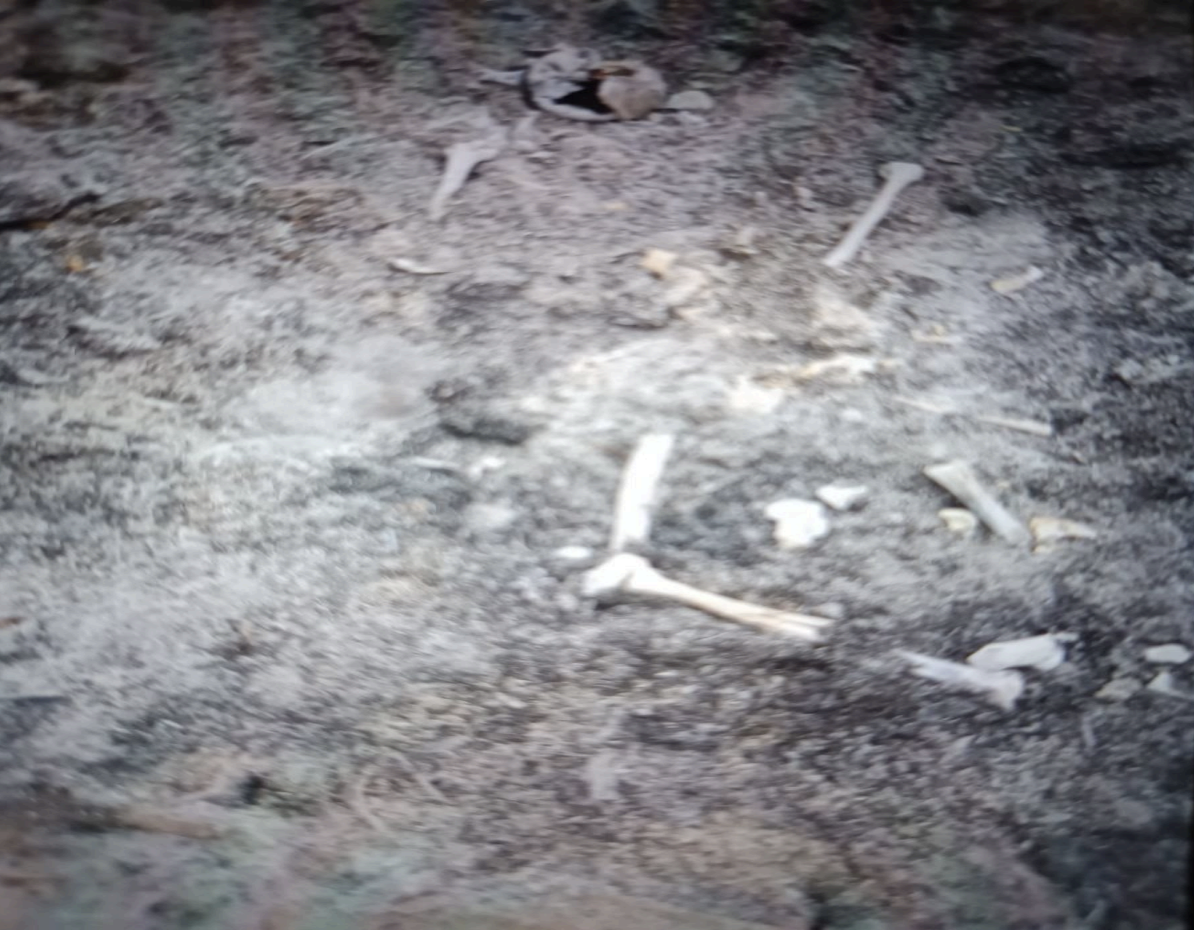
The burnt remains of a 70-year-old man in Sin Myay village, Chaung U township, Sagaing (source: Centre for Ah Nyar Studies)
Furthermore, three civilian men were also injured by landmines, artillery attacks and a suicide drone. We verified their identities as follows.
| Name | Age (yrs) | Gender | Village | Remark |
| Internal Record | 29 | Male | Sin Myay | Injured in a heavy artillery attack on 13 June 2026. |
| Internal Record | 28 | Male | Ma Hti Thar | Injured in landmine explosion on 12 June 2026. |
| Internal Record | 56 | Male | Min Khaung | Injured in a suicide drone attack on 12 June 2026. |
Airstrike on a Funeral Gathering Resulting in Civilian Casualties
Tatmadaw also carried out a jet fighter airstrike targeting the funeral of a resistance fighter who had been killed during the fighting in Chaung U Township. The funeral was held in Pauk Taw (West) village, Myaung Township. According to information verified by our researchers, the military aircraft dropped bombs on the funeral site, killing two resistance fighters and injuring 13 civilians. A local resistance administrative official interviewed stated,
“The attack happened after we had paid tribute to the deceased. Otherwise, the number of casualties would have been unthinkable.”
According to local witnesses interviewed, the airstrike on the funeral took place at approximately 11:15 a.m. on 10 June 2026. Those injured in the attack included local construction workers and villagers from Pauk Taw (West) village.
Analysis
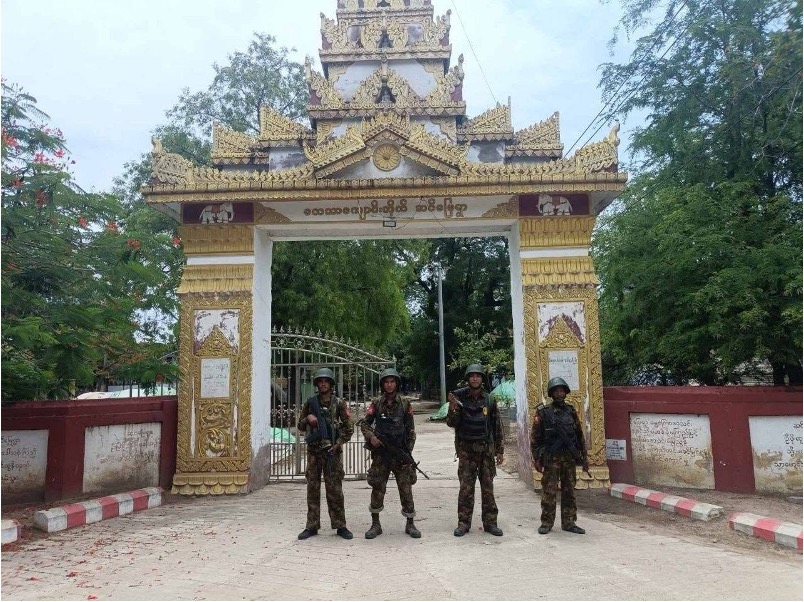
Tatmadaw stated that the operation was a counter-terrorism campaign aimed at regaining control of the main road connecting Chaung U and Yesagyo Townships.
[Junta Forces’] soldiers standing in front of the monastery in Sin Myay village (Photo: Myawaddy)
The findings from this investigation indicate that the military operation extended beyond armed confrontations with resistance forces and had severe consequences for civilians and civilian properties. The pattern of violations raises concerns regarding the conduct of military operations, particularly the protection of civilians and civilian objects under international humanitarian law.
Burning of Civilian Homes
We independently verified that a total of 255 residential homes in Sin Myay, Hman Cho and Nga Lone Tin villages were deliberately set on fire during the military operation. The destruction occurred after Tatmadaw forces had gained access to the villages and after large numbers of residents had already fled. Witness testimonies, physical evidence and digital evidence examined by our researchers indicate that the burning of civilian homes formed part of the military operation rather than resulting from active fighting. The message allegedly posted by a Tatmadaw soldier through a villager’s mobile phone, stating, “[We] will burn Sin Myay village,” further supports witness accounts that the destruction of civilian property was deliberate. The widespread burning of homes deprived hundreds of families of shelter and livelihoods and contributed to the displacement of approximately 8,000 civilians.
Destruction of Cultural and Religious Heritage
The military operation also destroyed a historic monastery and a Buddha statue estimated by the local community to be at least 200 years old. Beyond the physical damage, the destruction represents a significant loss of cultural and religious heritage for affected communities. Monasteries in central Burma serve not only as places of worship but also as centres for education, humanitarian assistance and refuge during armed conflict. During this incident, many displaced villagers had sought safety in monasteries before continuing their displacement. The destruction of these sites therefore had both cultural and humanitarian consequences for the local population.
Allegations Regarding the Use of Chemical Agents
We documented consistent allegations from local residents and resistance personnel that Tatmadaw forces deployed drones carrying substances believed to contain chemical agents during the military operation. Witnesses reported that resistance fighters and rescue workers wore protective gloves. However, we were unable to independently verify the composition of the substances or determine whether prohibited chemical agents had been used.
Elderly Civilians Unable to Flee
The death of the 70-year-old man who was reportedly burned alive inside his home illustrates the heightened risks faced by older persons and persons with disabilities during military operations. According to our investigation, the victim suffered from a long-term medical condition that prevented him from fleeing with other villagers. His death demonstrates how rapid military raids and the burning of civilian homes disproportionately affect individuals with limited mobility. This incident is not isolated. We documented a comparable case during military operations in Myay Zun Taw village, Yesagyo township in 2025, where an elderly resident was also burned alive after being unable to escape advancing Tatmadaw forces. These recurring incidents highlight the particular vulnerability of elderly persons and persons with disabilities during military operations involving the burning of civilian settlements. Reflecting on the findings of the investigation, the researcher at the Centre for Ah Nyar Studies commented,
“The military forces continuously conduct their campaign of terror against civilians not only by burning homes but also by destroying the cherished memories and cultural heritage of communities in central Burma. The use of suicide drones, landmines, and other attacks affecting civilian property poses a serious threat to civilian life, particularly for vulnerable groups such as women, older persons, and persons with disabilities.”
 English
  Myanmar