Briefing Papers on Federal Unit Politics of Central Burma | Part 6
This analysis is the sixth part of a series of briefing papers on the federal unit politics of Central Burma. Part 1 examined the structural formation of federal units, Part 2 analysed their internal power structures, and Part 3 focused on the human rights frameworks embedded in the interim constitutional arrangements of three federal units in Ah Nyar. Part 4 analysed the Magway’s Defence Force Law and security scenarios and Part 5 presented the Local Administrative Mechanisms within the resistance movement in Central Burma.
KEY TAKEAWAYS
- Magway’s resistance directly threatens the regime’s war machine. The region hosts 15 of Burma’s 25 Defence Industries factories, three military-use air bases and 32 ground units. Resistance forces control much of the countryside and key oil fields, prompting the regime’s heaviest air campaign in the country (at least 322 airstrikes in five months) and large-scale ground offensives in Pakokku and Gangaw districts.
- LDFs form an important pillar of the resistance, but they remain fragmented. Our records identify 93 active LDFs in Magway, 80% of them in Pakokku District. More than half (50 out of 93) operate under independent commands and a further 12 sit in two separate coalitions. LDFs cooperate in operation-based alliances but keep control over their own fighters, weapons and revenue.
- Magway Federal Unit has approached LDFs carefully and strategically since its interim political arrangement initiated, but its command remains geographically narrow. It brought LDFs into its political leadership and cabinet through the Chin, Yaw and Taung Thar and armed resistance blocs. Magway’s Defence Force Law offers LDFs flexible pathways into the unit’s security system. As a result, 31 of the 93 LDFs are now under the unit’s command led by Bo Let Yar. However, 30 of these 31 are in Pakokku District and the unit’s military reach barely extends to the south-western uplands or the Yaw area.
- LDFs in the Yaw and Asho Chin communities are gradually becoming ethnic identity-based armed organisations. Asho Chin Defence Force has become the Asho National Army, with its own political wing. Yaw Defence Force and Yaw Army plan to merge into a single Yaw force and three former NUG battalions have formed Yaw Liberation Army, which is likely to join them. These groups are consolidating around Yaw and Asho Chin identity rather than moving into the unit’s chain of command.
- Arakan Army is the decisive external actor in Magway’s western and northern zones. Five of the eight post-coup groups under AA control are active in Magway or on its border. AA engages LDFs bilaterally, through routes that bypass both the federal unit and the NUG–KIO command and it has not publicly welcomed the Magway Federal Unit Government. Whether AA accepts the consolidation of LDFs under the unit will shape whether Magway moves towards a single chain of command or a fragmented, bloc-based security landscape.
Myanmar Military in Magway
Magway is a central base of the Myanmar military (locally known as Tatmadaw). Fifteen of Burma’s 25 Defence Industries (DI or KaPaSa) factories are in Magway Region, which makes Magway the military’s main weapons-producing base. These factories produce mortars, multiple-launch rockets, aerial bombs, anti-aircraft guns, fuzes and small arms. Most sit on the western bank of the Ayeyarwady in Minhla, Sinbaungwe, Ngape and Sidoktaya, or in the uplands of Seikphyu, Pauk and Saw. Many of these areas are now contested. In addition, since the coup the military junta has used three active air bases in the region to run operations across the country’s western corner.
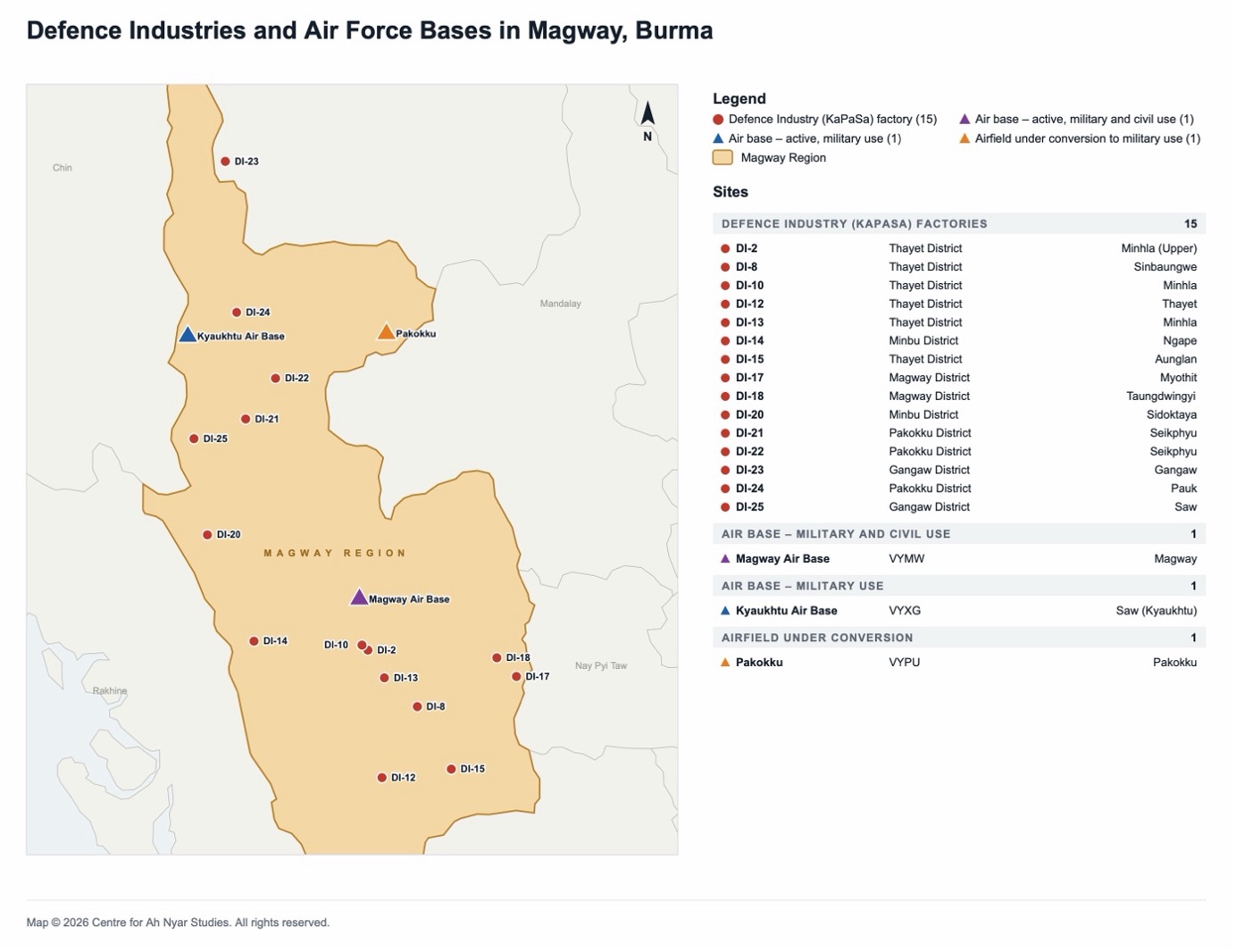
Figure 1. DI and military-use air bases in Magway (Sources: Centre for Ah Nyar Studies, Myanmar Defence and Security Institute and Myanmar Now)
Alongside this industrial base, Magway hosts a sizeable ground force. Centre for Ah Nyar Studies has identified 32 military units in the region. They include two Light Infantry Division headquarters (LID 88 in Magway and LID 101 in Pakokku) and two operations commands (AOC 905 and AROC-73). There are also 22 infantry and light infantry battalions, five artillery and tank battalions, and a basic military training depot (BMTD-7) in Taungdwingyi. Most units are positioned along the Ayeyarwady corridor. Magway District has the most (10), followed by Minbu and Pakokku (8 each), and Thayet and Gangaw (3 each). The largest concentrations are around Magway town, where LID 88 is based alongside two light infantry battalions and a tank battalion, and Pakokku, where LID 101 shares a base with four infantry battalions. Smaller clusters of three battalions each sit in Yesagyo and Salin. None of these units had been captured by resistance forces as of the time of this reporting.
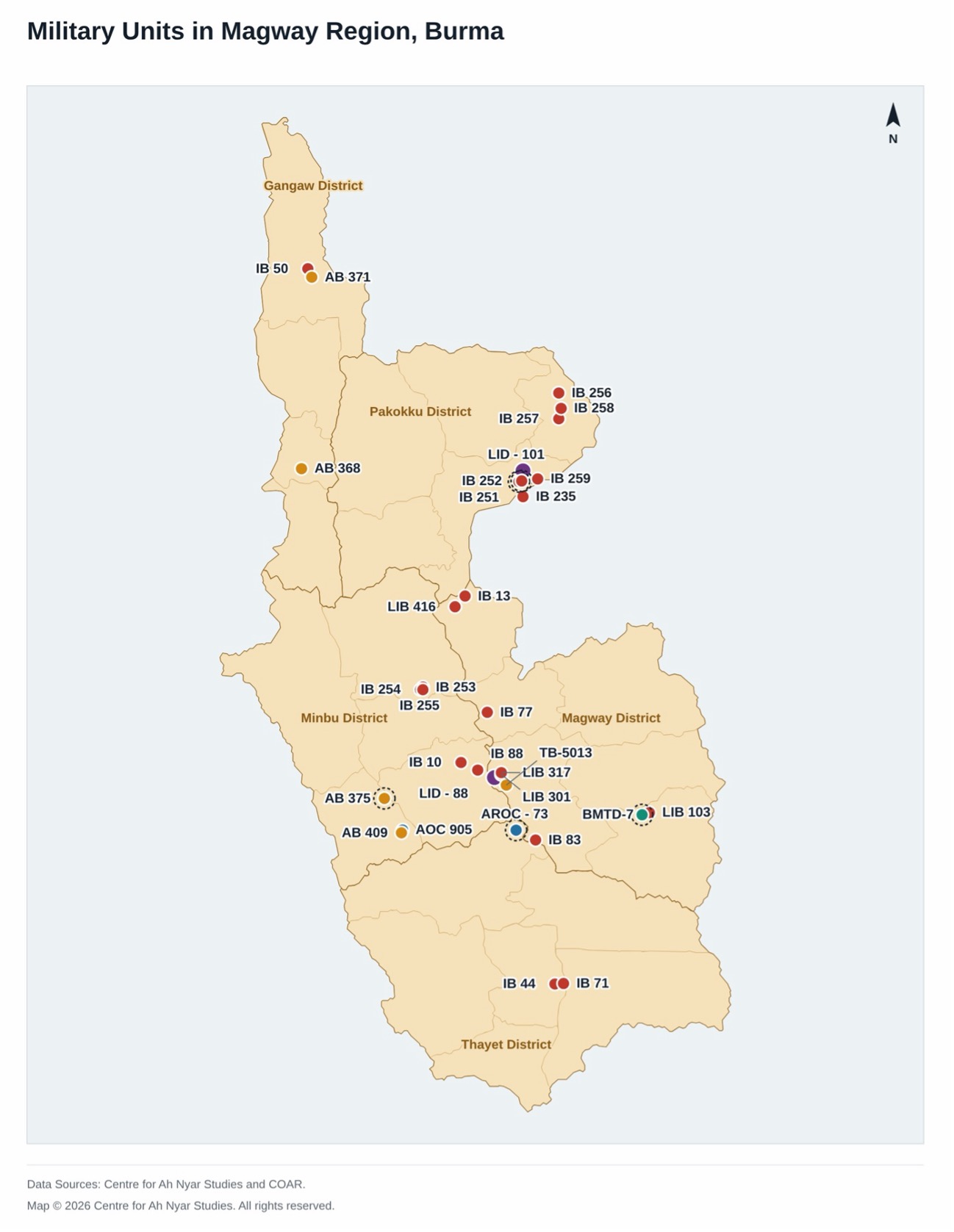
Figure 2. Ground military units in Magway (Sources: Centre for Ah Nyar Studies and COAR)
The Resistance Movement in Magway
Magway emerged as a new resistance stronghold after the military coup in 2021. Before the coup, the region was one of the military’s most secure areas, and it hosts most of the Defence Industries, airbases and several infantry battalions across five districts. The resistance that grew after February 2021 has therefore been a direct threat to the regime’s supply base, not a peripheral insurgency.
Armed resistance took hold within two months along with widespread resistance across Central Burma. The coup leader General Min Aung Hlaing then admitted that “To be honest… well, if I’m being honest, I didn’t expect it to be on this scale” (Centre for Ah Nyar Studies, 2024). In the Yaw area of Gangaw, Htilin and Saw, local defence forces merged into the Yaw Defence Force in 2021. By November that year, after about 80% of government employees there had resigned, local politicians and resistance fighters had formed their own People’s Administration Team (Myanmar Now, 2021). Nearly six years on, Magway’s resistance controls much of the countryside and the line between the two is fought over every month.
Fighting has increasingly centred on the regime’s industrial base and oil fields across Pakokku, Gangaw and Minbu districts. From late April 2026, LID 101 moved troops along the roads linking Pakokku, Pauk, Myaing and Yesagyo, and in June it launched a counteroffensive to either retake or destroy the resistance-held Kyaukkwet oil field in Myaing. LID 99 also involved in this large-scale operation (Centre for Ah Nyar Studies, 2026a). Between 23 June and 8 August 2026, a column of about 1,000 troops from the two divisions raided at least 31 villages in Myaing and Pauk while artillery and aircraft struck others. At least 38 civilians were killed, at least 15 were injured, and at least 370 homes were burned, displacing thousands of people (Centre for Ah Nyar Studies, 2026b). Air power has been central to the campaign. Between 31 March and 31 August 2026, Magway recorded at least 322 airstrikes, more than any other state or region and over 20% of the 1,583 recorded nationwide (ISP-Myanmar, 2026).
The human cost has been heavy. In July 2026, the UN reported that more than 100,000 people had recently been displaced across Myaing, Pakokku, Pauk and Saw townships, including more than 80,000 in Pakokku since mid-May (UN OCHA, 2026).
Territorial Control
Resistance controls majority of the rural villages, especially in three strategic areas below.
- Pakokku uplands (Myaing, Pauk, Yesagyo and Seikphyu),
- Yaw area (Gangaw, Htilin and Saw) and
- South-western uplands (Ngape, Minbu, Salin, Sidoktaya, Mindon and Thayet).
Pakokku uplands (Myaing, Pauk, Yesagyo and Seikphyu townships) are resistance stronghold and areas shaping Magway resistance landscape including emerging rebel governance structures within Magway Federal Unit arrangement. Resistance forces have held the Kyaukkwet oil field in Myaing since March 2024 and the larger Letpanto field in Pauk. The area’s oil revenue explains why the regime made it the main target of its 2026 counteroffensive. LID 101, backed by LID 99, moved troops along the main roads from Pakokku to Pauk, Myaing and Yesagyo to regain oil-producing areas and cut off resistance revenue (Centre for Ah Nyar Studies, 2026a).
Yaw area organised early and largely on its own terms. Local defence forces in Saw and Kyaukhtu merged into the Yaw Defence Force in 2021 (Burma News International, 2021). By November that year, after about 80% of government employees had resigned, local politicians and resistance fighters had formed their own People’s Administration Team (Myanmar Now, 2021). The area borders Chin State, and the road between Saw and Kanpetlet is a supply corridor for Magway, Chin and Arakan forces. Centre for Ah Nyar Studies’ records indicate that the junta’s late-2026 offensive aims not only to cut off this route but also to establish a firm foothold along it. The junta wants to turn it into a key staging area from which it can send sufficient forces from Magway to Kanpetlet. A large military convoy reached the Laung She defence factory in Saw in September 2026, and clashes were reported in Htilin Township in early November (DVB, 2026).
In the south-western uplands, local forces fight alongside the Arakan Army (AA) along the Ann–Padan road. The regime still holds the main towns, especially along the Irrawaddy River.
Local Defence Forces
Local Defence Forces (LDF) are a critical feature of the resistance landscape in central Burma. In Magway, they exist alongside the NUG resistance infrastructure: the People’s Defence Teams (PDT or PaKaPha), which are organised by township and village, and the district-based People’s Defence Force (PDF) battalions under the NUG Ministry of Defence. LDFs emerged from the same 2021 uprising, but they grew from the village up. Most were formed by local youth, community leaders and former protest organisers to defend their own areas, and they still recruit, fund and fight mainly where they began. For this analysis, a LDF is an armed resistance group that sits outside the NUG’s Ministry of Defence chain of command, meaning that it is neither a PDF battalion nor a Pa Ka Pha unit. Beyond this core criterion, LDFs typically share three further characteristics, although not every group displays all of them. First, they are formed by and recruit mainly from, a bounded constituency, whether territorial (a village, village tract or township), ethnic or tribal, social (such as students) or ideological (such as communist or social democratic). Second, they operate mainly within a defined area, usually where they were formed. Third, they were active during the period covered by our records. These characteristics are therefore used as indicators rather than strict requirements and borderline cases are classified on the balance of available evidence. Later affiliation with the Magway Federal Unit Government or a coalition does not change a group’s classification. The definition excludes armed organisations typically based outside Magway that operate in the region, such as the Arakan Army or Chin Brotherhood members, as well as regime-aligned militias.
Two types of LDF are broadly classified within Magway Federal Unit Defence Force Law: Territory-based and Ethnic or tribal-based forces (Centre for Ah Nyar Studies, 2026c).
Territory-based LDFs are rooted in a village tract or township and are defined by geography rather than identity. They make up most of the groups in our records and are concentrated in the Pakokku uplands (Myaing, Pauk, Yesagyo and Seikphyu). Examples named in public reporting include the Earthquake PDF, Myaing Solidarity Alliance and Southern Yesagyo PDF. Ethnic or tribal-based LDFs organise around a shared community identity and defend that community’s areas. The clearest examples are the Yaw Defence Force in Gangaw, Htilin and Saw and the Chin Defence Force-Asho (CDF-Asho) and Asho Chin Defence Force (ACDF), which represents Asho Chin communities in Minbu and Thayet districts and along the Arakan Yoma. For the purposes of this analysis, “ethnic or tribal group” is defined according to Section 12(d) of the Interim Political Arrangement Law of the Magway Federal Unit. Section 12(d)(4) expressly recognises the Yaw and the Taung Thar as ethnic groups (Interim Political Arrangement Law of the Magway Federal Unit, 2025).
Our records identify 93 active LDF groups in Magway, and 74 of them (80%) are in Pakokku District. The remainder are spread across Minbu (8), Gangaw (5), Magway (4) and Thayet (2). The size of these LDFs vary from a handful of troops to some hundreds.
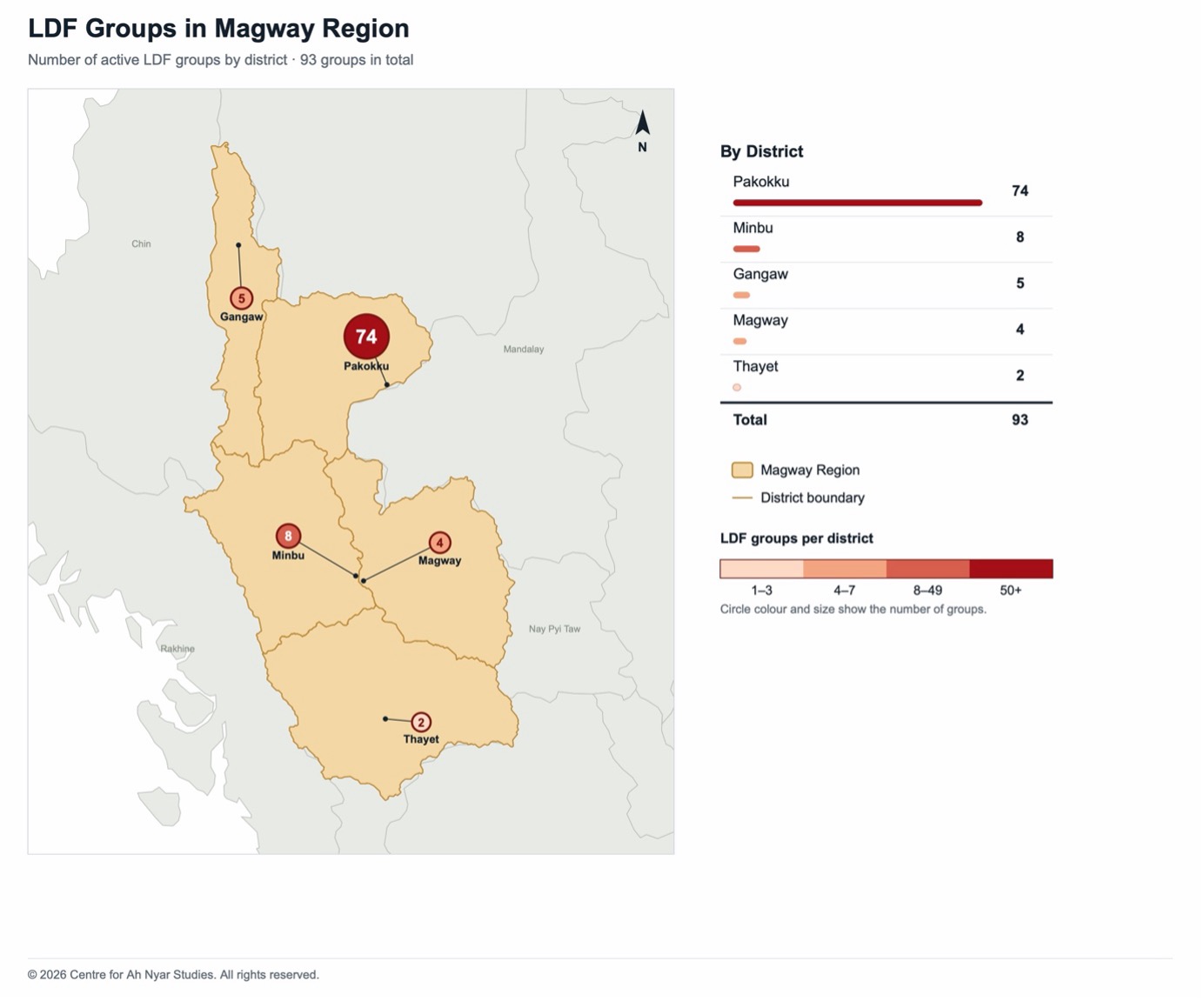
Figure 3. Active LDF groups by district (Source: Centre for Ah Nyar Studies)
Chain of Command
LDFs are structurally outside the NUG’s command, but they cooperate with NUG forces in the wider resistance across the region. This cooperation is usually project-based: groups join specific operations rather than a standing command, contributing fighters, weapons and local knowledge for a defined objective and then returning to their own areas. The Ah Nyar Tamar Operation is one example. In this way, LDFs give the resistance depth and local legitimacy that the NUG’s formal structures cannot provide alone, while keeping control over their own fighters, weapons and revenue.
More than half (50 out of 93) operate under independent or separate commands. Another 31 are under the Magway Federal Unit Government, while 7 belong to the Ah Nyar Myay Coalition and 5 to the People’s Liberation Coalition. Every structured command is concentrated in Pakokku District, which accounts for 30 of the 31 groups linked to the Federal Unit Government and all 12 coalition members (Ah Nyar Myay Coalition and People’s Liberation Coalition). Outside Pakokku, command integration is almost absent. Of the 19 LDFs in Minbu, Magway, Thayet and Gangaw districts, 18 operate independently, and only one, in Minbu, is linked to the Federal Unit Government. The Federal Unit Government’s military reach therefore rests largely on the Pakokku district rather than on a region-wide base, even though it claims authority over all of Magway.
Even within Pakokku, command is plural rather than unified. Of the district’s 74 groups, 32 remain independent and 12 sit within two coalitions that are distinct from the Federal Unit Government. The district with the densest resistance network is thus also the one with the most competing centres of command. This reflects the local origins of these groups: most were formed to defend particular villages or communities, and they retain control over their own fighters, weapons and resources. For many, joining a wider structure is a conditional choice rather than a given. They weigh access to arms, funding and legitimacy against the loss of autonomy. Independent status does not mean isolation. As noted above, LDFs routinely cooperate with NUG forces and with one another in operation-based alliances.
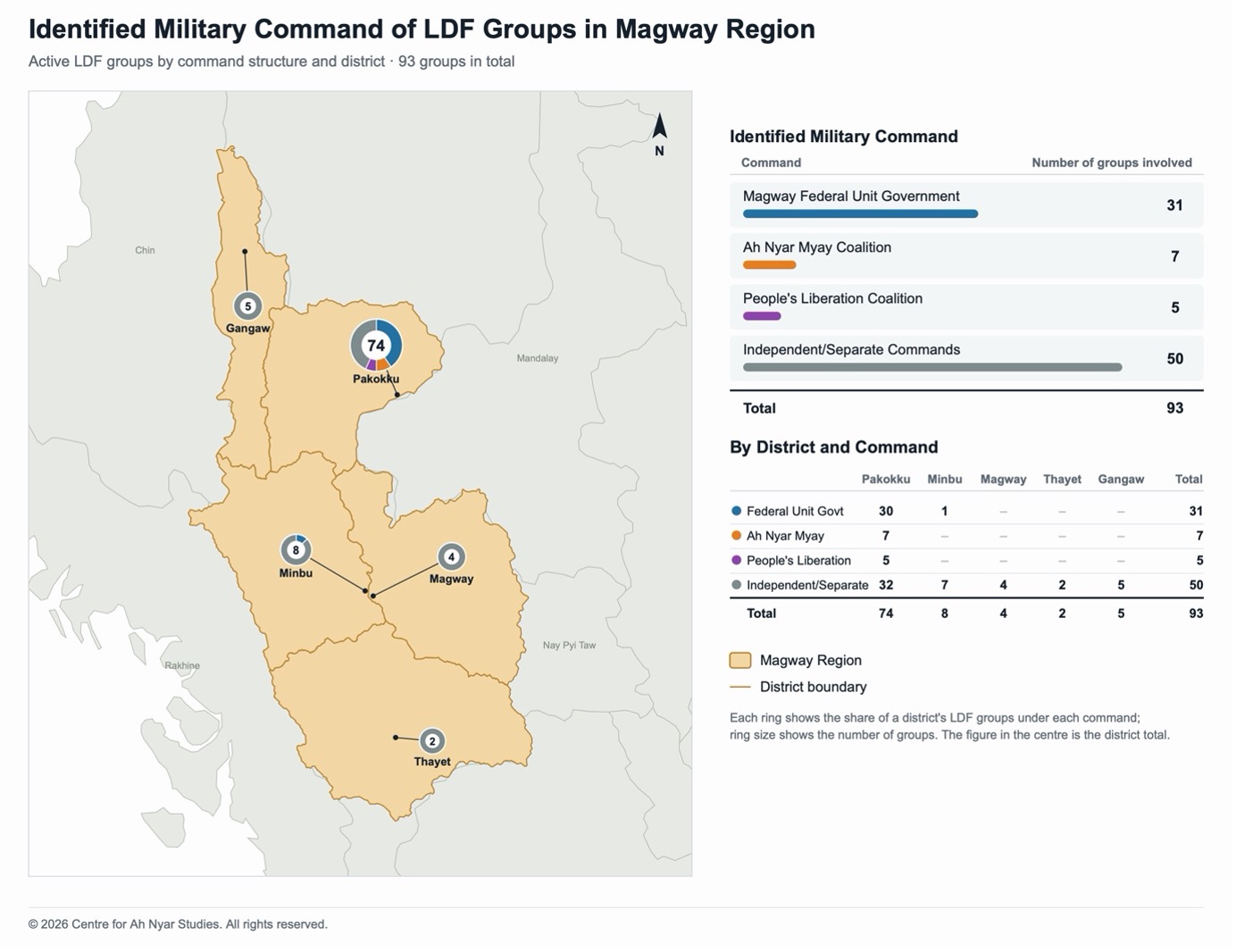
Figure 4. Identified Military Commands of LDF Groups in Magway (Source: Centre for Ah Nyar Studies)
The Politics of Ethnic Minority in Gangaw and Minbu Districts
Magway is commonly described as part of the Bamar heartland. According to the 2014 census, the region had 3.9 million people across five districts and 26 townships and sub-townships, 85% of them rural (Department of Population, Republic of the Union of Myanmar, 2015). Gangaw District (Gangaw, Htilin and Saw townships and Kyaukhtu sub-township), the core of the Yaw area, had 250,858 people in 2014, or 6.4% of the region’s population, and 89% of them were rural. The Taung Thar live mainly in villages in Htilin and Saw townships, with a few in Gangaw. The four south-western townships most associated with Asho Chin communities (Ngape, Saytottara, Mindon and Kamma) had a further 234,220 people, about 6% of the regional total. Not every resident of these areas belongs to a minority. However, they are remote, mostly rural, upland areas on the borders of Chin and Arakan states, and they have long been peripheral to the regional government in Magway town.
Since the coup, these communities have turned their distinct identities into distinct armed and political organisations. In the Yaw area, local defence forces merged into the Yaw Defence Force in 2021. Yaw forces have since moved closer to the Arakan Army (AA) and the Chin Brotherhood, and several PDF-Gangaw battalions left the NUG’s command to join the Yaw Army. In the south-west, the Chin Defence Force-Asho has fought alongside the AA along the Ann–Padan road since October 2025. Its Commander-in-Chief was killed in a regime ambush in Ngape Township in August 2026 (DVB, 2026a).
The Magway Federal Unit has begun to respond. Section 12(d)(4) of its Interim Political Arrangement Law expressly recognises the Yaw and the Taung Thar as ethnic groups. This acknowledgement goes beyond the state’s official classification, which treats the Yaw only as a sub-group of the Bamar and does not list the Taung Thar at all. The unit has also created a Ministry of Ethnic Affairs, headed by Salai Aung Win from Asho Chin representative bloc of Magway Federal Unit Government.
LDFs with Ethnic Identifications in Gangaw and Minbu Districts
Yaw Defence Force (YDF)
Founded | 12 May 2021 |
Base area | Gangaw District |
Key ties | PDFs, Arakan Army; planned merger with the Yaw Army, Spring Revolution Alliance |
YDF is a local armed resistance group founded on 12 May 2021, three months after the military coup. It is based in the Yaw area of Gangaw District, mainly Saw Township and Kyaukhtu Sub-township and was founded and led by local youth. Its stated aims are to resist regime forces and protect local communities and it has fought alongside PDFs and other resistance groups. In August 2022, its Patriot Mobile Rangers unit formed an alliance with the Daung Luth Linn LPDF. YDF has also built ties with ethnic armed organisations. When its deputy commander-in-chief, Phyo Wai Soe, a founding leader, was killed in a regime airstrike on 8 October 2022, the Arakan Army issued a condolence statement crediting him with building relations between the two groups. In 2023, YDF publicly endorsed the Myanmar National Democratic Alliance Army’s goals of federalism and self-determination. YDF is active in Gangaw district. Recently both YDF and YA released a joint statement on the plan for forming a single Yaw Armed Force.
Yaw Army (YA)
Founded | 2 January 2024 (origins in the YRPA, March 2021) |
Base area | Mainly Saw Township |
Key ties | Arakan Army, KIO, Spring Revolution Alliance, Chin Brotherhood |
Originated from the Yaw Regional People’s Defence Alliance (YRPA), a coalition of local defence groups formed in March 2021. YA was established on 2 January 2024 to build a stronger military and political organisation for the Yaw region. Its political aim is, at a minimum, a self-administered Yaw region, which it defines as six townships: Gangaw, Saw, Kyaw, Laungshe, Kyaukhtu and Htilin. Its external ties lie mainly with ethnic armed organisations. It credits the Arakan Army and the Kachin Independence Organisation with training and support, and it is a member of the Spring Revolution Alliance. It is close to the Chin Brotherhood. YA is mostly active in Saw township. Recently both YA and YDF released a joint statement on the plan for forming a single Yaw Armed Force.
Yaw Liberation Army (YLA)
Founded | 1 August 2026 (announced 5 September 2026) |
Base area | Gangaw District; southern Chin State and Kyaukhtu area |
Origins | Former NUG Gangaw District Battalions 1, 18 and 19 |
YLA was formally established on 1 August 2026 and announced its founding on 5 September 2026. It grew out of Battalion No. 18 of the NUG Ministry of Defence’s Gangaw District Command. Its Facebook page, created in December 2022 as “Yaw National Revolution Force – Htilin”, was renamed the Yaw National Revolution Force in January 2026 and the YLA in August. The founding statement says its members come from Battalions 1, 18 and 19, which served under the NUG Ministry of Defence for five years. YLA says its aim is to decide Yaw affairs for itself, gain greater military freedom and build wider alliances. It insists that its separation reflects neither distrust of the NUG nor personal disputes and it pledges to keep fighting alongside NUG battalions in southern Chin State and the Kyaukhtu area.
Asho National Army (ANA)
Founded | 16 November 2021 as ACDF; renamed 12 October 2026 |
Base area | Ngape and Sidoktaya townships |
Key ties | PRA-Magway, Myay Latt Bamar Defence Force, Galon People’s Defence Force, Arakan Army |
The army was founded on 16 November 2021 as the Asho Chin Defence Force (ACDF) and changed to its current name on 12 October 2026. It is now the armed wing of the Asho National Organisation (ANO). The new name was adopted at a congress held from 20 to 24 September 2026, and the group says it does not change its founding aims. These aims are to build an “Asho Land” with guaranteed self-determination, to establish a democratic federal union and to lead Asho national politics. The group claims to represent all Asho Chin areas. It has conducted joint operations with PRA-Magway, the Minbu District No. 2 Battalion, the New Society Army and the People Independence Army. It allied with PRA-Magway in November 2021 and with the Myay Latt Bamar Defence Force and Galon People’s Defence Force in August 2023. Notably, it has no alliance or recorded cooperation with CDF-Asho.
ANA is active in Ngape and Sidoktaya townships.
Chin Defence Force – Asho (CDF – Asho)
Founded | January 2023, Ngape and Padan area |
Base area | Ngape and Sidoktaya townships |
Key ties | Arakan Army, PRA-Magway |
CDF-Asho was formed on 21 January 2023 in the Ngape and Padan area. It is an Asho Chin force based mainly in Ngape and Sidoktaya townships. According to its position statement, its founders were Asho Chin youth together with soldiers, police, teachers, students and health workers who had joined the Civil Disobedience Movement, many of whom had received basic military training from ethnic armed organisations, local PDFs and NUG Ministry of Defence units. It presents as a protector not only of the Asho Chin but of all Chin peoples and oppressed communities. It commits the group to ending military dictatorship and securing freedom, justice, equality and self-determination for the Chin within a federal democratic union. It also pledges to work with the NUG Ministry of Defence, the Chin National Front and other Chin revolutionary groups and to follow the NUG’s military code of conduct. In practice, its closest ties are with the Arakan Army, for which it acts as an ally on the eastern front and with PRA-Magway and other local forces along the Ann–Padan road.
Its Commander-in-Chief, Salai Yoe Chin, was killed in a regime ambush in Ngape Township on 14 August 2026.
Magway Federal Unit Government and LDFs
Formed as a coalition of seven representative blocs, it recognises the NUG as the union government and the central authority of the revolution, reserves foreign affairs to the NUG, and sets out power-sharing in Chapter 17 of the interim arrangement (Centre for Ah Nyar Studies, 2026a). Seven representative blocs are
- Elected MPs of 2020 General Elections
- Political Parties3 Chin Ethnic Group
- Yaw and Taung Thar Ethnic Group
- Unions, Women, Youth and Strike Group
- CDM Civic Servants
- Armed Resistance Groups
Since its sub-national political process began in late 2023, Magway has approached LDFs carefully and strategically, incorporating them through three of these blocs. The Chin, Yaw and Taung Thar and armed resistance group blocs have served as the main channels through which LDFs entered the emerging federal unit leadership. LDFs with ethnic identifications in Gangaw and Minbu districts took part both in drafting Magway’s interim arrangement and in forming the interim federal unit government. This representation is reflected in the cabinet. U Aung Ko Latt, Minister of Planning, Finance, Natural Resources and Energy, was appointed from the Yaw and Taung Thar bloc. Salai Aung Win, Minister of Ethnic Affairs, was appointed from the Chin bloc. Bo Let Yar, Minister of Defence, represents the armed resistance group bloc.
Bo Let Yar is a resistance fighter who led the People’s Defence Team (Pa Ka Pha) in Myaing Township before becoming Minister of Defence of the Magway Federal Unit. Under his leadership, 21 LDFs in Magway welcomed the formation of the Magway Federal Unit Government and committed to joining its Ministry of Defence in order to establish a single chain of command for LDFs (Earthquake People’s Defence Force, 2026). Bo Let Yar has since coordinated and incorporated 31 LDFs into the federal unit’s command.
The enactment of the Magway Defence Force Law could further consolidate this arrangement. The law creates two main command structures:
- the Magway Federal Unit Defence Force; and
- the Joint Military Operation Commission (JMOC).
This arrangement gives LDFs flexible pathways. They can either join the Defence Force and be incorporated into its military columns under Bo Let Yar’s command, or work through the JMOC, which is chaired by Dr Ye Htun Zaw, the current Chief Minister of Magway (Centre for Ah Nyar Studies, 2026d). The JMOC route could allow LDFs to retain control of their forces and their organisational identity while cooperating, on their own terms, with the wider resistance, including the Magway Federal Unit Defence Force and the Arakan Army.
A closer look at where the 31 LDFs under Bo Let Yar’s command operate shows a highly uneven geography. Thirty of them are concentrated in Pakokku District and the unit’s command barely reaches the two other contested zones in Magway: the south-western uplands (Ngape, Minbu, Salin, Sidoktaya, Mindon and Thayet) and the Yaw area (Gangaw, Htilin and Saw). Only one group outside Pakokku, the Daung Sit Aung Local PDF in Minbu District, is currently under Bo Let Yar’s command, while several others in these zones remain outside the unit’s command structure.
This gap should be read alongside three recent developments within the Asho Chin and Yaw communities, which make up much of the armed landscape in these two zones. First, CDF-Asho lost its founding commander, Salai Yoe Chin, who was killed in a regime ambush in Ngape Township on 14 August 2026 (DVB, 2026a). As both a military leader and an influential figure within the Asho Chin community, his death could significantly affect the group’s internal cohesion and the social networks that link it to Magway’s wider security system. Second, the Asho Chin Defence Force (ACDF) repositioned itself as an ethnic armed organisation, renaming itself the Asho National Organisation/Asho National Army (ANO/ANA) on 12 October 2026 (Asho National Organisation/Asho National Army, 2026). The new name drops both “Chin” and “Defence”, a term that became the hallmark of the resistance forces formed after the 2021 coup. With a separate political and armed wing, the group now resembles the established ethnic armed organisations in Burma rather than a local defence force.
Third, in the Yaw area, YDF and YA recently issued a joint statement announcing plans to merge the two regional forces (Yaw Defence Force, 2026). Given the Yaw ethno-political agenda shared by both groups, this merger could lead to an arrangement similar to the one emerging in the Asho Chin community: a single, identity-based Yaw armed organisation rather than a set of local defence forces. Meanwhile, three Gangaw District battalions formerly under the NUG Ministry of Defence formed the Yaw Liberation Army (YLA) on 1 August 2026, outside both the NUG’s and the unit’s command (Yaw Liberation Army, 2026). It is likely that the YLA will eventually join the merged YDF–YA structure, which would consolidate most of the Yaw area’s armed actors into one organisation outside the NUG or unit’s chain of command.
Arakan Army’s Interests and Magway’s LDFs
Arakan Army’s (AA) engagement with Magway’s LDFs follows from a set of immediate and long-term interests that are rooted first in territory. Pakokku and Gangaw districts form a territorial route that connects the AA’s areas in Arakan and Chin State with Sagaing and Mandalay and, beyond it, with northern Shan State, where its Brotherhood Alliance partners operate. Minbu and Thayet districts provide a second connecting route across the Arakan Yoma along the Ann–Padan road. The AA’s interest in this route became visible when it and allied forces captured the Nat Yae Kan air defence base on the road in October 2025 (BNI, 2025), and later held villages inside Ngape Township (DVB, 2025). The regime’s late-2026 offensive on the Saw–Kanpetlet corridor, aimed explicitly at cutting supply routes between central Burma and areas held by Chin and Arakan forces (DVB, 2026b), shows that these routes now matter to both sides.
These routes serve two of the AA’s interests. The immediate interest is manpower. The AA’s town-capture operations in Arakan require a steady supply of fighters and allied channels in Magway offer a way to meet part of that need. Magway-based forces have already fought beyond their home areas; YA, for example, reports fighters killed in Arakan and Chin State (Yaw Army, 2026). The longer-term interest is logistics. Maintaining military and political allies along the supply pipeline that runs from central Burma into Arakan secures both short- and long-term access and Magway’s oil economy already feeds this pipeline (Centre for Ah Nyar Studies, 2026b).
LDFs are the most practical partners for pursuing these interests. A military alliance with LDFs does not require the AA to negotiate with the broader political agendas of the Magway Federal Unit, the NUG or the KIO/KIA. LDFs can be engaged quickly and are more likely to act on the AA’s direction. In return, the AA may have to guarantee weapons, food and shelter, and possibly to shield its partners from military or political action by the NUG or the unit. An ISP-Myanmar study lists eight post-coup groups operating under the AA’s military command, five of which are active in Magway or on its border: PRA-Magway, the ACDF (now the Asho National Army), CDF-Asho, the Student Armed Force and the PIO/PIA (DMG, 2025). PRA-Magway reported receiving AA weapons as early as 2022 (DVB, 2022), and CDF-Asho has fought alongside the AA on the Ann–Padan corridor since October 2025 (DVB, 2026a).
Command structures sharpen this logic. The NUG’s district-based PDF battalions in Magway fall under Regional Command 1 of the NUG, which operates under the chain of command of the KIO/KIA (Centre for Ah Nyar Studies, 2026d). This makes it difficult for the AA to draw on these battalions directly. LDFs and People’s Defence Teams (Pa Ka Pha), by contrast, sit outside Regional Command 1, which makes them the forces with which the AA can engage strategically on its own terms.
The emergence of ethnic-based armed organisations along the Magway–Arakan–Chin border and across the wider region, adds a political dimension to these interests. The ACDF’s transformation into the Asho National Army and the planned merger of the YDF and the YA point towards identity-based organisations with their own political wings. Several of these organisations already have ties to the AA (Arakan Army, 2022; Yaw Army, 2026). If this trend continues, the AA will enter the future political and military landscape of central Burma with an established set of allies.
The AA’s public stance towards the federal unit reinforces this reading. Neither the AA nor any of the established ethnic armed organisations issued a letter welcoming the formation of the Magway Federal Unit Government, nor did they publicly state a position on it (Centre for Ah Nyar Studies, 2026a). This silence contrasts sharply with the AA’s open recognition of individual LDFs, such as its public praise for PRA-Magway’s leadership (DMG, 2023) and its condolences on the death of a founding YDF commander (Arakan Army, 2022). The evidence suggests that the AA prefers bilateral relationships with LDFs to formal engagement with the unit’s emerging authority.
The most important question is therefore whether the AA would welcome the consolidation of Magway’s LDFs under the Magway Federal Unit. An organised, single command for LDFs could shift the balance of the AA’s short- and long-term interests. On one hand, it would give the AA one counterpart and the Defence Force Law already allows the unit’s Joint Military Operation Commission to conduct joint operations with neighbouring ethnic armed organisations (Centre for Ah Nyar Studies, 2026d). On the other hand, it would limit the direct, bilateral relationships with LDFs on which the AA’s access to Magway currently rests. How the AA weighs these considerations is likely to influence whether LDFs in Minbu, Thayet and Gangaw move towards the unit’s chain of command or remain outside it.
Conclusion
Magway’s revolution poses a direct threat to the junta’s war machine. Fifteen of the DI’s 25 factories sit in the region and that is why the regime has fought so hard to retake its oil fields and supply routes. Local defence forces carry much of this resistance. Our records identify 93 active LDFs, most of them in Pakokku District. Their local roots let them hold large parts of the countryside, but those same roots make them hard to command from outside. More than half of the groups (50 of 93) remain under independent or separate commands. Only 31 operate under the Magway Federal Unit.
The Federal Unit has approached LDFs carefully and strategically. It has offered them flexible routes into its command instead of demanding immediate integration. This has brought a third of the groups under its structure without open confrontation. It has also left the harder questions unresolved: command, revenue sharing and discipline. The Myaing dispute showed how quickly unresolved control over resources can turn allies into rivals.
LDFs with ethnic identifications in Gangaw and Minbu districts add a further layer. Yaw and Asho Chin forces have organised around their own identities and look more to the Arakan, Kachin and Chin allies than to the Federal Unit or the NUG. The Arakan Army’s interests sharpen these dynamics. Its advance into Ngape and its ties to LDFs along the western and northern edges give some groups a patron outside Magway’s own structures. Neither the AA nor established ethnic armed organisations publicly welcomed the Federal Unit’s formation. Their public silence may conceal quiet channels of communication behind the scenes, but it shows that the Federal Unit has yet to win open recognition from its most powerful neighbours.
Whether the Federal Unit can turn this fragmented landscape into a common security order will depend less on how many groups it absorbs than on whether it can set rules that independent LDFs, minority communities and allied armed actors accept.
References
Arakan Army. (2022, October 11). YDF ၏ ဒုတိယစစ်ဦးစီးချုပ် ဖြိုးဝေစိုး ကျဆုံးခြင်းအတွက် ပေးပို့သော ဝမ်းနည်းကြောင်းသဝဏ်လွှာ [Message of condolence on the death of YDF Deputy Commander-in-Chief Phyo Wai Soe] [Statement]. https://www.facebook.com/share/p/19wWdw5k5q/
Asho National Organisation/Asho National Army. (2026, October 12). အဖွဲ့အစည်းအမည် ပြောင်းလဲသတ်မှတ်ခြင်းနှင့် အမှတ်တံဆိပ်ဟောင်းများ ပယ်ဖျက်ခြင်းဆိုင်ရာ အသိပေးထုတ်ပြန်ကြေညာခြင်း (စာအမှတ်။ အဖခ/ဗဟရ/တထ-၄/၂၀၂၆/၀၀၁) [Public announcement on the change of organisation name and the revocation of former insignia] [Statement]. https://www.facebook.com/share/p/1CdCkGVFPB/
BNI. (2025, October 16). AA seizes strategically vital Natyaekan Base. https://www.bnionline.net/en/news/aa-seizes-strategically-vital-natyaekan-base
Burma News International. (2021, September 29). Youths form the yaw regional defence force (YDF). Mizzima. https://www.bnionline.net/en/news/youths-form-yaw-regional-defence-force-ydf
Centre for Ah Nyar Studies. (2024, December 25). အညာတော်လှန်ရေး၂၀၂၅ [Ah Nyar Revolution 2025]. Centre for Ah Nyar Studies. https://ah-nyarstudies.org/ahnyarrevolution2025/
Centre for Ah Nyar Studies. (2026a, February 15). Ah nyar’s big questions in 2026: Where are we headed? – Centre for ah nyar studies. https://ah-nyarstudies.org/ah-nyars-big-questions-in-2026-where-are-we-headed/
Centre for Ah Nyar Studies. (2026b, May 15). Petro-contestation and emerging governance orders in Magway. Centre for Ah Nyar Studies. https://ah-nyarstudies.org/petro-contestation-and-emerging-governance-orders-in-magway/
Centre for Ah Nyar Studies. (2026c, August 14). At least 38 civilians killed, 15 injured and 370 homes burned: Evidence of ground and aerial attacks by LIDs 101 and 99 in myaing and pauk. Centre for Ah Nyar Studies. https://ah-nyarstudies.org/at-least-38-civilians-killed-15-injured-and-370-homes-burned-evidence-of-ground-and-aerial-attacks-by-lids-101-and-99-in-myaing-and-pauk/
Centre for Ah Nyar Studies. (2026d, October 9). Magway’s defence force law and the security scenarios ahead. Centre for Ah Nyar Studies. https://ah-nyarstudies.org/magways-defence-force-law-and-the-security-scenarios-ahead/
COAR Global. (2024, December 20). Actors and Control Tracker: Administrative and Military Control in Myanmar. COAR Global. https://www.coar-global.org/
Department of Population, Republic of the Union of Myanmar. (2015, May). The 2014 Myanmar population and housing census: Magway Region (Census Report Volume 3–H) [Census Report].
Development Media Group. (2023, March 29). Arakan Army lauds Magway Region-based anti-regime armed group. https://dmediag.com/news/aapram.html
Development Media Group. (2025, July 10). AA provides military aid to at least 23 resistance groups: Report. Development Media Group. https://www.dmediag.com/news/apmat.html
DVB. (2022, June 20). Magway defense force aided by Arakan Army plans to take entire region. https://english.dvb.no/magway-defense-force-aided-by-arakan-army-plans-to-take-entire-region/
DVB. (2025, December 29). People’s defence force attacks military targets in magway region on election day. https://english.dvb.no/peoples-defence-force-launches-attacks-on-regime-targets-in-magway-region-as-elections-begin/
DVB. (2026a, August 17). CDF-Asho commander-in-chief Salai Yoe Chin killed in military ambush in Magway Region. https://english.dvb.no/cdf-asho-commander-in-chief-salai-yoe-chin-killed-in-military-ambush-in-magway-region/
DVB. (2026b, November 3). Military counteroffensive targets Magway-Chin corridor to choke off supply routes. DVB. https://english.dvb.no/military-counteroffensive-targets-magway-chin-corridor-to-choke-off-supply-routes/
Earthquake People’s Defence Force. (2026, April 18). မကွေးတိုင်းဒေသတွင်းအခြေစိုက်(Local People’s Defense Force) တပ်ဖွဲ့များ၏သဘောထား ထုတ်ပြန်ကြေညာချက် [Statement of Position by Local People’s Defence Forces (LPDFs) Based in Magway Region] [Statement]. https://www.facebook.com/share/p/19oRdXeUPm/
Interim Political Arrangement Law of the Magway Federal Unit, 12(d)(4) (2025).
ISP-Myanmar. (2026, September 24). Magway recorded the most airstrikes under new military chief. ISP-Myanmar. https://ispmyanmar.com/2026cst-01/
Myanmar Now. (2021, November 12). After hobbling junta’s ability to govern in yaw, anti-coup forces form people’s administration team. Myanmar Now. https://myanmar-now.org/en/news/after-hobbling-juntas-ability-to-govern-in-yaw-anti-coup-forces-form-peoples-administration-team/
United Nations Office for the Coordination of Humanitarian Affairs (OCHA). (2026). Myanmar humanitarian update no. 52. https://myanmar.un.org/sites/default/files/2026-07/OCHA%20Myanmar%20-%20Humanitarian%20Update%20No.%2052_final.pdf
Yaw Army. (2026, January 2). ယောတပ်တော် (Yaw Army) ဖွဲ့စည်းတည်ထောင်ခြင်း (၂) နှစ်ပြည့်အထိမ်းအမှတ် ထုတ်ပြန်ကြေညာချက် [Statement on the second anniversary of the founding of the Yaw Army] [Statement]. https://www.facebook.com/share/p/1PgF1VPgQV/
Yaw Defence Force. (2026, November 5). တပ်ပေါင်းစည်းရေးထုတ်ပြန်ကြေငြာချက် [Joint statement on the merger of forces] [Statement]. https://www.facebook.com/share/p/1FCKoMxxii/
Yaw Liberation Army. (2026, September 5). ယောလွတ်မြောက်ရေးတပ်တော် ဖွဲ့စည်းတည်ထောင်ကြောင်း ထုတ်ပြန်ကြေညာချက် [Statement announcing the formation of the Yaw Liberation Army] (Statement No. 1/2026) [Statement]. https://www.facebook.com/share/p/1PNbmZQkzG/
 English
 Myanmar
