
Living Alongside War: When Conflict Becomes Everyday Life for Ah Nyar Women – A case study from THE VILLAGE in Sagaing Region
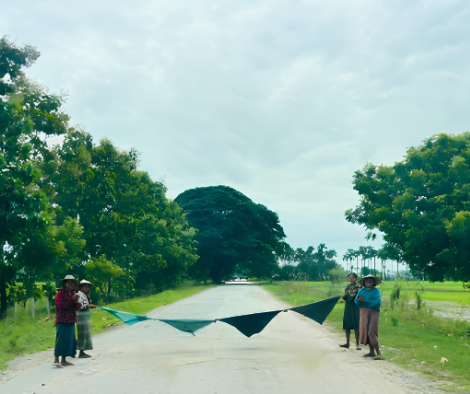
The crisis did not create women’s agency from nothing. It tested, expanded and made visible the economic judgement, courage and community responsibility that Ah Nyar women already possessed. War entered every part of an ordinary woman’s life, and she quietly developed the knowledge and economic strategies needed to keep her family alive.
In the last week of August 2026, shortly after severe flooding affected large parts of Sagaing Region, I returned to my native village in Sagaing. By then, the village had come under the control of pro-democracy resistance forces associated with the National Unity Government’s Ministry of Defence. What struck me most was not only the visible impact of conflict, but how my aunts, uncles and cousins had learned to continue their everyday lives amid frequent, sometimes daily, airstrikes and the continuing threat of ground raids.
As is customary in Ah Nyar society, we sat together and talked about our families and what had happened during the five years since the attempted military coup. Through these conversations, I began to understand more deeply how my female cousins had confronted dangers and hardships that would previously have been unimaginable to them.
One cousin’s experience stayed particularly strongly with me. She runs a small clothing shop in the village market. She is married to a local man who operates a vehicle-repair workshop, and they have a teenage daughter. Before the conflict, she lived what might be considered an ordinary and relatively comfortable life. The youngest daughter in a family of five children, she graduated from a university in Monywa, married a man from her village and settled into family life. She sold clothes, helped sustain the household and occasionally travelled to Monywa or Mandalay. Her aspirations were modest and grounded in the rhythms of everyday Ah Nyar life.
That life changed profoundly in late 2023.
One afternoon, while her husband was away, SAC [military junta] soldiers entered her compound. My cousin was at home with her 83-year-old father and her 15-year-old daughter. The soldiers suddenly dragged all three outside and ordered them to walk towards the police station. Meanwhile, other soldiers began setting fire to her house.
Inside the house was approximately MMK 34.5 million – 345 lakh – set aside to cover the costs associated with harvesting their paddy fields. It represented the income and productive investment on which the family would depend for the entire year. As the house began to burn, she understood that losing this money could destroy their ability to recover. Survival, for her, did not mean only escaping with her life. It also meant preserving the resources her family would need to continue living afterwards.
Gathering her courage, she told one of the soldiers that she and her daughter had been taken outside without even having time to put on their slippers. She asked for permission to go back inside. When the soldier nodded, she grasped her daughter’s hand and ran into the burning house.
Inside, she broke open a locked wardrobe and retrieved the bag containing the money. She also collected her husband’s driving licence, their vehicle documents, their citizenship cards and other essential papers. These were not merely possessions. The vehicle and its documents were directly connected to the family’s income, while their identity cards would be essential if they were displaced or forced to pass through checkpoints.
A three-storey reinforced-concrete building stood beside their house, separated from it by a narrow space along a brick wall. She hid the money and documents in this small gap, hoping the fire would not reach them.
At that moment, she and her daughter might have attempted to escape. But her elderly father had already been taken towards the police station. She feared that he would not know what had happened to them and would believe they had been injured or killed. Her daughter was crying and pleading not to return to the soldiers, but my cousin insisted that they could not abandon her father. Whatever happened, she said, the family must remain together.
They returned and were held at the police station until midnight. They were released around dawn the following morning. My cousin understood that the presence of her 83-year-old father and 15-year-old daughter had contributed to their release.
While running through the burning house, my cousin had struck her arm against a wall. In the intensity of the moment, she had not even felt the injury. She noticed it only after reaching the police station. When I visited her almost three years later, she showed me the large, uneven scar that remained on her arm.
Since that incident, her family has lived in a state of constant alertness. They built a small bomb shelter behind their house and have become accustomed to moving back and forth between their beds and the shelter, sometimes twice in a single day. Airstrikes, warnings and the possibility of another ground raid have become part of the routine through which they organise everyday life.
Nevertheless, whenever conditions permit, she continues opening her clothing shop. Her reasoning is simple and practical: if the family is forced to flee again, they will need money to survive and establish themselves elsewhere.
When pro-democracy resistance forces prepared to take control of the village, residents reportedly received only three hours’ notice to evacuate. Because her family owned a car, my cousin managed to load some of the clothes from her shop before leaving. They sought safety in a nearby village, where her mother was born. Even while displaced, she remained economically active. She began selling the clothes she had brought to people in the host village. She later told me with pride that she had earned approximately MMK 8.5 million – 85 lakh – during the period of displacement.
After the resistance forces took control of her village, the family returned home and resumed its livelihood. Yet their return did not mean that security had been restored. Airstrikes continued, and the risk of road raids remained. She now understands warnings communicated through walkie-talkies and can interpret the reported direction of approaching aircraft. She explained that if a warning mentions the northeast of Budalin, the aircraft may be heading towards the village. “If you hear that,” she cautioned me, “find somewhere safe immediately.”
She now keeps an emergency bag ready because she does not know when the family may have to run again. She is also conscious that SAC [military junta] forces might attempt to retake the village. Preparedness, mobility and the ability to read rapidly changing risks have become part of her daily knowledge.
As I listened, I found myself looking at my cousin differently. Before the conflict, she was an ordinary Ah Nyar woman leading a relatively secure and unremarkable life. She had not been trained as a humanitarian worker, political activist, security analyst or emergency responder. Yet the conflict compelled her to perform aspects of all these roles within her family and community.
Her experience illustrates why women in Ah Nyar should not be understood only as victims, vulnerable groups or recipients of humanitarian assistance. She protected three generations of her family. She made a rapid decision to preserve the household’s productive resources. She maintained her business during displacement, learned to interpret security warnings, prepared for further emergencies and continued supporting the wider pro-democracy movement with whatever limited resources were available to her.
This does not mean that suffering should be romanticised as resilience. She continues to bear an injury, persistent insecurity, economic uncertainty and the responsibility of protecting both an elderly parent and a teenage daughter. Her expanded agency has emerged at an enormous personal cost.
Nor should her quiet endurance be mistaken for acceptance of war. Like many women across Ah Nyar, she concentrates on what must be done next: keeping the family together, earning an income, preparing to flee, returning when possible and sustaining hope that the pro-democracy movement will make progress.
Her story shows that women’s agency in Ah Nyar is not something newly introduced through external “empowerment” interventions. It grows from women’s established roles in household management, agriculture, local trade, family care and community relationships. The crisis has intensified these responsibilities and made their social, economic and political significance more visible.
Across conflict-affected Sagaing, ordinary women are becoming indispensable actors in household survival, local economies, civilian protection and community resilience. They are not waiting to be empowered. They are already acting.
Let Pan Ni is an independent researcher specialising in the social dynamics of Myanmar’s central dry zone (Ah Nyar). Her research focuses on bridging the gap between realities on the ground and international policy frameworks.
The real name of the village has been anonymised to protect the identity and location of the village, as well as the safety and security of the individuals involved. The views and analyses presented in this commentary are solely those of the author and do not necessarily reflect the positions of the Centre for Ah Nyar Studies.
 English
  Myanmar