
Briefing Paper on Federal Unit Politics of Central Burma (part 1)
Introduction
The dry zone or Central Burma is locally known as Ah Nyar (or Anyar). The central plain where Burmese majority lives was once politically referred to as the heartland of the Myanmar military (or Tatmadaw). It could be due to some demographic and geographic strategy of the Tatmadaw. Firstly, Tatmadaw is the state military, and it is formed by the Burmese majority, and the founding father General Aung San is from Natmauk of Ah Nyar. On the second, and more importantly, the tactical formation of Tatmadaw was strategically built on fighting against its domestic enemies in the periphery states. Tatmadaw has been a central figure of the decade-long civil war with ethnic liberation movement, particularly Karen, Mon of southern Burma, Kachin of northern Burma, Shan of Eastern Burma and Rakhine and Chin of western Burma. In light of this peripheral warfare in the mountainous regions, its major supply bases were heavily located in the central plain areas of Ah Nyar, mostly in Magway region. Out of 25 Weapon Manufacturing Industries of Directorate of Defence Industries of Tatmadaw, 68% of industries manufacturing major weapon supplies are situated in Ah Nyar alone, while the remaining 32% are in Bago and Yangon. Additionally, its human resource pool has long been filled by unemployed young men from central Burma. It was not an unfounded hypothesis for the Tatmadaw’s military strategists to view Ah Nyar as a strategic and secure position from which to counter and contain its enemies in the peripheral states. Who would have imagined the rise of a revolutionary movement in Ah Nyar? Neither the Tatmadaw nor its opposition groups, including Burma’s ethnic revolutionary organisations, could have foreseen it.
The 2021 military coup d’état became a miracle in the history of revolution in Burma. The people of Ah Nyar became a central figure of the prominent Spring Revolution in Burma since the early days of 2021. Despite the tragedies on the frontlines and the fragmented structure of the resistance groups, their guerrilla campaigns have, at times, demonstrated efforts to evolve into conventional warfare, most notably marked by the launch of Operation 1027. This has also led to re-framing revolutionary strategies in Ah Nyar.
Nearly five years into the Spring Revolution, with Ah Nyar at its heart, the movement now confronts escalating threats from the Tatmadaw. This raises a critical question: what direction is the revolution in Ah Nyar now taking?
Contextual origins
Across central Burma, the emergence of federal units was not from the prior constitutional design but a response to the evolving dynamics of the Spring Revolution. As resistance forces gained territorial control across Sagaing, Magway and Mandalay alongside advances in northern Shan, Chin, Kachin and Rakhine, the need for structured governance became increasingly urgent. Beginning in early 2023, consultations among local revolutionary actors, 2020 elected representatives and community networks led to the creation of drafting bodies for interim arrangements. These interim frameworks opened political space for decentralised regional federal governments that complement, coordinate with and strengthen the broader federal-democratic movement led by the National Unity Government.
The three regions of central Burma are currently in the process of establishing federal units; most notably Sagaing, which many diplomats and scholars see pioneer of federal units. All three regions of central Burma have now enacted legal arrangements for forming federal unit governments. These interim arrangements form the core of the regional political framework and are key to understanding the direction in which the revolution in Ah Nyar is heading, despite the presence of several tiny factions of resistance groups in each region.
Drafting and Approval Framework
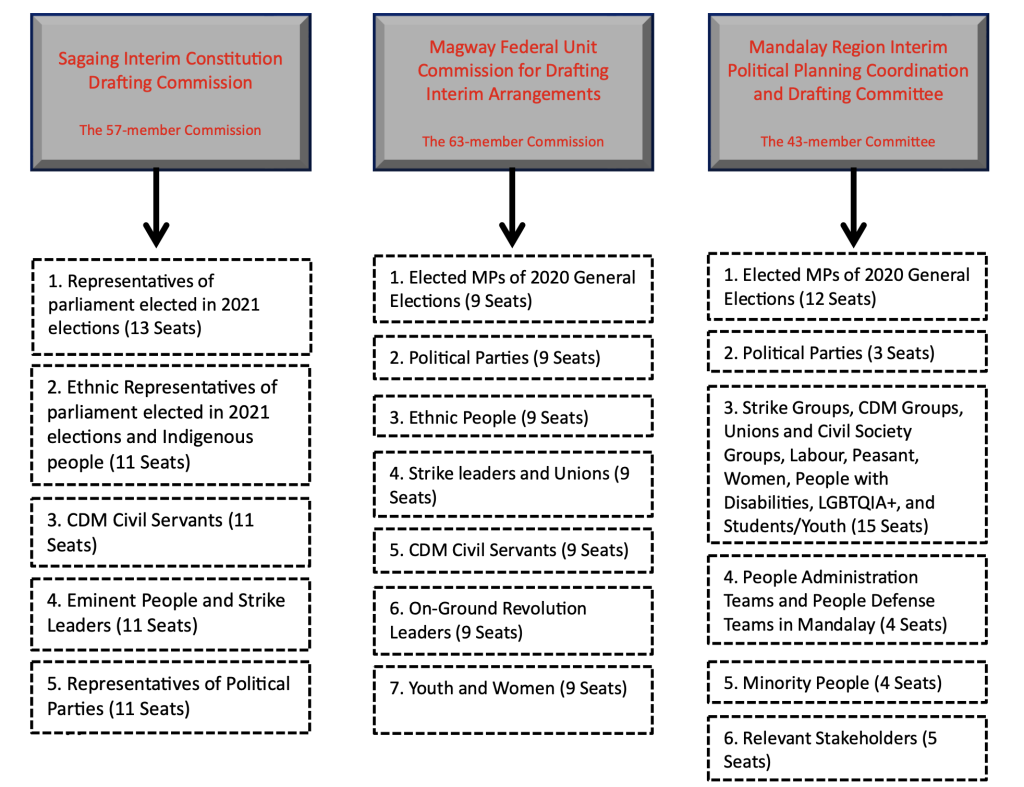
The drafting processes were led by the drafting bodies established by the respective regional parliaments. In Magway and Sagaing, the interim arrangements drafting processes began following the enactment of Laws No. 1/2023 in both regions, dated 17 November 2023. In contrast to these two regions, the Mandalay interim arrangements drafting process commenced through an agreement between the Mandalay parliament (Committee Representing Mandalay Hluttaw) and revolutionary groups in Mandalay. Unlike Sagaing and Magway, Mandalay deliberately avoided using the term “law”; instead, it adopted the “Plan for Coordination and Drafting of Interim Political Arrangements in Mandalay”. The plan was officially approved on 12 July 2024. Nevertheless, the principles and drafting processes across all three regions are largely similar.
Drafting Bodies
Approval Process
Unit parliaments hold the sole authority to approve the interim arrangements in Sagaing and Magway. Mandalay follows a two-step approval process: first, the interim arrangements must be approved by the Mandalay Region People’s Revolutionary Forces Coordination Platform, which comprises seven groups representing revolutionary forces; and second, the Mandalay Parliament (in Burmese, မန္တလေးဒေသလွှတ်တော်) approves and announces the arrangements to the public.
Executive
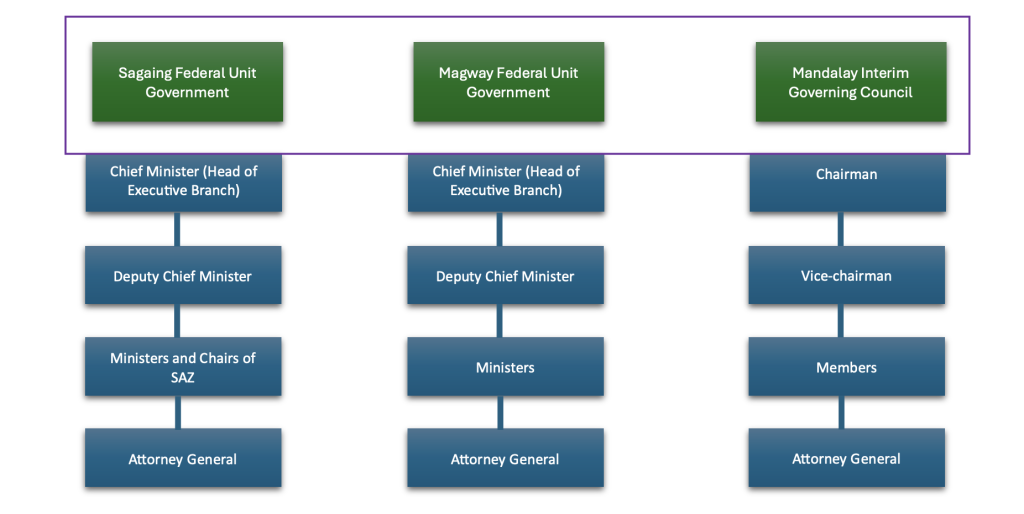
Despite differences in terminology, the structure and functions of unit governments in central Burma are largely similar.
Structure
Who Forms the Cabinet?
Sagaing
Constituting the Sagaing Cabinet is based on selection, as defined in Chapter 5 of the constitution, rather than appointment. Section 67 requires the parliament (Sagaing Federal Unit Hluttaw) to form a Scrutiny and Selection Commission (SSC) for the Interim Sagaing Federal Unit Government. By structure, the SSC comprises representatives similar to those in the drafting commission (for the interim arrangement), together with representatives from the People’s Administration Team in Sagaing. The SSC plays a crucial role in selecting candidates for the position of Chief Minister, and the parliament elects the Chief Minister through a secret ballot system.
Once the Chief Minister is confirmed and formally appointed by the parliament, the Chief Minister joins the SSC to select and nominate the remaining members of the cabinet for parliamentary approval.
Magway
The Magway Interim Cabinet is constituted through a selection-based system, rather than an appointment system. Under Section 61 of the interim arrangement, the Selection Commission is required to nominate candidates for the position of Chief Minister for approval by the parliament. Once the parliament confirms the Chief Minister, the CM, upon the agreement of the seven parties represented in the Interim Drafting Commission, may nominate the remaining members of the cabinet. These nominations must then be submitted to the parliament for final approval.
Mandalay
The Mandalay Region People’s Revolutionary Forces Coordination Platform serves as the key body responsible for forming the Selection Commission for members of the Mandalay Interim Governing Council (MIGC), in accordance with Section 67 of the interim arrangement. The Mandalay parliament is then required to approve the Commission’s selections and formally announce the formation of the MIGC.
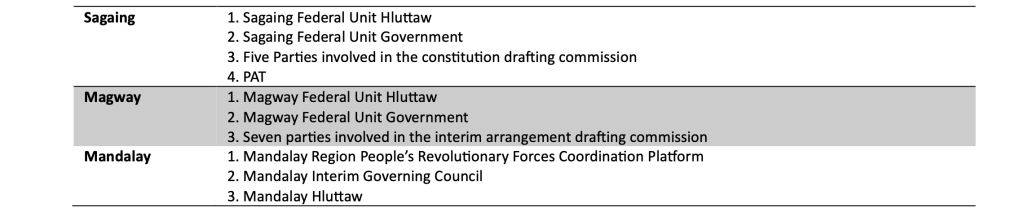
Political Leadership
Defence and Security
Sagaing
Sagaing Federal Unit establishes a federalised, civilian-led, and NUG-coordinated security architecture. The constitution allows Sagaing to form two types of armed forces — the People’s Security Team and the People’s Defence Team (the “2-Ps”), excluding the People’s Defence Force. Although NUG may deploy the 2-Ps with the agreement of the Unit Government, these forces remain under the authority and control of the Unit Government. In accordance with Section 142, the Unit Government is required to establish a Defence and Security Council to oversee the security governance of the Unit.
Magway
Magway interim arrangement sets out a civilian-led, locally grounded, and revolutionary-aligned security architecture. Section 114 establishes that security and defence functions fall under the authority of the Magway Interim Government. To support this, the Magway Federal Unit Parliament is mandated to enact laws governing the Unit’s security and defence forces (Section 123). An additional provision is also included that the Unit’s Ministry of Defence must form a preparatory committee to organise the Unit’s security and defence force in coordination with the armed revolutionary actors operating within the region.
Mandalay
The interim arrangement does not contain any provisions on this matter.
Terms of Government

Photos: Internet

 English
  Myanmar