
An Emerging Bill of Rights? Human Rights in Ah Nyar’s Federal Units
Briefing Paper on Federal Unit Politics of Central Burma (Part 3)
This analysis is Part (III) of the Briefing Paper on Federal Unit Politics of Central Burma. While Part I examined the structural formation of federal units and Part II analysed their internal power structures, this section focuses on the human rights frameworks embedded within the interim constitutional arrangements of three federal units in Ah Nyar. In the context of ongoing armed conflict and evolving governance arrangements, these interim constitutional frameworks represent early attempts to articulate commitments to fundamental rights, freedoms, and protections for people from war zones. This section, therefore, examines the scope of rights recognised in these interim constitutions and assesses the institutional mechanisms provided for their protection.
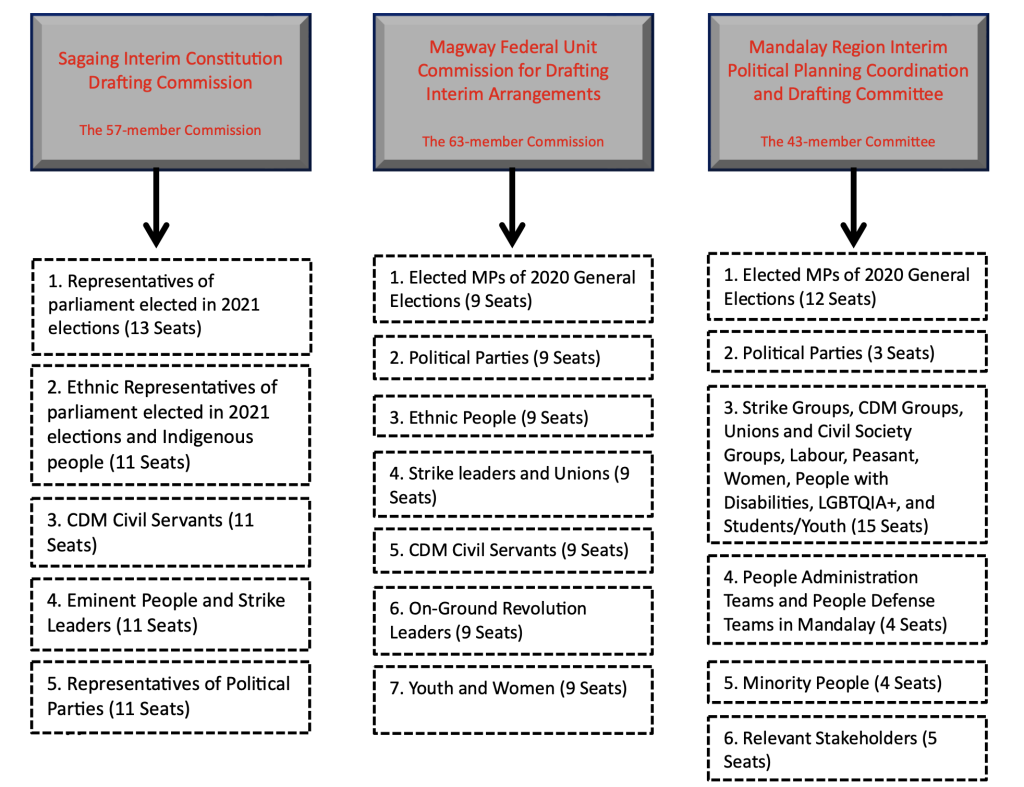
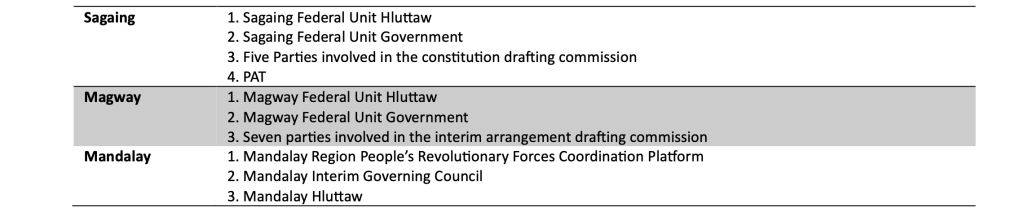
Before examining the human rights frameworks, it is important to understand the nature of the interim political arrangements adopted by the three federal units in Ah Nyar. These arrangements are neither purely legal nor purely political; rather, they represent a hybrid arrangement that combines legal foundations with the practical necessities of interim governance amid the revolutionary context in central Burma. The terminology used in these documents itself reflects different approaches to the legality and political nature of the arrangements. Sagaing refers to its document as a “constitution”, Magway adopts the term “arrangement law”, while Mandalay uses “interim arrangement.” These distinctions are not merely semantic. They reflect attempts to balance legal legitimacy with the need for flexibility in governance under conditions of conflict and political transition. Moreover, the authority and process through which these documents were adopted have also influenced the terminology used in each case. Nevertheless, these interim political arrangements function as the supreme legal frameworks during the interim period (Art. 18 of the Magway Interim Arrangement Law, Art.11 of the Mandalay Interim Arrangement, and Art. 2 of the Sagaing Interim Constitution).
Human Rights Responsibilities of the State
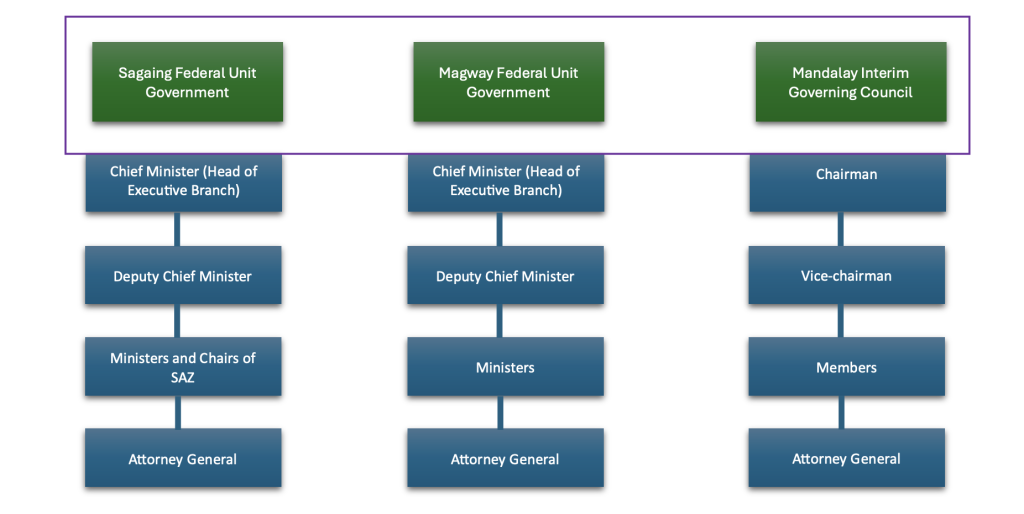
Over decades of civil war, Burma has long experienced different forms of sub-national governance and political arrangements, particularly among ethnic liberation movements such as the Karen, Wa, and Kachin. They are driven by liberation and self-determination. These structures have largely been shaped by wartime necessity. What is different in the emerging federal units in central Burma is the deliberate division of power across the three branches of government – legislative, executive and judicial. The state constitutions set out clear boundaries between these branches (Art. 7 of Mandalay Interim Arrangement, Art. 12 of Magway Interim Arrangement and Arti 6 of Sagaing constitution). These institutions are expected to exercise checks and balances. On human rights, these interim constitutional arrangements provide legal foundations to guarantee fundamental rights and freedoms of citizens.
International human rights law establishes that the primary responsibility for protecting and promoting human rights lies with the state. The UDHR affirms that individuals are entitled to effective remedies for violations of their rights (Art. 8) and to the realisation of economic, social, and cultural rights necessary for human dignity (Art. 22). These principles are further codified in the two major international covenants (ICCPR and ICESCR). Together, these instruments require states to respect, protect and fulfil human rights by establishing legal frameworks to ensure human rights responsibilities of the state, including taking appropriate measures to realise social, economic and cultural rights progressively.
Burma is not a State Party to the International Covenant on Civil and Political Rights. However, it is a State Party to several other core international human rights treaties, including the International Covenant on Economic, Social and Cultural Rights, the Convention on the Elimination of All Forms of Discrimination against Women, the Convention on the Rights of the Child, and the Convention on the Rights of Persons with Disabilities. In the absence of a federal constitutional framework, sub-national constitutions re-affirm commitments to state responsibilities under international law (Art. 177 of the Magway Interim Arrangement Law; Art. 191 of the Sagaing Interim Constitution; with no corresponding provision in the Mandalay Interim Arrangement).
Fundamental Rights and Freedom
The three constitutional frameworks demonstrate a clear commitment to the protection of fundamental freedoms and human rights. In doing so, they broadly reflect core international human rights standards, particularly in relation to civil and political rights, across all three federal units. While these provisions are articulated within interim constitutional arrangements, they indicate a deliberate effort to align with established human rights norms.
At the core, a set of fundamental rights and freedoms is consistently recognised across all three frameworks. These include:
- Right to Life
- Right to legal recognition as a person, and the right to acquire respect and protection for her/his human dignity
- Right to equality before the law.
- Right to freely express, write, publish, and have access to and disseminate information.
- Right to freedom of thought, belief, religion and the freedom to observe and practice customs and traditions.
- Right to freedom of assembly and peaceful demonstration.
- Right to freely form and participate in associations.
- Right to trade and work
- No one shall be subjected to forced labour, torture, enslavement, sexual abuse, and degrading treatment.
Civil and Political Rights
The civil and political rights provisions across the three constitutional frameworks show a partial but meaningful alignment with the standards set out in the International Covenant on Civil and Political Rights. Core protections are broadly recognised across Sagaing, Magway and Mandalay. These include the right to life, protection from torture and forced labour, liberty and security of the person, equality before the law, and fundamental freedoms such as freedom of expression, religion and association. Other core civil and political rights are also widely listed in all three constitutional frameworks across Sagaing, Magway and Mandalay. These include
- Equal rights of men and women to the enjoyment of civil and political rights
- Fair trial rights
- Right to recognition (as a person) before the law
- Right to be free from arbitrary or unlawful interference with one’s privacy, family, home or correspondence, and from unlawful attacks on one’s honour and reputation.
- Freedom of thought, conscience and religion
- Right to hold opinions without interference
- Right to marriage
- Minority rights (to enjoy their culture, religion, etc.)
At the same time, the comparison highlights notable gaps and inconsistencies when assessed against international human rights law. Certain foundational rights under the ICCPR, such as the right to an effective remedy and the prohibition of propaganda for war, are absent across all three frameworks. Other core rights, including the right to self-determination, freedom of movement, political participation, and child protection, are unevenly recognised, appearing in some constitutions but not others. In Sagaing, the right to self-determination, particularly for ethnic minorities, is generally recognised under Articles 153 and 47 of the constitution. However, this right is not explicitly provided for in Mandalay and Magway.
Meanwhile, certain rights are not constitutionally entrenched but are instead left to be addressed through specific legislation to be enacted by the interim parliaments, including the Child Rights Law in the Magway Federal Unit. Rights to participate in public affairs, to vote, and to be elected are not constitutionalised in Sagaing and Mandalay, but are recognised in Magway under Article 25 of the Interim Arrangement Law.
Economic, Social and Cultural Rights
The economic, social and cultural rights across the three constitutional frameworks show an uneven and selective level of development when compared to civil and political rights. While all three recognise certain core labour-related rights such as the right to work, just and favourable conditions of work and the right to form trade unions, this reflects only a partial alignment with the standards set out in the International Covenant on Economic, Social and Cultural Rights. The principle of equal rights of men and women in the enjoyment of these rights is also consistently recognised.
However, other key ESCR protections remain limited. The right to social security is only provided in Sagaing, while absent in both Magway and Mandalay. Similarly, the right to education is fully recognised in Sagaing but only partially addressed in Mandalay and not explicitly provided in Magway. Broader rights, such as the right to an adequate standard of living and the right to mental health, are largely absent across all three frameworks.
At the same time, each framework goes beyond the ICESCR in its own way. This is not incidental. It reflects the lived realities and priorities of each federal unit in central Burma. In Sagaing, for example, the constitution brings in environmental rights, guarantees healthcare access without discrimination, and recognises protections for youth, women, and persons with disabilities. These are not abstract commitments. They respond directly to conditions on the ground. Taken together, they point to an emerging effort to shape a broader, more responsive social policy framework, even within the limits of interim governance. Mandalay, meanwhile, includes provisions on primary healthcare, targeted healthcare for vulnerable groups, farmers’ rights, and cultural promotion.
Sub-national protection mechanisms
The sub-national protection mechanisms for human rights across three federal units remain varied. They are still evolving. A key question is whether protection is institutionalised through an independent mechanism or embedded within existing governance structures. The central issue, however, is whether a coherent human rights protection system is taking shape across Sagaing, Magway and Mandalay under the current constitutional frameworks. That said, what have we seen now?
All three federal units provide for a “free and fair judiciary system” (Art. 6 in Sagaing, Art. 7 in Mandalay and Art. 12 (a and b) in Magway). This matters. It places the judiciary at the centre of rights protection. At the same time, interim parliaments and governments are mandated to establish independent commissions, including for human rights protection (Art. 61 in Sagaing, Art. 46 in Mandalay, and 72(l) in Magway). These are still openings rather than fully operational institutions. But they point to a direction where more structured protection mechanisms could emerge as they create space.
Sagaing goes further in setting out constitutional protection. Article 42 (a) provides
“The right to apply to the Office of the Supreme Court of Sagaing Federal Unit when seeking constitutional protection”.
This right is non-derogable (Art. 42 (b)). In addition, Article 41 (a) states “The right to receive legal protection by filing a complaint to the Unit’s Human Rights Commission in cases of human rights violations.”
More broadly, there is also a baseline expectation that the state provides protection. Article 24 of the Sagaing Constitution states that “Every citizen residing in Sagaing Federal Unit has a right to receive protection from the Sagaing Federal Unit Government in accordance with the law.” A similar provision appears in Article 51 of the Magway Constitution. Taken together, these provisions indicate that responsibility for protection is recognised. But how this responsibility is exercised and coordinated across institutions remains an open question.
At the same time, it should be noted that discussions on the Division of Competencies (DoC) are still ongoing. It is not yet clear how these federal units will cooperate with the Human Rights Commission or the Ministry of Human Rights of the National Unity Government. As these arrangements continue to take shape, a key question remains: will these emerging mechanisms evolve into a coherent system of protection, or remain fragmented across different levels of governance?
Conclusion
These constitutions are not only framed as rights-based documents; they also reflect this in their structure and emphasis. A significant portion of their content is dedicated to human rights and protection—23 per cent in Sagaing, 22 per cent in Magway, and 18 per cent in Mandalay. While the differences are not substantial, they suggest a relatively consistent prioritisation of rights across the three frameworks, with Sagaing showing a slightly stronger emphasis. They set out a foundation of fundamental rights and freedoms that, in many ways, function as an emerging Bill of Rights across the federal units. Some specific rights are also set to be defined through separate legislation, such as the Farmers’ Rights Law in Sagaing and the Minority and Child Rights Laws in Magway. There is also a clear effort to draw from and respect international human rights law. This matters. It shows that these frameworks are not being built in isolation. That said, this is a meaningful starting point. The foundations are there.
Cite this article: Centre for Ah Nyar Studies. (2026, April 11). An Emerging Bill of Rights? Human Rights in Ah Nyar’s Federal Units [Briefing paper]. Centre for Ah Nyar Studies. https://ah-nyarstudies.org/an-emerging-bill-of-rights-human-rights-in-ah-nyars-federal-units/

 Myanmar
  English