
Highlight
- At least 38 civilians were killed, including victims in two massacres documented in Htauk Shar Pin village (Pauk Township) and Baw Ton village (Myaing Township).
- At least 15 civilians were injured in heavy artillery and aerial attacks.
- At least 370 civilian homes were verified as burned across Myaing Township and neighbouring Htauk Shar Pin village in Pauk Township.
- Infantry units raided at least 31 villages across Pauk and Myaing Townships, while aerial and heavy artillery attacks affected at least seven additional villages in Myaing Township.
- LIDs 101 and 99 conducted repeated aerial attacks and heavy artillery shelling against civilian-populated areas, including villages, displacement sites and a monastery.
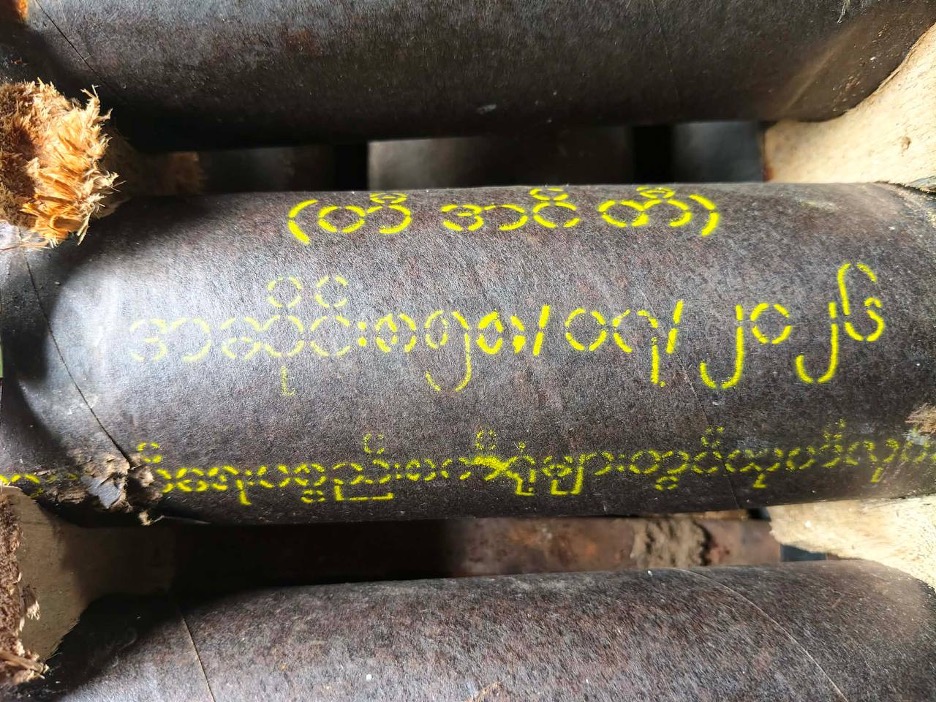
- Photographs of military shirts bearing the insignia of both LID 101 and LID 99 corroborated local accounts concerning the units involved in the operation.
- Evidence from victims’ families, eyewitnesses, aid workers, photographs and weapon remnants indicates patterns of extrajudicial killings, severe ill-treatment, destruction of civilian property and attacks affecting civilian areas.
Methodology and Evidence Assessment
This investigation was conducted through a combination of field-based interviews, incident documentation, on-site observations, photographic evidence and cross-checking with local early-warning and flight-spotter information. Our researchers interviewed 11 individuals, including victims’ family members, eyewitnesses, residents, humanitarian and civil society actors and local sources familiar with the movement and activities of the military column. Information collected through interviews was assessed against incident records, photographs, videos, casualty information, property-destruction records and, where available, physical evidence such as remnants of mortar rounds. Our researchers reviewed 117 photos and 11 videos obtained from several sources. The investigation focused on incidents occurring between 23 June and 8 August 2026 in Myaing Township and neighbouring areas of Pauk Township.
Timeline of the Incident [23 June – 8 August 2026]
Date | Key Events |
23 June 2026 | Magway resistance forces reported engaging and destroying a Myanmar military helicopter near Twin Ma village. |
24 June 2026 | LID 101 and 99 units advanced nearby villages from Twin Ma village. Raided Thar Si and Hnan Si Kan, before reaching Kaing Taw Ma. |
Late June–early July | Infantry units advanced towards Thin Ma and Gyoke Kone villages. |
13–14 July 2026 | 28 civilian homes were burned in Let Khoke Pin village as the military column moved through the area. |
20 July 2026 | Heavy artillery attacks from military positions in Thin Ma affected surrounding villages. Multiple civilian killings were also documented during the military operation, including six victims in Baw Ton. |
21 July–1 August 2026 | 65 civilian homes burned in Thin Ma village. |
22 July 2026 | Artillery fire from Thin Ma struck Wet Hpoe, killing civilians and injuring others. |
24 July 2026 | Multiple aerial attacks struck civilian and displacement sites, including Hnan Si Kyin, Gyote Kone and Hnan Sar Kyin. |
24–29 July 2026 | More than 140 aerial attacks were reported over six days, involving fighter aircraft and gyrocopters. |
26 July 2026 | A fighter aircraft attacked So Taw village, Bone Gyi Kan village tract, damaging a monastery and injuring one Buddhist monk and two civilians. |
27 July 2026 | A fighter aircraft attacked Kyet Mauk village. The incident damaged a power line but no civilian casualties were reported. |
31 July 2026 | A fighter aircraft dropped a bomb near Thaphan Kan (Hpan Kan) village. Two gyrocopters subsequently attacked Ma Gyi Kan, damaging civilian homes and injuring cattle. Later that afternoon, another fighter aircraft attacked Ywar Thit Gyi, damaging at least seven houses. |
1 August 2026 | Military forces moving from Thin Ma arrived in Baunt Bin and remained there until the evening. |
2 August 2026 | Military forces reportedly burned civilian homes in Baunt Bin at around 10:00 a.m. |
2 August 2026 | Military forces moved into Yar Gyi Pyin village and remained in the area. |
3 August 2026 | 31 civilian homes burned in Kan Net village, Kaing Taw Ma village tract. |
5 August 2026 | Local sources reported that military forces burned homes in Yar Gyi Pyin for the first time during the later phase of their movement through the area. |
6 August 2026 | Local sources reported a second round of house burnings in Yar Gyi Pyin in the morning. |
7–8 August 2026 | Gyrocopters attacks in Su Win killed two civilians and resulted three injuries. |
Background of Myaing Township
Myaing Township, in northern Magway Region, lies along a strategic security corridor linking central Burma with Chin State, Rakhine State and India. It is also the origin of the Myaing–Pauk–Kamma–Pakokku–Chauk oil belt, which contains several traditional hand-dug oil fields and a major modernised oil and natural gas field.
Following the 2021 military coup, Myaing became one of the principal contested townships between the junta forces (locally known as Tatmadaw) and pro-democracy resistance forces. Earlier in 2026, resistance forces captured the Pyu-Saw-Htee positions in Wet Poke, Tha Yet Kwa and Tha Yet Kan villages. Currently, resistance groups of the Magway Federal Unit Government controlled most of the township, while Tatmadaw maintained a limited presence through two Pyu-Saw-Htee strongholds and two frontline bases. As the territorial control contracted, Tatmadaw increasingly relied on air power to project military force across Myaing Township, including against oil fields under the control of resistance groups. These operations involved a range of aerial platforms, including fighter aircraft, helicopters, gyrocopters, military-grade paramotors, drones and loitering munitions (kamikaze drones).
On 23 June 2026, Magway People’s Defence Force released video footage showing its fighters engaging a Tatmadaw helicopter during a military operation, which the group announced resulted in the aircraft being shot down. The incident illustrates the increasingly contested operating environment in Myaing Township.
Large-Scale Infantry Offensive by LIDs 101 and 99
On 24 June 2026, a military column comprising troops from Light Infantry Divisions 101 and 99 launched an operation in villages surrounding Twin Ma, where the military-backed Pyu-Saw-Htee militia had maintained a presence since the 2021 coup. Over the following days, the column advanced through a number of villages before reaching Gyoke Kone and Thin Ma, both located near resistance-controlled oil fields in Ba Hin, Wei Taung and Su Win villages along the Myaing–Pauk township boundary.
Our researchers attributed the military operation to forces from LIDs 101 and 99 based on multiple accounts from local sources familiar with the column’s movements and composition. These accounts were corroborated by photographic evidence obtained from the field, including photographs of military shirts bearing the insignia of both LID 101 and LID 99.
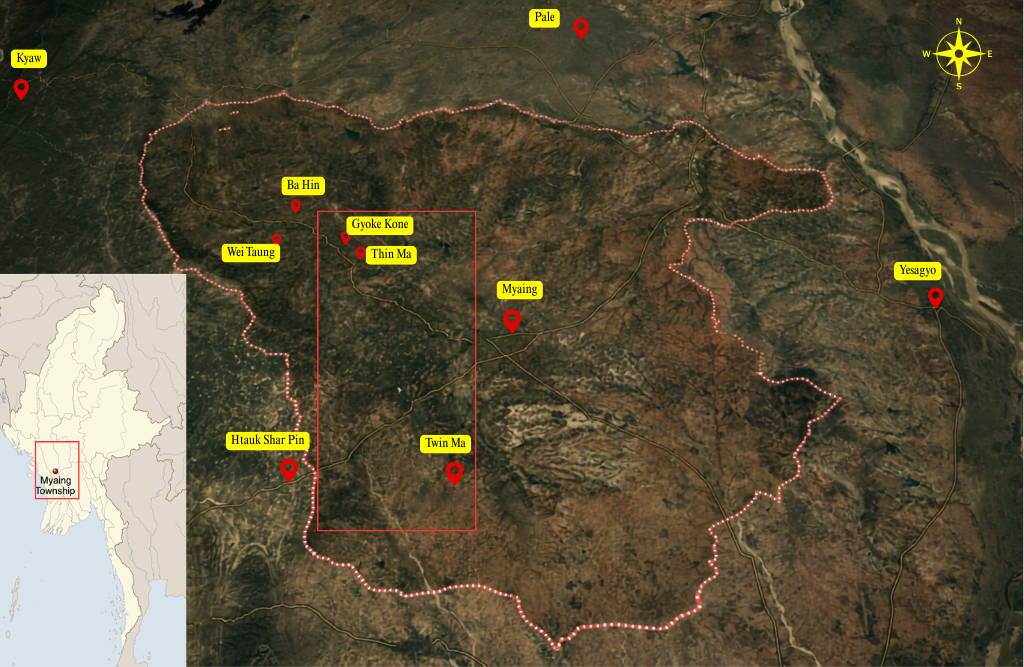
Operation Area Map of Infantry Raids in Myaing Township (source: CAS)
Interviews with local resistance sources indicate that the military operation was launched from two staging points – Twin Ma village and the No. 2 Factory in Myaing Township. The sources estimated that the operation involved approximately 1,000 soldiers. Our researchers independently verified that the military column subsequently raided at least 27 villages between 23 June and 2 August 2026. During the period, armed clashes were also reported in several villages, specifically in Hnan Si Kan and Kaing Taw Ma villages. Between 20 and 25 July 2026, junta forces stationed in Thin Ma village repeatedly shelled surrounding villages using 60 mm, 80 mm and 120 mm mortars. The mortar attacks were reported and verified in Baunt Bin, Wet Hpoe, Nyaung Kone (from Ma Gyi Kan village tract), and Kyet Mauk villages. The attacks killed three civilians, injured at least seven others, damaged civilian properties and left unexploded ordnance.
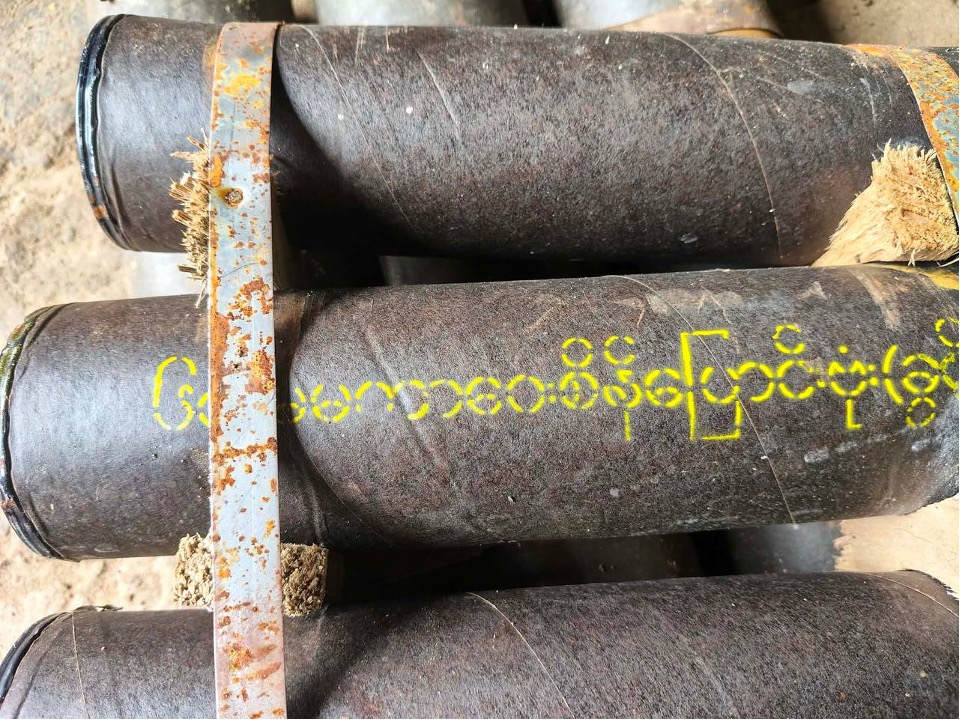
Mortar rounds documented in Thin Ma village (Photo: private)
In addition to ground operations, LIDs 101 and 99 extensively employed aerial attacks during the operation, many of which struck civilian-populated areas. Our researchers verified that at least nine villages were subjected to airstrikes involving fighter aircraft and gyrocopters, particularly in areas north of Ba Hin village. The affected villages were Thin Ma, Gyoke Kone, Hnan Sar Kyin, So Taw, Kyet Mauk, Thaphan Kan (Hpan Kan), Ma Gyi Kan and Ywar Thit Gyi. The military column used at least 200 aerial attacks in the last ten days of July, as reported by the Democratic Voice of Burma. Aerial attacks injured at least five civilians, including a Buddhist monk and an elderly woman and caused damage to civilian homes, religious property and other civilian infrastructure across several villages.
“Which village to burn, which village to burn…”
Our incident-tracking data documents extensive destruction of civilian homes across several villages during the operation. We verified that LIDs 101 and 99 burned down at least 370 houses across ten villages in Myaing Township and neighbouring Htauk Shar Pin village from Pauk Township. A village-by-village breakdown of the documented destruction is provided below.
Sr | Village | Township | Number of Houses burnt down |
1 | Htauk Shar Pin | Pauk | 104 |
2 | Thin Ma | Myaing | 65 |
3 | Baunt Bin | Myaing | 90 |
4 | Kan Net | Myaing | 31 |
5 | Let Khoke Pin | Myaing | 28 |
6 | Kaing Taw Ma | Myaing | 2 |
7 | Htan Nge Taw | Myaing | 4 |
8 | Nyaung Kone | Myaing | 5 |
9 | Than Chaung | Myaing | 5 |
10 | Gyoke Kone | Myaing | 16 |
11 | Mya Zee Taw (Zee Taw) | Myaing | 20 |
The destruction occurred repeatedly as the military divisions moved through villages. In Let Khoke Pin, our researchers documented 28 houses burnt between 13 and 14 July. In Thin Ma, 65 houses were recorded as burnt between 21 July and 1 August, while 31 houses were documented in Kan Net on 3 August. The geographical spread and timing of these incidents indicate that the burning of civilian homes accompanied the military divisions’ advance through several villages, as illustrated above. One interviewee described the burning of homes in Let Khoke Pin, Kan Net, Myin Koe Thit and Nyaung Kone,
“It was not that they only burned particular houses. As the military column moved through the villages, they burned the houses they encountered.”
The arson attacks also affected places where displaced civilians took shelter. At Mya Zee Taw (Zee Taw) monastery, displaced civilians and monks had taken shelter, while villagers had moved food, seeds and other belongings there because they considered it safer than their homes. The same interviewee said,
“When the column suddenly arrived, the monks and the displaced people in the monastery had to flee. They ran away with only the clothes they were wearing. The motorbikes, clothes and food supplies that the displaced people had stored at the monastery because they thought it would be safe – all of them were caught up in the burning.”
The interviewee further stated that food and rice were taken by the soldiers and that two religious buildings and motorbikes were burned. According to a villager who survived the military arrest, the field commander of the military column issued direct instructions to his soldiers about which villages to burn. The source said that the man subsequently escaped from the bunker while the commander was issuing these instructions.
Despite the escalation of conflict and repeated military raids, villagers in the area had limited access to timely information that could enable them to prepare for or safely evacuate ahead of military advances. The operation also took place amid severe restrictions on civilian communications. In addition to the area-wide internet shutdown, telephone communications were reportedly disrupted as LIDs 101 and 99 entered the area. The disruption of communications severely constrained the ability of local authorities and communities to share early warnings and coordinate civilian evacuations. This largely increased the risk that civilians would encounter the advancing military column. A local resistance source explained,
“The internet lines on our side were completely cut off, and the telephone lines were also completely cut off. Because of this, the resistance administration could only communicate among themselves as they tried to move civilians away from the military column. Sometimes civilians and resistance forces could no longer make contact and people ended up in different places. They then encountered the military column, and these kinds of things happened.”
As our researchers observed during the on-site investigation, displaced villagers remain scattered across neighbouring communities and farmland, with extremely limited access to food, shelter and other essential supplies. Among the thousands of people displaced and hundreds of families whose homes have been destroyed, many face a heightened risk of prolonged displacement, having fled with little or no belongings beyond the clothes they were wearing. The displacement has also taken a severe psychological toll on affected communities. One interviewee described the distress experienced by her mother-in-law:
“My mother-in-law is still very sad. She cannot even speak well over the phone. The more she saw the thick smoke, the more she cried.”
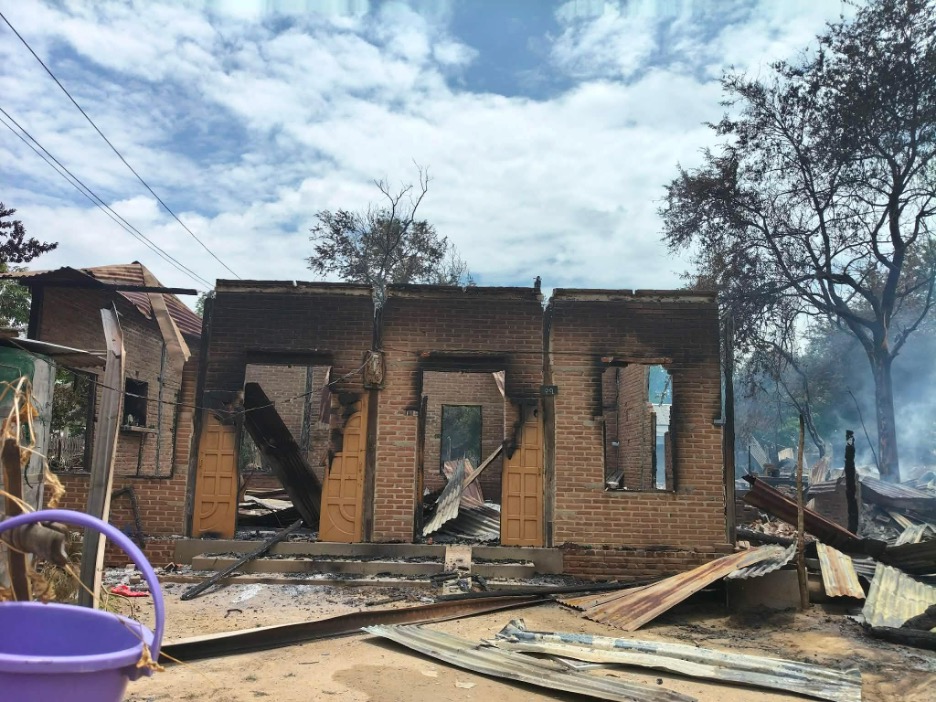
Houses being burnt down in Thin Ma village, Myaing township on 1 August 2026 (source: CAS)
Extrajudicial killings: Massacre in Htauk Shar Pin and Baw Ton villages
Our researchers confirmed that at least 33 civilians were killed during infantry raids by LIDs 101 and 99 between late June and 8 August 2026. Of these, we were able to verify the names, ages, genders, villages of residence and townships of 24 victims, while the remaining victims have not yet been identified. The documented cases include civilians who were reportedly arrested and subsequently killed, subjected to torture and other ill-treatment, shot, or apparently burned alive.
The circumstances surrounding several of the killings demonstrate a pattern of capture, detention, severe ill-treatment and subsequent killing, rather than deaths occurring solely as a result of armed clashes. In one case in Htauk Shar Pin village, the victim was captured by soldiers while returning from visiting his sisters. According to his wife, who subsequently received the call to identify his body, he was found the following day with his hands bound behind his back and severe injuries to his genital area. His anus had been cut and mutilated with a knife, and his penis had also been cut. The physical condition of the body, together with the fact that his hands had been bound, provides strong evidence that he was subjected to severe physical abuse before his death.
The victim’s wife provides a direct explanation of the sequence of events leading to his death. She stated that he was captured by soldiers while returning from visiting his sisters and that the family was subsequently contacted by the village rescue team to identify his body. Through our local sources, we have confirmed that he was taken alive and subsequently found dead in military custody, rather than killed during an armed engagement. The restraints and extensive mutilation documented on his body further demonstrate the severe ill-treatment inflicted upon him before or in connection with his killing.
The account is further corroborated by a local aid worker whom we interviewed and who participated in recovering the bodies of other victims in the area. The aid worker described two additional victims, both men aged 50 and 63, whose bodies were found naked, with their elbow tendons cut. The worker also reported finding a military knife inserted into the anus of one of the victims. Our researchers reviewed photographs taken at the scene and verified that the bodies were naked and displayed visible signs of severe physical ill-treatment. These accounts reiterated our finding of a recurring pattern of ill-treatment of civilians by the junta forces across central Burma.
Another massacre was also verified in Baw Ton village of Myaing, where our researcher confirmed six civilian deaths on 20 July 2026. Five victims were identified as men, aged between 23 and 59 while one female victim remained unidentified. A local civil society group we interviewed reported that these villagers were burnt alive, but we couldn’t independently verify it.
The victims were civilians from the same village, and our evidence does not indicate that their deaths resulted from an armed clash. The Baw Ton incident therefore constitutes a significant case for further investigation into the military column’s treatment of civilians and the broader pattern of extrajudicial killings documented across Myaing Township.
Table 1: List of the victims who were killed by the military column of LIDs 101 and 99
Sr | Name | Age | Gender | Village |
1 | Internal Record | Unknown | Male | Thar Si |
2 | Internal Record | Unknown | Male | Hnan Si Kan |
3 | Internal Record | Unknown | Male | Hnan Si Kan |
4 | Internal Record | Unknown | Male | Meik Hti Lar |
5 | Internal Record | Unknown | Male | Meik Hti Lar |
6 | Internal Record | Unknown | Male | Wet Poke |
7 | Internal Record | 30 | Female | Htauk Shar Pin |
8 | Internal Record | 48 | Male | Htauk Shar Pin |
9 | Internal Record | 58 | Male | Htauk Shar Pin |
10 | Internal Record | 35 | Male | Htauk Shar Pin |
11 | Internal Record | 75 | Male | Htauk Shar Pin |
12 | Internal Record | Unknown | Unknown | Htauk Shar Pin |
13 | Internal Record | 50 | Male | Kan Net |
14 | Internal Record | 63 | Male | Kan Net |
15 | Internal Record | 70 | Male | Myin Koe Thit |
16 | Internal Record | 67 | Male | Kaing Taw Ma |
17 | Internal Record | 31 | Male | War Yin Chaing |
18 | Internal Record | 45 | Male | Baunt Bin |
19 | Internal Record | 40 | Male | Baunt Bin |
20 | Internal Record | 45 | Male | Baunt Bin |
21 | Internal Record | Unknown | Male | Myin Koe Thit |
22 | Internal Record | 60 | Male | Kaing Yoe |
23 | Internal Record | 35 | Male | Kun Lat |
24 | Internal Record | 35 | Male | Kun Lat |
25 | Internal Record | 68 | Male | Kun Lat |
26 | Internal Record | 23 | Male | Kun Lat |
27 | Internal Record | Unknown | Female | Baw Ton |
28 | Internal Record | 40 | Male | Baw Ton |
29 | Internal Record | 35 | Male | Baw Ton |
30 | Internal Record | 35 | Male | Baw Ton |
31 | Internal Record | 59 | Male | Baw Ton |
32 | Internal Record | 40 | Male | Baw Ton |
33 | Internal Record | 56 | Male | Than Chaung |
Aerial Attacks and Heavy Artillery
The ground offensive by LIDs 101 and 99 was accompanied by repeated aerial attacks and heavy artillery fire. Our evidence indicates that these attacks were not isolated incidents; instead, they are critical elements of a coordinated military operation, during which civilian homes, monasteries, displacement sites and other civilian-populated areas were repeatedly targeted.
While the infantry raids were concentrated around villages connected to the Tatmadaw’s two frontline positions – Twin Ma Pyu-Saw-Htee post and No. 2 Factory frontline post – the aerial attacks were concentrated in villages farther from the military column’s immediate reach. A closer examination of airstrike incidents in eight villages indicates that LIDs 101 and 99 used aerial attacks to support the advance of their infantry column towards resistance strongholds. As the infantry column advanced from Thin Ma village, aerial attacks were repeatedly reported in neighbouring villages, including Kyet Mauk, Thaphan Kan (Hpan Kan), Ma Gyi Kan and Hnan Sar Kyin. According to our on-site observation, the military column used at least 200 aerial attacks, which caused serious harm to the civilian population in the community. According to local sources we interviewed and early warning information, the attacks involved both gyrocopters and fighter jets operating from different airbases.
The military column also used 60 mm, 80 mm and 120 mm mortars from positions in Thin Ma village to strike surrounding communities. We reviewed photos of remnants of these weapons, recovered from three locations after the forces left Thin Ma. Some 120 mm mortar remnants bore lot numbers indicating manufacture in 2026 by Myanmar Defence Industries (commonly known as KaPaSa). Unexploded 60 mm mortar rounds were also documented in Ywar Thit Gyi and Baunt Bin on 22 July.
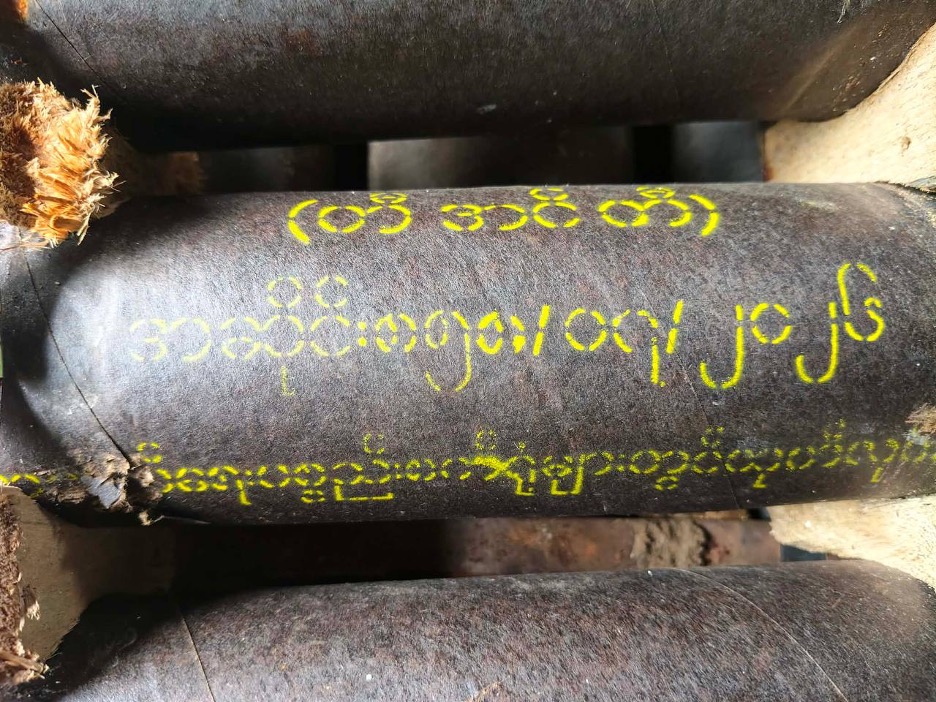
Weapon remnants found in different locations in Myaing (Source: CAS)
The artillery attacks caused both immediate and delayed civilian harm. On 22 July, junta forces stationed in Thin Ma fired heavy mortar rounds at Wet Hpoe village, which killed three civilians and injured at least seven others. Two days later, 120 mm mortar rounds were reportedly fired towards other villages, while additional mortar fire continued as the column moved through the area. The use of heavy mortars allowed the military to strike villages beyond its immediate physical presence; however, civilians remained exposed even when the ground column had not entered their communities.
In the case of Wet Hpoe, we verified that a husband and wife, both over 50, were killed when artillery struck their home. Their 28-year-old daughter, who was seriously injured in the same attack, subsequently died from her injuries. Other members of the family and nearby civilians sustained serious or minor injuries. A local healthcare worker described the victim’s condition on arrival at the clinic:
“When she arrived at the clinic at 11:00 am, she was already in a critical condition. We could only provide basic emergency care to stop the bleeding and provide fluids. She had severe injuries, heavy blood loss and her chances of survival were considered unlikely. She was later transferred for further treatment but died from her injuries on the same day.”
A young, displaced person who witnessed the incident described how the family was attempting to flee when the shell struck.
“They [affected family] went into their village, Wet Hpoe, to get the medicine. When they [soldiers of Tatmadaw] fired artillery toward Wet Hpoe village, they [the villagers] heard the first shell and shouted, ‘It is dangerous, move, move!’ They rushed to get onto the three-wheeled motorbike. If they did not get on, they might not have been hit. But as they were getting onto the vehicle, the artillery shell struck next to their location. Three of them were injured, and later their daughter died.”
Our casualty records document 15 people injured and 5 killed by aerial and artillery attacks between 22 and 26 July. Seven of the 15 injured were over the age of 50. The victims included displaced people from Thin Ma, Baunt Bin and Khway Mway, as well as civilians sheltering at a monastery in So Taw.
Table 2: List of casualties due to aerial attacks in Myaing township
Sr | Name | Age | Gender | Village | Remarks |
1 | Internal Record | 50 | Male | Wet Hpoe | Death due to artillery attacks. |
2 | Internal Record | 52 | Female | Wet Hpoe | Death due to artillery attacks. |
3 | Internal Record | 28 | Female | Wet Hpoe | Death due to artillery attacks. |
4 | Internal Record | 39 | Male | Su Win | Death due to gyrocopter attacks. |
5 | Internal Record | 32 | Female | Su Win | Death due to gyrocopter attacks. |
6 | Internal Record | 52 | Male | Wet Hpoe | Injured due to artillery attacks. |
7 | Internal Record | 54 | Female | Wet Hpoe | Injured due to artillery attacks. |
8 | Internal Record | 60 | Male | Wet Hpoe | Injured due to artillery attacks |
9 | Internal Record | 40 | Male | Wet Hpoe | Injured due to artillery attacks |
10 | Internal Record | 51 | Male | Wet Hpoe | Injured due to artillery attacks |
11 | Internal Record | 42 | Female | Wet Hpoe | Injured due to artillery attacks |
12 | Internal Record | 53 | Female | Wet Hpoe | Injured due to artillery attacks |
13 | Internal Record | 30 | Male | Khway Mway | A displaced man from Khway Mway village, got Injuries due to gyrocopter attacks in Hnan Sar Kyin on 24 July 2026. |
14 | Internal Record | 60 | Male | Baunt Bin | A displaced man from Baunt Bin village, got injuries due to attacks in Han Sar Kyin on 24 July 2026. |
15 | Internal Record | 34 | Male | So Taw | Got injuries due to aerial attack against the monastery of So Taw village, on 26 July 2026 by Y-12 of Tada-U airbase. |
16 | Internal Record | 42 | Male | So Taw | Injured due to aerial attack against the monastery of So Taw village, on 26 July 2026 by Y-12 of Tada-U airbase. |
17 | Internal Record | 81 | Female | So Taw | Injured due to aerial attack against the monastery of So Taw village, on 26 July 2026 by Y-12 of Tada-U airbase. |
18 | Internal Record | 37 | Male | Su Win | Injured due to gyrocopter attack. |
19 | Internal Record | 47 | Male | Su Win | Injured due to gyrocopter attack. |
20 | Internal Record | 34 | Male | Su Win | Injured due to gyrocopter attack. |
Findings and Assessment
The operation combined ground raids, village burning, extrajudicial killings, heavy artillery and aerial attacks, extending the military’s reach beyond areas directly engaged by infantry forces. While ground forces advanced through villages, artillery positions in Thin Ma repeatedly shelled surrounding communities, while fighter aircraft and gyrocopters struck villages farther from the column’s immediate position. The timing and geographic overlap indicate that aerial and artillery attacks formed an important component of the wider operation.
The investigation verified at least 38 civilian deaths, including cases involving arrest followed by killing, shooting, severe ill-treatment and alleged burning alive. In several cases, evidence indicates that civilians were taken alive and subsequently found dead. In Htauk Shar Pin, a victim was reportedly captured and found the following day with his hands bound and severe genital injuries. His wife’s testimony was corroborated by an aid worker and photographs showing visible signs of severe physical ill-treatment. The evidence establishes a pattern of capture, detention, severe ill-treatment and subsequent killing, amounting to extrajudicial executions and torture or other cruel, inhuman or degrading treatment.
Researchers verified the burning of at least 370 civilian homes across Myaing Township and neighbouring Htauk Shar Pin village in Pauk Township. The timing and geographic spread indicate that the destruction accompanied the military column’s advance rather than resulting solely from armed clashes. Witnesses also described soldiers burning homes along their route and destroying property stored at Mya Zee Taw (Zee Taw) monastery, where displaced civilians had sought shelter.
Aerial and artillery attacks further extended the operation’s reach into civilian areas. Researchers documented fighter aircraft and gyrocopter attacks, alongside 60 mm, 80 mm and 120 mm mortar fire from Thin Ma, affecting villages, displacement sites and a monastery and causing civilian casualties and property damage. Photographs of weapon remnants and information from early-warning and flight-spotter networks corroborated accounts of these attacks. The pattern raises serious concerns regarding compliance with the principles of distinction, proportionality and precautions in attack.
Accountability and Recommendations
The evidence warrants further investigation into the responsibility of LIDs 101 and 99 and their commanders for unlawful killings, severe ill-treatment, destruction of civilian property and attacks affecting civilians. Accountability mechanisms should preserve and independently assess available evidence, establish the chain of command and operational responsibility and investigate individual and command responsibility. Domestic and international actors should ensure that survivors and victims’ families have access to truth, justice and effective remedies, including reparations, while protecting witnesses and preserving evidence for future judicial proceedings.
 Myanmar
  English