
This situational analysis is produced under Ah Nyar Studies as part of our broader effort to inform developments in central Burma and advance contextual understanding of the region. The analysis examines post-coup dynamics of natural resource control in Magway, with particular attention to the oil industry’s strategic importance to armed actors. It explores how oil fields have become embedded within evolving conflict structures and shaped authority, revenue generation and local governance.
In addition to an extensive review of secondary sources, the analysis draws on nine key informant interviews with individuals possessing expert knowledge of the subject matter, including senior CDM staff formerly employed in oil fields in central Burma.
Introduction
After the 2021 coup, oil fields (locally known as Yae Nan Hmaw or Yae Nan Myay) have become contested strategic assets, where control over production and revenue is increasingly fragmented among the military regime, the NUG and local resistance groups, with significant implications for governance, security and energy access for people. These groups have been heavily contested across Magway, particularly in resource-rich townships.
As of 2026, local resistance forces in Magway controlled two of the seven oil fields under the union government’s authority. The two major oil fields located in Pakokku, Myaing, and Pauk townships are currently under the management of the resistance administration. Oil and gas from these fields provided supplies for the Refinery Industry in Chauk township through Kamma and Pakokku.
What do these oil fields and routes mean to resistance groups in Magway? How do these resources define the fate of the resistance movement and governance?
Active Oil Fields in Magway
Myanmar’s crude oil production is sourced from both onshore oil fields and offshore oil and natural gas blocks. There are at least ten onshore oil fields across the country, of which seven are in Magway. Major production comes from Yenangyaung, Chauk, Mann Yae Nan Myay, Pyay Yae Nan Myay, Shwepyitha (Myan-aung), and the Myaing–Pauk areas, according to senior officials who worked in the industry and now joined CDM. Among these, the Yenangyaung, Chauk, and Mann Yae Nan Myay in Magway Region are among the oldest in the country and have historically been among the most productive.
The Htauk Shar Pin Oil field historically referred to the oil-producing area south of Minbu, beginning from Ta Pin village and extending through the areas around Htauk Shar Pin, Kywe Tho Myaung, Shwe Yaung Taung, and Hpa Lan Yone villages. The Kanni Oil field refers to the oil-producing area around Kanni village at the southern edge of Minbu township, including the surrounding areas of Htein Taw and Pike Pin villages. At present, the Htauk Shar Pin and Kanni oil fields in Minbu township, together with the Htan Kaing and Yae Nan Ma oil fields in Minhla township, are collectively referred to as the Htauk Shar Pin–Kanni Oil fields.
The Sabe–Thagyitaung oil fields are located along the route from Pakokku through Kyun Chaung toward Seikphyu township, forming part of a broader oil belt that stretches across the country’s centre. According to a local source from Myaing township, this petroleum belt extends from Padauk Kone village in Pale Township, Sagaing Region, southward through areas such as Nyaung Ma, Sin Swei, Wei Taung, and Su Win, before continuing toward Thagyitaung and the Si Kaung area near the Bagan River port (of Irrawaddy River).
Other major oil fields in Magway include Kyauk Khwet and Hpa Lan Kaine in Myaing and Pauk townships, as well as Wei Taung, Suwin, Nyaung-ma, Htan Kaing, Sabe–Thagyitaung, and parts of the broader Pakokku–Myaing–Pauk oil belt. Local sources describe the area stretching along the ASEAN Road between Myaing and Pauk as one of the main concentrations of hand-dug oil wells and small-scale extraction sites. Some areas, particularly Kyauk Khwet from Myaing township and Hpa Lan Kaine from Pauk township, are also known for their relatively high oil output, with local sources describing some wells as producing large volumes of crude oil.
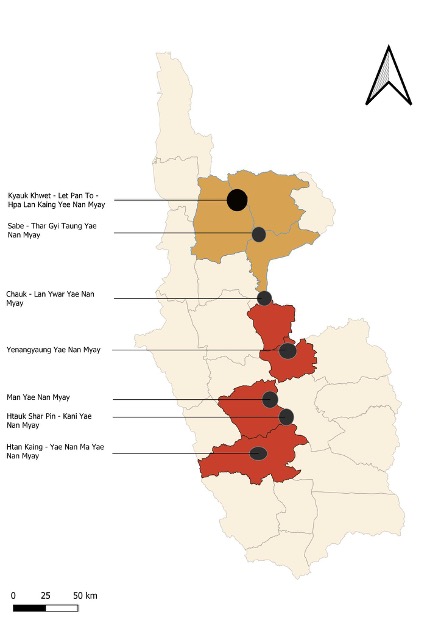
Seven Oil Fields in Magway. Two in the yellow zones are under the control of resistance groups.
Unlike smaller hand-dug wells common in other parts of the central dry zone, some deposits in these mountainous areas reportedly require deeper and more mechanised extraction methods. In recent years, however, extraction methods have gradually become more mechanised with the increased use of machinery and technical equipment.
Traditional Hand-Dug Well or Let Yet Twin
Apart from the said major onshore oil fields, there are several tiny oil fields spreading across Magway. These are better known as Let Yet Twin, as locals call them. Traditional hand-dug wells in the region can reach depths of thousands of feet, with workers manually drilling, lowering equipment, and extracting crude oil under difficult conditions. According to Magway government records , there were 45 existing shallow hand-dug oil blocks and 11 newly approved blocks operating in Magway Region in the 2016–2017 fiscal year. This expansion continued into the 2017–2018 cycle as authorities approved 20 license extensions and 12 new permits, generating over 1.5 billion kyats for the regional fund in a single year. These figures represent the last phase of formal stability before the sector became contested; by the 2018–2019 fiscal year, the region’s output from seven major oil fields reached over 2.1 million barrels of crude oil, followed by nearly 3.5 billion cubic feet of natural gas in the 2019–2020 period.
Resistance Control over Oil and Natural Gas Fields in Magway
Resistance groups have gained control over oil fields and surrounding communities across Myaing, Pauk and Kamma townships, including two major oil fields previously under the authority of the union government. These are Kyauk Khwet–Let Pan To and Hpa Lan Kaing oil fields in Myaing and Pauk townships and Sabe-Thargyitaung oil field in Pakokku township.
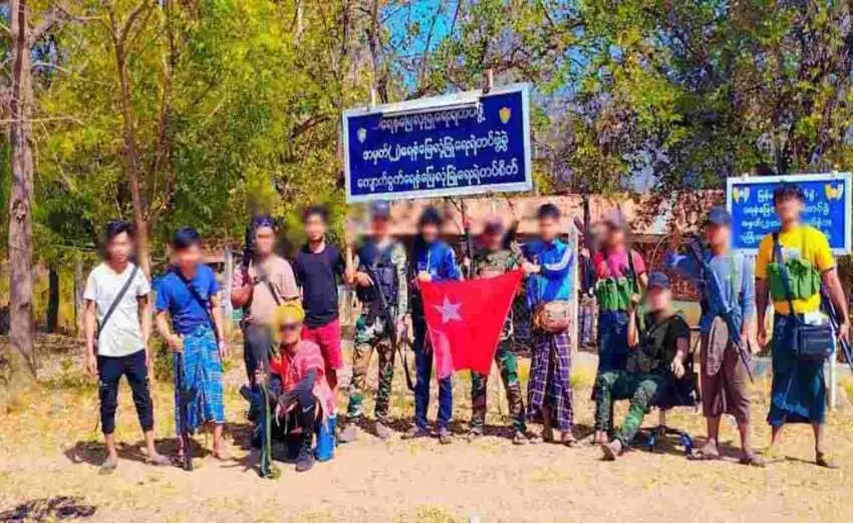
Earthquake People’s Defence Force fighters in front of a security station of Kyauk-Khwet Oil Field (Photo: Earthquake People’s Defence Force)
According to U Zaw Min, Minister of Planning and Finance in 2020, these oil fields produced not only crude oil but also natural gas prior to the expansion of resistance control. Official data indicates that the annual natural gas production capacity in FY 2019–2020 reached 3,480 million cubic feet across five major oil fields, including the two now under resistance control. Local sources connected to resistance administrations in Myaing and Pauk confirmed the continued extraction of crude oil, but noted technical limitations regarding natural gas production, stating that:
“We are only capable of producing crude oil from these two fields, but not natural gas due to technical requirements.”
Magway regional government data further reported that total regional natural gas production capacity reached 4,554 million cubic feet in FY 2017–2018 and 3,739 million cubic feet in 2018–2019. The gas was distributed across Magway and Mandalay Regions to supply state-owned industrial facilities, including cement and cotton factories. Apart from these two major oil fields, resistance forces also control numerous traditional hand-dug oil wells across Magway, particularly in the areas of Myaing, Pauk, Kamma and Pakokku.
Refinery Industries
Magway is a major refinery spot for Myanmar’s petroleum sector. Two of the three major refineries are located in the region. They are;
- The Petrochemical Complex, locally known as Man Thanbayakan, is located near Minhla Township in Magway Region. The facility was constructed in 1982 by Mitsubishi Heavy Industry with a design refining capacity of 25,000 barrels per stream day (BPSD), and production commenced in 1986. Historically, the complex processed crude oil primarily sourced from the Mann Yae Nan Myay and Htauk Shar Pin–Kanni oil fields. Its products include gasoline, diesel, ATF (aviation turbine fuel), LPG, kerosene, fuel oil (FO) and petroleum coke (pet coke). According to official information, the current operational capacity is approximately 8,500 BPSD (around 300,000 gallons per day), depending on the availability of locally produced crude oil. The facility is also reportedly undergoing upgrading and modernisation works.
- The (2) Refinery in Chauk Township is one of the oldest refineries in Myanmar. Built in 1954 by the Foster Wheeler Company of England, the refinery consists of an atmospheric distillation tower, a vacuum tower and wax extraction plants, with a design processing capacity of 6,000 barrels per stream day (BPSD). The facility historically processed only locally produced crude oil, primarily sourced from the Chauk and Yenangyaung oil fields, as well as crude oil extracted from the Kyaut Khwet and Lat-pan-to oil fields in Pauk and Myaing townships. Crude oil from the upper part of Magway was transported via pipeline to the Ayadaw Oil field near Tant-Kyi-Taung in Pakokku Township before being sent onward to the refineries in Chauk. In addition to crude oil transportation, natural gas extracted from the Kyaut Khwet field was previously transported by pipeline to Aya-daw and industrial facilities in Wazi to support factory operations. The refinery historically produced gasoline, kerosene, diesel, wax, fuel oil (FO) and blue oil. However, according to official information, the plant was shut down on 5 March 2019 due to the declining availability of local crude oil and natural gas.
Their combined output accounted for only around 3 per cent of domestic fuel consumption.
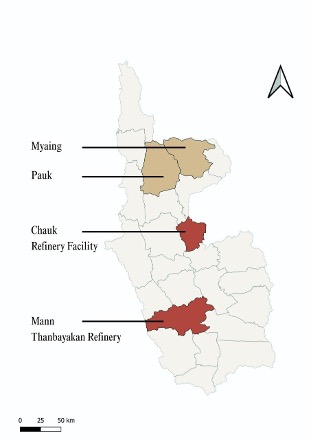
Map Showing Refinery Industries in Magway
The Recent Deal with the Chinese Corporation for Htauk Shar Pin-Kanni Oil Field
According to state media reports published on 12 April 2026, the Ministry of Electricity and Energy of the Naypyitaw regime signed an agreement with China-based North Petro-Chem Corporation (Myanmar) to increase crude oil production at the Htauk Shar Pin–Kanni oil field in Min–hla township. The company, with its mother corporation in Xi’an, northern China, is closely associated with the Belt and Road Initiative. The company started Myanmar operations in 2011 with its principal activity for the extraction of crude petroleum and natural gas, as stated in Myanmar’s official source. It has been involved in Myanmar’s petroleum sector for more than a decade through exploration and production projects.
On 10 April 2026, the agreement was reportedly concluded shortly after the formation of the newly formed Naypyitaw regime led by ex-general Min Aung Hlaing. Myanmar state media reported that the initiative aims to boost domestic crude oil production in response to Myanmar’s heavy reliance on imported fuel, which accounts for approximately 97% of national consumption, and to help alleviate ongoing fuel shortages. The details of the agreement remain unknown.
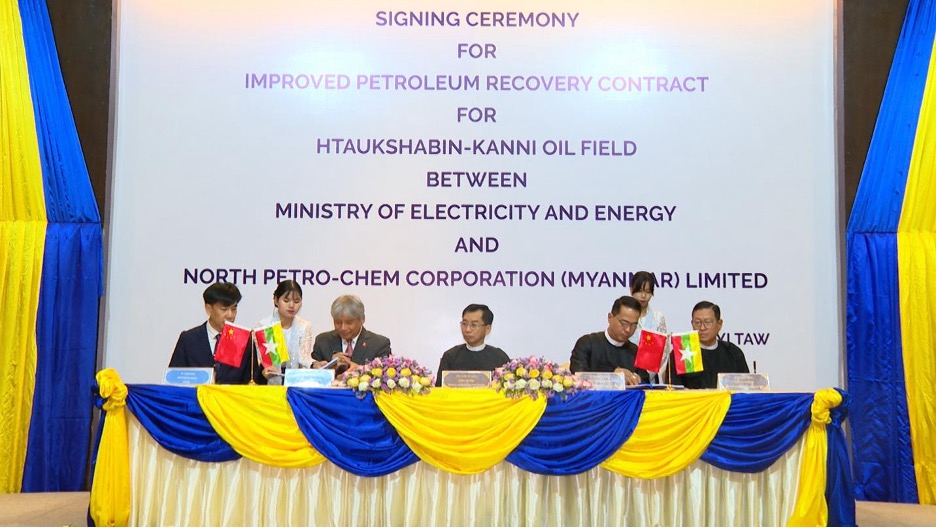
Signing Ceremony for Hautkshabin-Kanni oil field between the Chinese Company and MOGE (Photo: Global New Lights of Myanmar)
Under the evolving landscape of natural resources politics in Central Burma, four key issues emerge that shape how oil fields are contested, governed, and integrated into the broader conflict economy.
1) How is the conflict economy structured around oil fields?
The conflict is increasingly shaped by a fragmented and adaptive political economy rather than fixed territorial control. Since the 2021 coup, oil-producing areas such as Htauk Shar Pin–Kanni and the Myaing–Pauk fields have become contested economic nodes where authority over extraction, transport, and taxation is dispersed among the military, resistance structures, and local actors. While formal ownership often remains with state-linked institutions, actual control on the ground is fluid and continuously negotiated.
In particular, mature fields like Htauk Shar Pin–Kanni, where most reserves have already been exploited and production is technologically constrained, retain strategic value not because of untapped resources, but because of their integration into wider supply chains and refining systems, including the Mann Thanbayarkan refinery. Within this system, brokers and traders play a critical but less visible role by facilitating the movement of crude oil, refined fuel, and essential goods across conflict lines. These intermediaries operate through highly flexible arrangements, often engaging with multiple armed actors simultaneously and shifting allegiances based on access, security guarantees, and profit margins. As a result, the conflict economy is sustained not only by armed actors but by a network of commercial agents who mediate flows of fuel, taxation, and information.
2) How are local armed actors competing over oil fields?
Myaing and Pauk townships have been resistance stronghold areas since 2021. Several local resistance groups exist alongside the NUG’s 3P-forces and LID 101 of Tatmadaw. Some of them are Ah Nyar Myay Alliance (အညာမြေတပ်ပေါင်းစု), Myaing Villages Revolution Front, Earthquake People’s Defence Force and Myaing Solidarity Alliance (မြိုင်ညီညွတ်ရေးတပ်ပေါင်းစု), Ghost Of Enemies-GOE Revolution and Southern Yesagyo PDF. The competition among armed actors is structured around control of infrastructure rather than the oil wells themselves. Local resistance forces, including the “3Ps” (people’s defence, administration, and security teams), have consolidated influence by embedding themselves within the oil economy—taxing extraction, regulating access to drilling sites, and controlling key transit routes. For instance, these routes are particularly important, as crude and semi-refined oil must pass through checkpoints linking Pauk–Myaing to Pakokku, Monywa, Mandalay, and beyond. Control over these corridors allows actors to extract revenue at multiple points, creating layered taxation systems that can favour one side or another depending on local arrangements.
At the same time, Tatmadaw continued to rely on fixed checkpoints and garrison-based control, particularly along major transport axes, requiring goods from certain areas to be channelled through junta-controlled routes. However, the system is not purely adversarial. In practice, there are negotiated flows of commodities—such as rice, fuel, and basic goods—where both sides tolerate or facilitate movement that sustains local economies. This produces a form of transactional coexistence, where economic interdependence tempers military confrontation. Nevertheless, the strategic objective for Tatmadaw remains clear: to regain control over oil-producing zones like Pauk in order to cut resistance revenue streams and re-establish centralized control over fuel distribution, through its continuous raids and aerial attacks.
3) How do external and allied actors fit into this system?
China’s involvement is primarily anchored in long-term investments and infrastructure, including pipeline corridors and pre-existing production agreements, some of which date back to before 2015 with contract durations spanning 30–50 years. Recent agreements to increase production at fields such as Htauk Shar Pin–Kanni likely suggest continued interest in maintaining output despite the field’s age and technical limitations. The potential reasons could be seen as to
First, they may have broader strategic and resource interests in the area beyond oil production, including the potential for coal extraction in central Myanmar. For instance, strategic oil and gas pipeline routes pass through areas such as Ngape, Minbu, and Yenangyaung, while coal-related projects and extraction sites have also been linked to areas around Ngape, Padan, and Minbu. According to local sources, several of these projects are owned, operated, or backed by Chinese-linked companies and investors.
Second, many Chinese companies had already entered Myanmar’s oil and gas sector long before the 2021 coup through long-term exploration and production agreements. Third, as many Western and foreign companies withdrew from Myanmar after the coup, competition in the sector weakened significantly. This created opportunities for Chinese companies to secure market access, expand their influence, negotiate favorable terms, and establish a stronger foothold in Myanmar’s energy sector with fewer competitors.
Meanwhile, the role of the Arakan Army (AA) appears to operate through logistical and commercial linkages. For instance, fuel produced in Myaing–Pauk is reportedly refined into usable forms and transported toward Chin and Rakhine areas, where it supports both civilian and military needs. Within this system, brokers and trading networks potentially serve as intermediaries connecting Central Burma’s oil economy to AA-aligned supply chains, reflecting a pattern of alliance-based resource sharing. At the same time, constraints on arms purchase and financing among resistance groups may increase reliance on such resource-based networks. As a result, Magway’s oil fields are not isolated assets but form part of a wider, interconnected conflict economy that links production zones in Magway to operational theatres in Chin and Rakhine which reinforces the strategic significance of even declining oil fields.
4) Tensions in Myaing and Pauk Townships
Magway Federal Unit is a recently emerged political unit within the Spring Revolution, shaped through the interim constitutional arrangement that recognises the National Unity Government of Myanmar as the union/federal government. The arrangement establishes three branches of power: legislative, executive and judicial. NLD lawmaker Ye Htun Zaw, elected from Constituency No. 2 of Min Hla Township, serves as the Chief Minister of the newly formed government, while youth activist Chit Win Maung serves as his deputy, representing the bloc of unions, women’s organisations, youth organisations and people’s strike committees from the Spring Revolution.
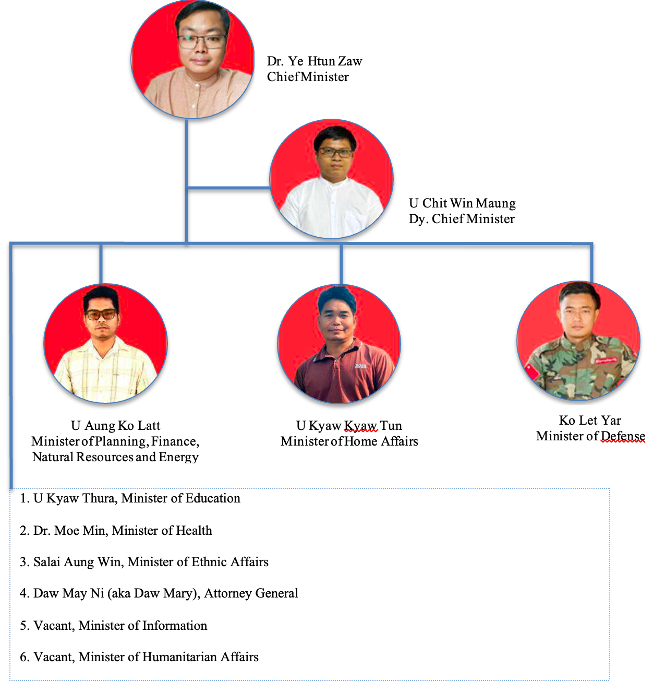
Magway Federal Unit Government (2026)
Magway has emerged as a unit within the evolving federal model, with the authority to establish armed forces at the level of a state guard. Article 114 of the constitutional arrangement provides that:
“The Magway Federal Unit Government shall, in consultation with the National Unity Government of Myanmar, establish the following armed forces for defence and security purposes: (a) the Magway Federal Unit Guard Force; and (b) the Magway Federal Unit Security Force / Police Force.”
In practice, however, the situation is far more complex than it may appear, given the fragmented landscape of armed resistance groups across Magway, despite their shared objective of resisting the military junta. Within Magway’s political geography, numerous small resistance factions, commonly known as Local People’s Defence Forces (LPDFs), operate independently across villages. Alongside them are the National Unity Government’s People’s Defence Forces (PDFs) and People’s Security Teams (PSTs), more widely known as Pa Ka Pha, active across several townships in Magway. The region is also home to ethnic minority communities and their respective armed organisations.
These include the Yaw, Taung Thar and Asho Chin ethnic groups. The Yaw and Taung Thar communities are indigenous populations inhabiting the Pon Taung and Pon Nyar hill tracts in north-western Magway. In these hilly areas, the Yaw Army and the Yaw Defence Force are the predominant local armed groups. Both identify themselves as Ethnic Armed Organisations/Revolutionary Organisations (EAOs/EROs) and advocate for self-determination in the region. At the same time, major battalions and PSTs (Pa Ka Pha) under the Ministry of Defence of the NUG are active across the three townships of Gangaw, Tilin and Saw.
The Asho Chin (also known as Plains Chin) are a small ethnic subgroup of the broader Chin ethnic population inhabiting lowland areas of Myanmar, particularly in western Magway. Following the military coup, two major armed groups emerged within the community: the Asho Chin Defence Force (ACDF) and the Chin Defence Force–Asho (CDF-Asho). Both maintain connections with resistance forces operating in the hilly areas of Ngape and Sidoktaya townships along the Magway–Rakhine border. Both groups advocate for ethnic liberation and self-determination.
These local armed groups have been substantially integrated into the political processes of drafting of the Magway interim constitutional arrangement and formation of the Magway Federal Unit Government. They constitute two of the seven representative blocs shaping the political process and institutional development of the Magway Federal Unit.
Beyond these two ethnic armed branches, several other LPDFs continue to operate alongside the NUG’s PDFs and PSTs. These include groups such as the People’s Revolution Alliance (Magway), the Southern Yesagyo PDF and the United States of Burma Army-USBA. While some maintain affiliations with the NUG, others operate independently outside the formal NUG command structure.
Within this fragmented security landscape, security governance in Magway remains inherently challenging, beyond the influence of the NUG alone. The petroleum sites in the resistance strongholds of Myaing and Pauk Townships have constituted particularly intense contestation among the various security actors operating in Magway. More recently, following the formation of the Magway Federal Unit Government and its attempt to establish a Unit Guard Force, Chief Minister Ye Htun Zaw and Security Minister Let Yar attended the closing ceremony of the first cohort of Guard Force training. The event subsequently sparked existing complexities and tensions within the regional dynamics between LPDFs, the NUG and the Magway Federal Unit.
Bo Let Yar and Ye Htun Zaw attend the closing ceremony of the first cohort training of the Magway Federal Unit Guard Force. (Photo: Mandalay Free Press)
The NUG reportedly mobilised hundreds of PDF personnel to the area amid claims that the operation aimed to capture Bo Let Yar. However, Soe Thura Zaw, a senior official from the Ministry of Defence, denied the accusation, stating that the situation was not a dispute between the Magway Federal Unit and the NUG. He further rejected claims that the operation concerned control over petroleum sites. According to him, the operation had two primary objectives: (1) to undertake corrective and chain of command measures in response to issues relating to the Myaing PST, following unsuccessful attempts to impose administrative action in 2024 and 2025; and (2) to deploy forces for security duties to protect petroleum sites placed under union/federal management. In response to Soe Thura Zaw’s statement, Chief Minister Ye Htun Zaw wrote on his Facebook that the conflict was associated with resource governance. He further stated that senior NUG officials needed to adhere to the decisions jointly agreed upon between the NUG and the Magway Federal Unit on 5 April 2026 regarding the management of petroleum and related products. Coinciding with the timing of the incident, 42 local PDFs operating in the area and across Magway issued a statement on 18 April 2026 declaring that the groups would affiliate with the Magway Federal Unit under its military command structure.
Adding to this contestation, Tatmadaw’s LID 101, based in Pakokku and backed by Meiktila-based LID 99, launched a large-scale mobilisation of troops along the main roads connecting Pakokku to Pauk, Myaing and Yesagyo. This triggered the most recent escalation of conflict from late April through to the time of writing of this briefing paper. Thousands of villagers from the three townships have reportedly fled to farmlands and neighbouring villages. More recently, junta forces raided and burned houses in several villages in Yesagyo Township.
The recently adopted constitutional arrangement of the Magway Federal Unit establishes a policy framework for the sharing of revenues and financial interests between the NUG and the Unit (Section 129), while the Unit retains legislative authority over natural resources (Section 169(d)).
Conclusion
Three major contested zones can be observed within Magway’s resistance landscape:
- The eastern bank of the Ayeyarwady River, particularly the Salay-Chauk-Gwaycho plain;
- The upland areas on the western bank of the Ayeyarwady River, particularly Minhla, Ngape, Sidoktaya, Mindon and Thayet townships;
- The Bhan-Kywe and Pa-Khan plains (In Burmese: ဗန့်ကျီ-ပခန်းလွင်ပြင်) (Yesagyo, Myaing, Pale and Yinmarbin townships) and the Pon Taung-Pon Nyar Hills.
Key Takeaways
- Security and political contestation are likely to intensify further in resource-concentrated zones and key transportation corridors. These dynamics will involve not only confrontation between the Tatmadaw and resistance forces but also growing competition between the Magway Federal Unit and the NUG.
- The petroleum agreement between the Chinese company and the Naypyitaw regime represents a development that warrants close attention. It may be understood as more than merely technical assistance from China for petroleum production, carrying potentially significant implications for regional security and political dynamics.
- The ways the NUG and the Magway Federal Unit manage disputes concerning the administration of petroleum fields in the Myaing-Pauk area will test the integrity of the Magway Federal Unit’s political arrangement. At the same time, the case presents an important point of reference for other emerging federal units and states in Burma.
- The influence exercised by Arakan and Chin revolutionary organisations, operating within broader alliance frameworks, over Magway’s petroleum fields and strategic transportation routes has become a significant factor shaping the region’s security and political developments. In particular, the security and political positioning of revolutionary forces operating in the Pon Taung-Pon Nyar Hills and the Arakan Yoma hill tracts – areas aligned with the Arakan Army – are becoming critical determinants in Magway’s evolving conflict and political landscape.
Cite this article: Centre for Ah Nyar Studies. (2026, May 15). Petro-Contestation and Emerging Governance Orders in Magway [Situational Brief]. Centre for Ah Nyar Studies.
 English
  Myanmar