
Executive Summary
Myanmar’s Naga SAZ is shaped by three intersecting pressures: fragmented armed organisations, contested political authority and cross-border security and connectivity. The Naga SAZ – Lahe, Leshi and Nanyun is part of a wider Naga homeland of India and Myanmar. Isolation, conflict and disrupted supply routes heighten human-security concerns; cross-border access matters for livelihoods and essential goods. Six Naga organisations are reported active. They are NSCN-K-YA, NSCN-K-AM, NSCN-IM, its Eastern Flank, Naga PDF and ENNO/ENDA. Their relationships with Myanmar’s military diverge. NSCN-K-AM and NSCN-IM’s Eastern Flank have reportedly cooperated in operations, while Naga PDF and ENDA have fought alongside resistance forces against the military. NSCN-K-AM is pursuing ceasefire discussions with the military regime in Myanmar and India; NSCN-K-YA remains outside India’s ceasefire framework and has engaged in reported cross-border attacks. NSCN-IM’s central leadership continues negotiations with India under the 2015 Framework Agreement. KIO/KIA’s role can generally be understood as both a military partner and a political fault line. It has supported Naga PDF and ENDA with training, supplies and joint operations. Yet NSCN-K-AM has challenged KIA involvement in the SAZ. Disputes over personnel, territory and the proposed “Naga Unit” could sharpen disagreements over Naga autonomy, representation and Naga–Kachin relations. Sagaing Federal Unit’s 2025 constitution establishes a framework for shared powers, Naga self-administration, courts and a seven-member interim government in the region. Implementation remains uncertain: we observe that the SAZ administrative and judicial authorities have not been formed. ENNO/ENDA’s separate interim political arrangement and the unclear engagement of eight NLD MPs elected in the 2020 General Elections complicate institution-building; however, they hold decisive influence over the SAZ’s status within the Unit’s constitutional framework. India’s proposed border fencing and limits on the Free Movement Regime have drawn Naga opposition. India’s security cooperation with the military regime in Myanmar and interest in strategic resources may affect armed groups’ mobility, leverage and economic prospects.
Who Are the Nagas?
Naga communities in Myanmar have historically inhabited the mountainous borderlands between north-western Myanmar and north-eastern India, where village-based societies maintained distinct customary institutions and cultural traditions. During British colonial rule, imperial expansion gradually brought parts of these territories under administration, while colonial classifications and frontier policies shaped how Naga communities were governed. In 1940, the Naga Hills Tract in Burma was upgraded to a district, although some Naga-inhabited areas remained outside direct administration (Kakati, 2025). Following Burma’s independence in 1948, the international boundary increasingly separated Naga communities across Myanmar and India, while cross-border connections and negotiations with state authorities continued. With the military-drafted constitution in 2008, Myanmar established the Naga Self-Administered Zone (N-SAZ). However, the zone does not encompass all Naga communities in Myanmar, whose historical experiences and political relationships extend beyond its administrative boundaries.
The N-SAZ is located in the northwestern part of Sagaing Region, Myanmar, bordering Nagaland State in India. The Naga people have historically inhabited a wider region known as Nagaland, which extends across north-eastern India and north-western Myanmar. Although the majority of the Naga population resides in India, substantial Naga communities also live in Myanmar. Scholars identify more than 40 Naga tribes across the two countries, while the Myanmar government recognises seven major Naga tribes: Tangshang, Tankung, Makury, Para, Konyak, Khiamniungan and Lainong. According to the Naga Literature and Culture Committee, approximately 400,000 people identify as Naga (Htar et al., 2020).
The N-SAZ covers approximately 5168.206 square miles (Oo, 2023), with a total population residing within three main townships and five sub-townships as of 2014: 116,828 (2014 Census Reports). It comprises three main townships and five sub-townships, with Lahe serving as the administrative centre.
Main Township | Sub-Township |
Lahe Township | Htanparkway |
Leshi Township | Mobaingluk |
Sonemara | |
Nanyun Township | Donhee |
Pansaung |
Table showing the list of Townships and sub-townships in N-SAZ (Source: 2014 Census Report)
Naga communities also reside in Hkamti, Homalin and Tamu of Sagaing, as well as in parts of Kachin State. The zone is home not only to Naga communities but also to smaller populations of Shan, Kachin and Bamar people. With its isolated nature, the region faces significant public health and environmental challenges. According to the World Food Programme, it is highly vulnerable to natural disasters and disease outbreaks. In 2016, a measles outbreak reportedly killed more than 40 children across the Naga SAZ (Nang & Paddock, 2016). The N-SAZ’s geographical position along the India–Myanmar border also has important implications for regional connectivity and human security. The zone borders Homalin Township in Sagaing and areas of Kachin. Amid ongoing conflict and political instability, communities across these areas have faced significant restrictions on movement and access to essential supplies, particularly in areas affected by military checkpoints and blockades. These constraints have disrupted the movement of food and other basic necessities, increasing the vulnerability of communities in remote areas. In response, some communities in Sagaing Region have relied on supplies entering through the Naga border from India. Cross-border connectivity therefore remains an important factor shaping local livelihoods, access to essential goods and human security in the Naga region.
Armed Organisations
The National Socialist Council of Nagalim (NSCN) emerged on 31 January 1980, when Isak Chisi Swu, Thuingaleng Muivah and S. S. Khaplang established the organisation in opposition to the 1975 Shillong Accord, which sections of the Naga National Council had signed with the Indian government (South Asia Terrorism Portal, n.d.-a). The NSCN pursued Naga self-determination and sought to unite Naga-inhabited territories in India and Burma with the vision of sovereign Nagalim or People’s Republic of Nagalim (Tajwar, 2026). According to Dahiya (2015), the NSCN split in 1988 when the Isak–Muivah faction broke away from the Khaplang-led faction amid deep mutual suspicions and a massacre in which approximately 140 Tangkhul and Sema cadres were reportedly killed by insurgents loyal to Khaplang, who were predominantly Konyaks. The resulting division gave rise to NSCN-IM, led by Isak Chisi Swu and Thuingaleng Muivah, and NSCN-K, led by S. S. Khaplang. The split also reflected regional and community-based divisions within the movement. The NSCN-K subsequently established a significant presence in Myanmar’s Naga-inhabited borderlands, which became an important base for its activities and its relations with other armed organisations operating in the region (South Asia Terrorism Portal, n.d.-c).
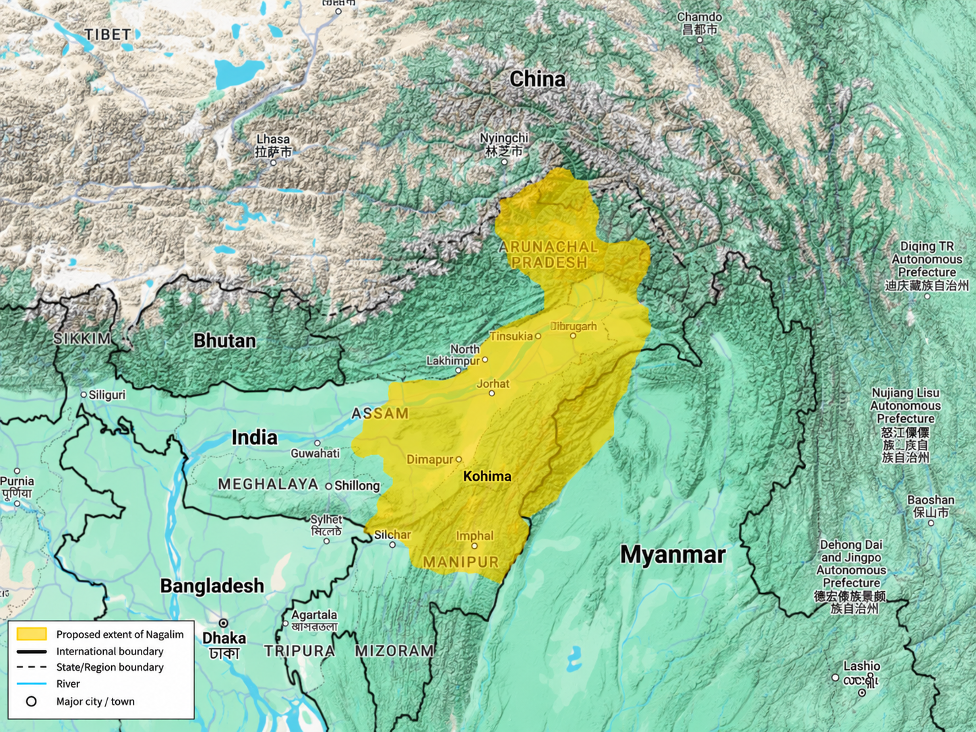
Map of the Proposed Extent of Nagalim (Source: adapted from the Unrepresented Nations and Peoples Organization)
Several Naga armed organisations are currently reported to be active in the Naga SAZ inside Myanmar, including
- NSCN-K-YA (Yung Aung)
- NSCN-K-AM (Ang Mai)
- NSCN-IM (Isak-Muivah)
- NSCN-IM (Eastern Flank)
- Naga People’s Defence Force (Naga PDF)
- Eastern Naga Defence Army (ENDA)
In addition to Naga armed organisations, armed groups associated with Meitei and Assamese insurgent movements have reportedly maintained a presence in Myanmar’s Naga-inhabited borderlands, which have served as bases for several Indian insurgent groups (The Irrawaddy, 2024). The operational alignments of these organisations vary. NSCN-K-AM and NSCN-IM (Eastern Flank) have reportedly conducted coordinated operations alongside the Myanmar military, whereas the Naga PDF and ENDA have reportedly carried out offensive operations against it (International Institute for Strategic Studies, 2021; KaPhe’ (In Burmese, ‘ကဖေး’), 2025). Since the 2021 military coup, three clashes have reportedly occurred among NSCN factions, reflecting continuing divisions and competition within the Naga armed movement (Mizzima, 2026a).
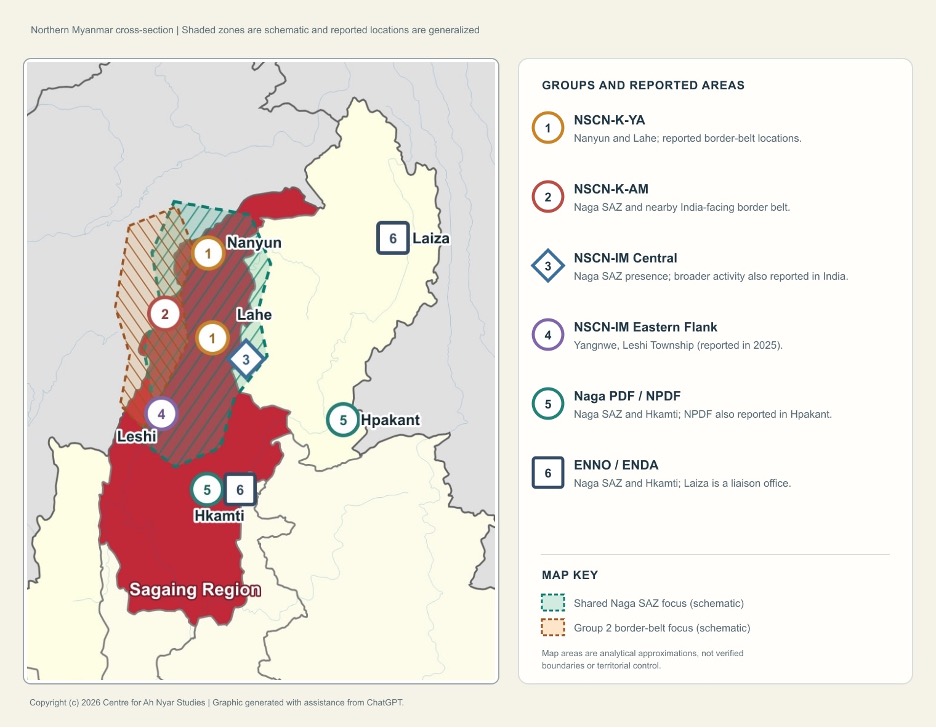
Reported Activity Areas Map of Naga Armed Organisations (Source: Centre for Ah Nyar Studies)
1. National Socialist Council of Nagaland–Khaplang (Yung Aung) [NSCN-K-YA]
The group is a Naga armed organisation led by Yung Aung and primarily based in Myanmar’s Naga SAZ. Its reported areas of operation include the Naga SAZ and territories along the India–Myanmar border. Sources estimate that the faction had approximately 400–500 cadres, although its current strength remains unclear (Hasnat, 2024). The organisation has continued its armed campaign for Naga self-determination and does not participate in India’s ceasefire arrangements. It has also been reported to maintain links with other armed organisations in Northeast India, including the United Liberation Front of Asom–Independent (ULFA-I) and Manipur’s People’s Liberation Army (PLA) (Hasnat, 2024; Ministry of Home Affairs, Government of India, 2020).
The faction has also reportedly been targeted in cross-border military operations. On 13 July 2025, the Indian military was accused of conducting drone strikes against armed-group camps in Nanyun and Lahe townships, Sagaing Region, targeting NSCN-K-YA and ULFA-I positions (The Irrawaddy, 2025). On 20 October 2025, another reported drone strike targeted an NSCN-K-YA base in Lahe Township. According to Myanmar Now (2025), the attack struck Karm Way Lawri village and killed two people, including the 27-year-old son of an NSCN-K leader and an eight-year-old child. These incidents have raised concerns about the effects of cross-border military operations on communities living in the Naga SAZ.
2. National Socialist Council of Nagaland–Khaplang (Ang Mai) [NSCN-K-AM]
In January 2019, the Myanmar military seized NSCN-K’s headquarters in Taga village, Nanyun Township, amid allegations that the group supported Assamese and Meitei armed organisations opposing the Indian government (EastMojo, 2019; The Irrawaddy, 2019). On 6 November 2019, 11 NSCN-K members, including Ang Mai, were reportedly sentenced to two years’ imprisonment under Section 17(1) of Myanmar’s Unlawful Associations Act (Southeast Asia Journal, 2019). Colonel Than Naing, spokesperson for the Myanmar military’s Northwest Regional Command (Radio Free Asia, 2019), stated that
“It is a violation of the terms of the preliminary peace agreement reached with the regional government. The main reason is that they have been engaged in military cooperation with Assamese and Meitei armed groups that oppose India. Since this constitutes a breach of those terms, action has been taken against them.”
Reports stated that Myanmar authorities stated that instructed the group to dismantle its bases and continue negotiations within the framework of the Nationwide Ceasefire Agreement (Mizzima, 2019). These events preceded the formation of NSCN-K-AM in 2023. The NSCN-K-AM is a splinter faction of NSCN-K led by retired Major General Ang Mai. The group separated from the Yung Aung-led NSCN-K faction on 2 July 2023 (CNI, 2025c). It operates primarily in Myanmar’s Naga SAZ and neighbouring areas along the India –Myanmar border. Its reported strength remains uncertain, although analysts estimate that the faction had more than 100 fighters in 2024 (Hasnat, 2024).
NSCN-K-AM has sought to strengthen its position in the Naga region while managing relations with other armed organisations and pursuing negotiations with authorities in Myanmar and India. In February 2025, the group reported that it had sent a letter to the Kachin Independence Army (KIA), asking it not to enter or interfere in the Naga SAZ. According to CNI News, the faction’s peace committee chairman, U Chin Aung, stated that the group was seeking to maintain regional peace and stability while engaging in discussions with both the Myanmar military and the Indian government (CNI, 2025b).
The faction has also pursued parallel ceasefire initiatives. On 9 February 2025, The Morung Express reported that NSCN-K (Ang Mai) had entered what it described as a bilateral ceasefire process with the Government of India. According to a statement issued by the faction’s Ministry of Information and Publicity, the initiative aimed to create conditions for dialogue and advance the resolution of the Indo-Naga-Myanmar political issue (The Morung Express, 2025). Separately, CNI News reported that NSCN-K-AM had held meetings with Myanmar military representatives during 2024 and subsequently discussed a preliminary bilateral ceasefire agreement with the Sagaing Region government. The group indicated that it intended to retain its identity as a Naga armed organisation rather than transform into a militia or Border Guard Force. As of 5 May 2025, the proposed regional ceasefire had not been formally signed (CNI, 2025a).
Engagement with Myanmar’s military authorities continued in 2026. Myanmar’s Ministry of Information reported that the National Solidarity and Peacemaking Negotiation Committee (NSPNC) met a delegation from NSCN-K-AM in Nay Pyi Taw to discuss regional stability, socioeconomic development and long-term peacebuilding in the Naga region. The meeting also addressed potential ceasefire arrangements, liaison offices, future high-level talks and coordination with government departments (Ministry of Information, Naypyitaw, 2026).
3. National Socialist Council of Nagalim–Isak-Muivah (NSCN-IM)
Founded after the split of the mother organisation NSCN in 1988, the NSCN-IM is one of the principal Naga armed and political organisations. Historically led by Isak Chishi Swu and Thuingaleng Muivah, the organisation pursues Naga self-determination and the establishment of Nagalim, combining Naga-inhabited territories. The group primarily operates in the NE region of India, especially in Nagaland. It also maintains a significant presence inside the Naga SAZ of Burma (Singh, 2020).
The NSCN-IM maintains a hierarchical political and military structure under its central leadership, historically headed by Chairman Isak Chisi Swu and General Secretary Thuingaleng Muivah. Its political administration operates through the Government of the People’s Republic of Nagaland (GPRN), comprising nine ministries: four principal ministries responsible for defence, home affairs, finance and foreign affairs, and five others covering education, information and publicity, forests and minerals, law and justice, and religious affairs. Administratively, its areas of influence are divided into 11 regions, extending governance to town and village levels. Its military wing, the Naga Army, reportedly comprises one brigade and six battalions, with an estimated 4,500 personnel, alongside specialised mobile units and local commands (South Asia Terrorism Portal, n.d.-b).
In June 2026, the NSCN-IM Joint Council reaffirmed its collective leadership under Chairman Q. Tuccu, Vice-Chairman Tongmeth Wangnao, General Secretary and Ato Kilonser Th. Muivah, and Deputy Ato Kilonser V. S. Atem (Morung Express, 2026b). However, in July 2026, the Eastern Flank declared a provisional government under Ikato I. Chishi Swu, indicating significant internal divisions over leadership and the organisation’s political direction (NE NOW NEWS, 2026). On 3 August 2015, the Government of India and the NSCN signed the Framework Agreement to establish a basis for further negotiations towards a political settlement (Press Information Bureau, Government of India, 2015a). NSCN-IM’s published version refers to sharing sovereign power through negotiated competencies and an “enduring inclusive new relationship of peaceful co-existence of the two entities” (Singh, 2020). The organisation has also demanded recognition of a separate Naga national flag and constitution.
4. National Socialist Council of Nagalim–Isak-Muivah (Eastern Flank)
The Western and Eastern Flanks of the Naga Army were split in September 2019 with the aim of strengthening its military capacity amid pressure from the Government of India (GoI) to conclude negotiations without a separate Naga flag and constitution. The Eastern Flank later criticised the NSCN-IM’s central leadership for failing to take necessary political action during this period. According to a 2025 report, the group is operating in Yangnwe Village in Leshi Township.
Former leader Lt. Gen. (Retd.) H.S. Ramsan has had a complex relationship with India and other armed actors in Myanmar. A local news outlet covering the NE region of India claims that Ramsan was on a “most wanted list” by Indian authorities and to have operated in Myanmar after leaving India (Mirror Desk, 2026). In 2022, his faction reportedly cooperated with the Myanmar military in operations against resistance forces in Homalin and Tamu townships (KaPhe’ (In Burmese, ‘ကဖေး’), 2025). On 13 January 2025, a letter attributed to Lt. Gen. (Retd.) H. S. Ramsan, commander of the Eastern Flank, NSCN-IM Naga Army, expressed the faction’s willingness to cooperate with National Unity Government (NUG) Prime Minister Mahn Win Khaing Than and support the struggle against Myanmar’s military junta (Naga Voice – နာဂအသံ, 2025). However, the letter’s authenticity could not be independently verified, and no official NUG response was identified in the sources reviewed.
In April 2025, Ikato I. Chishi Swu, son of the late NSCN-IM co-founder Isak Chishi Swu, reportedly broke with the organisation’s central leadership amid growing internal tensions (Manipur Update, 2025a). The split became more explicit in July 2026, when the Eastern Flank appointed Ikato as chairman of a nine-member team tasked with forming a provisional government following a meeting, which the group named the “Extraordinary Joint Emergency Meeting” at Mt. Horeb Camp in Myanmar’s Sagaing Region (Morung Express, 2026c). The meeting was chaired by Lt Gen (Retd) Hs Ramsan. The meeting formed the “Provisional Government” in the following structure.
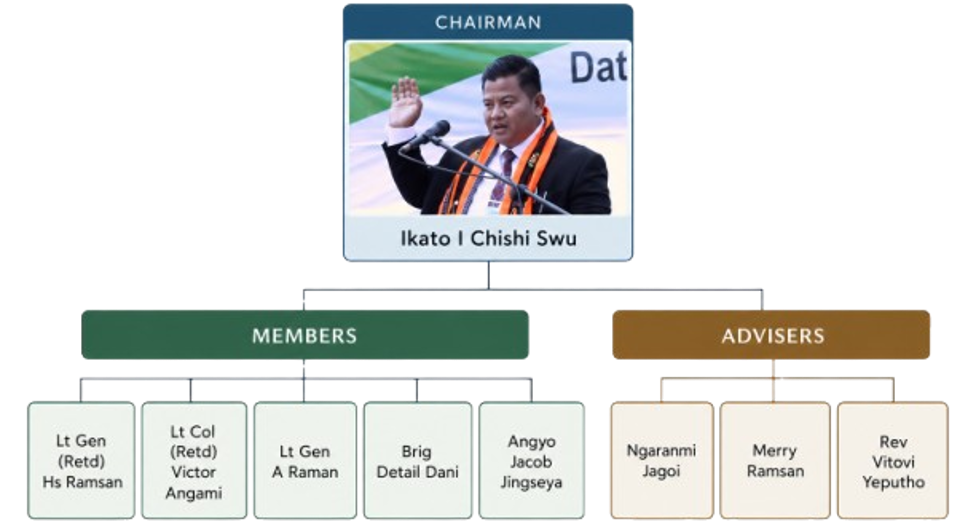
Organisational structure of the Provisional Government of NSCN-IM Eastern Flank (Source: Design created based on information from Morung Express)
The faction declared that the spirit of the 1997 ceasefire agreement with the Government of India had “ceased to exist” and criticised the central leadership for allegedly compromising the Naga political position in negotiations (Eastern Mirror News, 2026; NE NOW NEWS, 2026). Both the NSCN-IM (Eastern Flank) and the NSCN-K-YA use the name Government of the People’s Republic of Nagalim (GPRN) for their administrative structures, although they use different logos to represent their respective organisations.
Alongside these political developments, the security dynamics surrounding the Eastern Flank, particularly the reported attack on its Mt. Horeb Camp, provide important context for understanding the faction’s evolving position. On 7 October 2026, India and Myanmar held their third Defence Cooperation Meeting in Guwahati, reviewing existing defence initiatives and discussing further cooperation in training, capacity-building and mutual security (The Economic Times, 2026). Four days later, the Eastern Flank alleged that drones had dropped approximately 60 bombs on Mt. Horeb Camp, damaging parts of the site. Although the faction initially reported no casualties, subsequent reporting indicated that three cadres were injured. The perpetrators have not been independently confirmed (Ukhrul Times, 2026; Rural Post, 2026).
5. Naga People’s Defence Force (Naga PDF) and PaKaPha
Naga PDF was formed on 20 June 2021 by the young people of Naga in collaboration with Shan, Chin and Bamar communities in response to Myanmar’s military coup (NPDF, n.d.). It is reported to operate as the No. 1 Battalion of Naga District under the NUG Ministry of Defence. In a March 2024 interview with Kachin News Group, NPDF official Bo Lin Yone stated that the force was fighting for federalism, equality and individual rights and had maintained an alliance with the Kachin Independence Organisation/Army (KIO/KIA) since December 2022. The group also participated alongside the KIA in fighting around Selzin. More recently, CNI Myanmar reported the opening of basic military training in the Naga region. Naga PDF operates alongside Naga People Defence Organisations (locally known as PaKaPha) of the NUG. PaKaPha are also active across townships within Naga SAZ (The Voice of Spring, 2026). Naga PDF is reportedly active in Hkamti Township in Sagaing Region and Hpakant Township in Kachin State.
6. Eastern Naga National Organisation (ENNO)/Eastern Naga Defence Army (ENDA)
The ENDA is the armed wing of ENNO. According to its General Secretary Eno Jimi Naga, the group was established on 4 November 2021 in response to the military coup in 2021 (Kachin News Group, 2023). ISP Myanmar Peace Desk claims that ENDA is a rebranded entity resulting from a joint initiative between former NSCN-K officials and Naga legislators from the NLD (ISP Myanmar Peace Desk, 2024). However, individuals close to ENNO reportedly stated that most of the NLD legislators subsequently ceased participating in the organisation (CNI, 2025d). The organisation’s political and military structures are commonly referred to in its public statements as the ENNO/ENDA Government (Eastern Naga Defence Army, 2023b).
The organisation was established under the leadership of R. S. Awng Sai, a former lieutenant colonel in the NSCN-K who was reportedly dismissed from that organisation. He was among the group of eleven NSCN-K officials who were imprisoned in 2019 under Section 17(1) of the Unlawful Association Act in Burma (Wai Mar Tun, 2019). Within ENDA, he is identified as a lieutenant general and serves as the force’s leader (Eastern Naga Defence Army, 2024). An ENDA statement dated 30 March 2023 reportedly confirmed that the organisation held a ceremony to arm its first batch of trained recruits in 2022 (Eastern Naga Defence Army, 2023a). The organisation is run by a central committee with departments operating under it. The reported officeholders include Eno Jimi Naga as General Secretary and San Waung Moses as the person responsible for media and information. The organisation has also established a central liaison office in Laiza, Kachin State, and reportedly receives weapons and ammunition support from the KIA. Its principal areas of operation include Hkamti Township and the Naga SAZ, where it has reportedly conducted operations against Myanmar’s military alongside the KIA and other resistance forces. Its current territorial reach and operational capacity, however, remain difficult to establish independently.
Beyond its military activities, ENNO/ENDA has articulated a political programme centred on ending military dictatorship, protecting ethnic rights and establishing a federal union. In February 2025, the organisation announced that it had prepared, since December 2023, the Interim Political Arrangement of Nagaland, a proposed framework to guide interim political arrangements in the eastern Naga region (Eastern Naga Defence Army, 2025). The arrangement was prepared within a month of the parliaments of Sagaing, Magway and Mandalay federal units enacting laws to establish interim political arrangements in their respective territories in late November 2023. Nevertheless, the content of the proposed framework and the extent of its implementation remain unclear, as ENNO/ENDA has not yet publicly released the document.
Border Dynamics and Naga Armed Groups
India’s plan to fence its 1,643-kilometre border with Myanmar has raised concerns among Naga communities whose social, cultural and economic ties span the border (Choudhury, 2024; Mohta, 2025). The Indian government cites security concerns, including insurgency and drug trafficking, while restrictions on the Free Movement Regime (FMR) have prompted opposition from Naga organisations (Press Information Bureau, 2024; The New Indian Express, 2025). On 26 August 2025, eleven representatives of the United Naga Council (UNC), the Naga Women’s Union (NWU) and the All Naga Students’ Association Manipur (ANSAM) met Indian central government officials in New Delhi to discuss border fencing and the Free Movement Regime (FMR). The talks ended without agreement, as the Naga delegation called for the restoration of the FMR and a halt to border fencing (The New Indian Express, 2025; IANS, 2025). No information on the participation of Myanmar-based Naga groups was found. At the Pansaung–Nampong crossing, which connects Nanyun Township of Naga SAZ with Arunachal Pradesh of India, the border market reopened on 30 July 2026 after more than six years of closure due to the COVID-19 pandemic and the military coup. Cross-border movement, however, remains restricted, with only 30 people per day permitted to enter India for shopping and visits (Mizzima, 2026b). Border fencing has also prompted opposition from Myanmar-based Naga organisations, which argue that it threatens Indigenous land rights and divides communities (Mizzima, 2025).
On 26 March 2026, the NSCN-K-YA claimed responsibility for an attack on a 10th Assam Rifles construction team reportedly engaged in border-fencing work along the Namgoi–Pansaung Road near Pansaung Pass, Arunachal Pradesh. The group claimed that three personnel were killed. However, Indian security officials disputed the reported fatalities, stating that one Assam Rifles personnel was injured and that no deaths had been confirmed (Ajum, 2026; B. Singh, 2026; Nagaland Post, 2026). The GoI signed the Framework Agreement with the NSCN-IM on 3 August 2015. In contrast, on 16 September 2015, the Indian government declared the NSCN-K an unlawful organisation for five years, citing its continued attacks on Indian security personnel from bases in Myanmar (Press Information Bureau, Government of India, 2015a, 2015b). Its faction – NSCN-K (AM), however, has reportedly pursued peace negotiations with both the Myanmar military regime and the GoI (CNI, 2026b; Kalita, 2026). By contrast, no comparable public reporting confirms that the NSCN-IM (Eastern Flank), the ENNO/ENDA, or the Naga PDF has participated in these formal peace talks. With that said, it should also be noted that India maintains security and defence cooperation with Myanmar’s military regime, particularly on border security and counterinsurgency. This cooperation could affect Myanmar-based Naga armed groups’ freedom of movement and cross-border operations, depending on its implementation.
Beyond border security, access to critical minerals is another important dimension of India’s strategic interests and its relations with armed actors along the border. India seeks to diversify its rare-earth supply chains and reduce dependence on China, which dominates global rare-earth processing. In this context, Kachin State’s rare-earth deposits could offer potential opportunities for India, particularly as the KIO/KIA exercises greater control over key mining areas, including Chipwi and Pangwa. The KIO/KIA influence over mining operations, taxation and exports could therefore have implications for future regional trade and India’s access to these resources. However, Myanmar’s rare-earth exports remain heavily oriented towards China, while alternative routes to India face logistical and security challenges (Banerjee, 2026; ISP-Myanmar, 2025). Although potential trade with India could diversify the KIO/KIA’s export markets and strengthen its financial position, no confirmed supply agreement has been established. India’s interests in border security and critical minerals thus illustrate two distinct but potentially interconnected dimensions of its engagement with Myanmar, with possible implications for armed groups’ economic resources and regional influence.
Political Parties in Naga SAZ
In the 2020 general election, the principal parties competing in Naga SAZ were;
- National League for Democracy (NLD),
- Union Solidarity and Development Party (USDP) and
- Naga National Party (NNP).
The Union Betterment Party (UBP) also fielded candidates, which later dissolved itself by its founding chairman, U Shwe Man after the military coup in 2021. In the 2020 general election, each township of Naga SAZ (Lahe, Leshi and Nanyun) had one Pyithu Hluttaw (House of Representatives) constituency, for a total of three constituencies. In the Sagaing Region Hluttaw, each township was divided into two constituencies, for a total of six. It also includes Sagaing Region Constituency No. 12 for the Amyotha Hluttaw (House of Nationalities).
The NLD won seven of the nine township-based constituencies examined in the Pyithu Hluttaw and Sagaing Region Hluttaw, while the USDP won two. In the Pyithu Hluttaw, the NLD won in Leshi and Nanyun, while the USDP won in Lahe. In the Sagaing Region Hluttaw, the NLD secured both seats in Leshi and Nanyun, as well as one seat in Lahe. The USDP won the remaining seat in Lahe Township. NLD won Sagaing Region Constituency No. 12 for the Amyotha Hluttaw. These results indicate that the NLD secured most of the seats across the township-based constituencies covered by the report, while the USDP retained representation in Lahe.
The NNP contested constituencies across all three townships and both legislatures but did not win any of the nine township-based seats examined. Nevertheless, its candidates received notable shares of the vote. In the Pyithu Hluttaw, the NNP received between 18.55 and 22.62 per cent of the vote across the three townships. In the Sagaing Region Hluttaw, its candidates received between 14.80 and 24.63 per cent across the six constituencies. After the 2021 coup and military crackdown on political parties, the NNP re-registered and later contested the junta-orchestrated 2025 election.
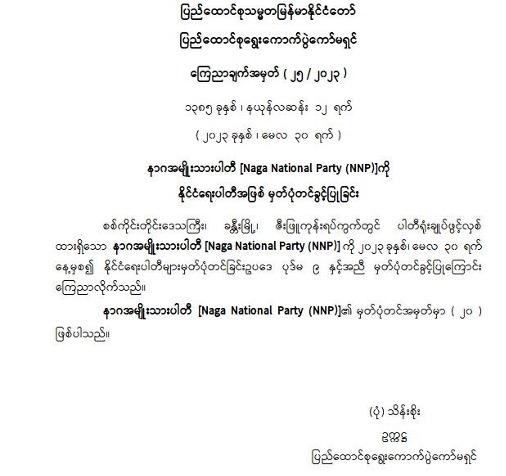
Junta-appointed Union Election Commission approved NNP registration on 30 May 2023 (Source: Ministry of Information, Naypyitaw, 2023)
The table summarises the election results in 2020.
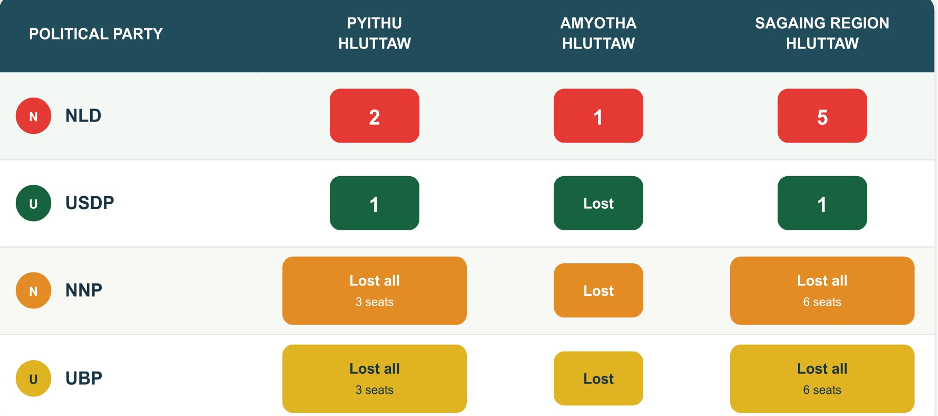
Election Results in the 2020 General Elections (Source: Committee Representing Pyidaungsu Hluttaw, National Unity Government of Myanmar, 2024)
Naga SAZ and KIO/KIA
The historical relationship between the KIA and Naga armed movements has been influenced by the shifting strategic interests of China, India and Myanmar. From 1966, the KIA facilitated Naga fighters’ journeys to China, where they received military training and weapons, and later provided some Naga armed groups with bases, training and arms. However, between 1990 and 1992, India’s intelligence agency reportedly supplied weapons to the KIA in exchange for its commitment to cease providing bases, weapons and training to Naga and other northeastern Indian armed groups. Following the KIA’s ceasefire with Myanmar’s military government in 1994, its support for these groups reportedly declined further (Bhaumik, 2009). More recently, the KIA has supported Naga resistance forces operating in Kachin State and Sagaing Region. The NPDF, formed in 2021, has conducted military activities in alliance with the KIA since 2022 (Kachin News Group, 2023).
Tensions over territorial authority became more explicit in February 2025, when the NSCN-K (AM) reportedly asked the KIA not to enter or interfere in the Naga SAZ. The faction argued that it was seeking to maintain regional stability while pursuing peace negotiations. These tensions were further highlighted in July 2025, when the Naga Students’ Organisation in Lahe demanded the release of 16 NSCN-K (YA) members reportedly captured by the KIA (Manipur Update, 2025b). In February 2026, the dispute intensified after KIA leader Lieutenant-General Gun Maw referred to a proposed “Naga Unit” as part of a wider strategy involving Kachin, Chin and other areas of Sagaing Region. The NSCN-K (AM) rejected the “Naga Unit” designation, arguing that the Naga struggle remains focused on achieving independence. It also expressed concerns about ethnocentrism and stressed that the Nagas and Kachins have historically lived together as brothers (CNI, 2026a). The proposed “Naga Unit” could therefore intensify disputes over territorial control and political representation by raising questions about who has the authority to govern Naga areas in Myanmar and represent Naga political aspirations. It could also deepen tensions between the NSCN-K (AM) and the KIO/KIA over political autonomy, ethnic identity and the future of Naga–Kachin relations.
Naga SAZ and Sagaing Federal Unit
Under the 2025 Constitution, the Sagaing Federal Unit Government was formed in late 2025, with legislative, executive and judicial powers established as separate branches of government (Section 6). Section 7 further provides for the sharing of powers among the Federal Unit Government, the Naga SAZ Government and local governments. However, the territorial boundaries of Sagaing remain unchanged from those in place at the time of the 2020 General Election, as defined under the 2008 Constitution of Myanmar (Section 44). Accordingly, the three townships comprising the Naga SAZ – Leshi, Lahe and Nanyun – retain their existing territorial boundaries (Section 46). In addition, Section 47 constitutionalises the right of indigenous peoples in Sagaing to self-determination, including through self-administered zones, subject to two conditions: territorial contiguity and conformity with future political agreements on state-building.
The extent of the Naga SAZ’s autonomy is further defined by its relationship with the legislative institutions of Sagaing. Under Section 59(b), the SAZ may draft bills, but these must be submitted to the Sagaing Federal Unit Parliament for consideration and passage in accordance with the Parliament’s rules and procedures. This arrangement allows the Naga SAZ to initiate legislation while retaining the Federal Unit Parliament’s authority over its formal enactment. Legislative autonomy is therefore exercised within a broader institutional framework in which powers are shared between the SAZ and the Federal Unit.
The Constitution also establishes a framework for forming the Naga SAZ’s Interim Government, linking its composition to both political representation and the 2020 electoral mandate. The government is to comprise seven members, including a Chief Administrator and a Deputy Chief Administrator (Section 86). Section 87 identifies six categories of eligible participants in its formation:
- Sagaing Federal Unit Hluttaw representatives elected in the 2020 multi-party general election who do not cooperate with the terrorist coup regime.
- Representatives of political parties.
- Representatives of ethnic groups.
- Civil servants participating in the Civil Disobedience Movement (CDM).
- Members of the Strike Forces.
- Other relevant individuals.
Although this framework provides for participation by a range of political and social actors, Section 88 assigns a decisive role in selecting the seven-member government to eligible Hluttaw representatives elected in 2020 from the Naga SAZ who do not cooperate with the military junta. The arrangement thus combines broader participation in government formation with an electoral basis for executive selection. Regarding the judiciary, the Sagaing Federal Unit Constitution recognises the Naga SAZ’s authority to establish its own courts (Section 123(b)). It also permits the application of customary legal practices, provided that they do not contradict international human rights standards (Section 135).
To our observation, the Sagaing Federal Unit has not established administrative or judicial authorities for the Naga SAZ since its formation in late 2025. One possible explanation is that Sagaing’s political leadership is adopting a cautious and conflict-sensitive approach to the Naga SAZ, particularly in light of the KIO’s position on the proposed Naga Federal Unit and the 3K area (Kantbalu, Kathar and Kawlin). The political position of the KIO-trained ENDA is another factor that may shape this relationship. ENDA has stated that it has established its own interim political arrangement (Eastern Naga Defence Army, 2025), alongside the interim constitutional framework of Sagaing Federal Unit. This raises questions about whether ENDA intends to operate within Sagaing’s emerging political structure or pursue a separate interim arrangement.
The role of Naga elected Members of Parliament in shaping this relationship also remains unclear. Eight representatives from the NLD were elected in the Naga SAZ in the 2020 general election and secured seats in the Union and regional parliaments. Their engagement with the emerging institutions of Sagaing Federal Unit, however, has yet to be clarified. This is politically significant because, under the interim constitutional framework, they may hold substantial influence over decisions concerning the Naga SAZ’s institutional status and the exercise of its autonomy. Their participation, or lack thereof, could therefore affect the formation of the SAZ’s administrative and judicial authorities, as well as the broader relationship between Naga SAZ and Sagaing Federal Unit.
Political Authority, Representation and the Future
Competing sources of authority, political representation and different ambitions for self-determination shape the Naga SAZ’s political landscape today. Currently, elected representatives, established armed and political organisations, and emerging groups derive their political mandates through different pathways. However, they do not necessarily share a common vision of governance. The Naga SAZ, also commonly referred to as the eastern flank in Naga political discourse, represents only a small part of the broader Naga vision held by many armed and political groups. India, or New Delhi, remains a critical factor in understanding the Naga issue as a whole. In that sense, the Naga SAZ is a geopolitical nexus between the two countries – India and Burma (Myanmar). There is, however, no clearly established mechanism through which these actors can reconcile their political objectives and determine the future of the Naga people or the Naga SAZ.
With the emergence of federal units, particularly Sagaing, new questions arise. Would the Sagaing Federal Unit offer a solution, or a political pathway towards a solution, to the existing complexities within the Naga SAZ? With this in mind, it is vitally important to understand that the current arrangements within the federal units in central Burma (better known locally as Ah Nyar) are temporary; they are not yet transitional. Although the interim constitutional (or political) arrangements may be complex in their language and interpretation, the immediate objective of these emerging federal units, including Sagaing, can generally be summarised as consolidating sub-national governance and political groupings. Constitutionally, the Sagaing Federal Unit is notably cautious in its approach to ethnic minority issues, including those concerning the Naga people or the Naga SAZ. It retains the existing territorial boundaries (as of 2020, before the military coup). At the same time, Sagaing is constitutionally committed to the right to self-determination, particularly for ethnic minorities. It is important to note here that successive governments of Burma (Myanmar) have been relatively cautious and silent on this particular right within the international legal framework, given the decades-long ethnic liberation movement. When the NLD administration ratified the United Nations’ International Covenant on Economic, Social and Cultural Rights, it reserved its position on Article (1) of the Covenant concerning the right to self-determination. This, however, was not unique to the NLD administration. This constitutional commitment marks a politically significant departure from the historical caution of successive governments towards the right to self-determination. However, this alone is not a remedy for the protracted identity conflicts and liberation struggles within the Naga community or the Naga SAZ. Therefore, how the Sagaing Federal Unit brings actors on the ground into its political process becomes important.
The eight NLD representatives elected from Naga SAZ constituencies in the 2020 general election retain a potentially significant electoral mandate, although their current engagement in the evolving political landscape remains unclear. The Naga PDF and township-based PaKaPha (People’s Defence Teams) operate under the authority of the NUG Ministry of Defence through Regional Command 1. Their role in supporting the five representative blocs of the Sagaing Federal Unit to establish sub-national governance in the Naga SAZ remains an open question. This process is further complicated by the ongoing transition of NUG mechanisms, including healthcare, education and administration, to the emerging federal units in Sagaing and Magway. Moreover, Regional Command 1, led by a KIA-appointed regional commander, may have limited incentives to facilitate this process, particularly if it conflicts with the KIO/KIA’s political interests in the Naga region.
Meanwhile, ENNO/ENDA’s interim political arrangement and the distinct political objectives of Naga armed organisations indicate that political institution-building is proceeding through multiple channels. This creates a potential divergence between electoral representation, armed influence and emerging institutional authority. Without mechanisms to connect these sources of legitimacy, competing political arrangements may reinforce fragmentation rather than produce a broadly accepted framework for self-governance.
Regional relationships further complicate this process. The KIO/KIA’s proposed “Naga Unit” has exposed disagreements over territorial authority and the political future of Naga-inhabited areas. The NNP’s move towards participation in the junta-orchestrated 2025 elections adds another dimension to the existing complexities within the Naga SAZ. The NNP did not secure any seats in the Naga SAZ constituencies in the 2020 general election. Among the four parties in the Naga SAZ, the NLD and UBP abandoned their previous political pathways by moving away from the military junta, while the NNP chose a different course by participating in the junta-orchestrated elections.
The future political trajectory of the Naga SAZ will therefore depend on whether its diverse actors can translate their respective sources of influence into an agreed framework for representation and governance. Without such an agreement, parallel institutional initiatives and competing claims to authority may persist, limiting political coordination and weakening the legitimacy of emerging governance structures.
Conclusion
The Naga political landscape constitutes a complex intersection of armed competition, political fragmentation and competing approaches to self-determination. Although six Naga armed organisations are identified in this analysis, their strategic alignments and relationships with the Myanmar military, resistance forces and the KIO/KIA differ significantly. Cooperation on the battlefield does not necessarily translate into political unity, as these organisations maintain distinct interests and positions regarding territorial authority and the future political status of the Naga region or the Naga SAZ. Similar divisions characterise Naga political parties and organisations. The NNP participation in the junta-orchestrated elections in 2025, alongside ENNO/ENDA’s pursuit of an interim political arrangement, illustrates divergent approaches to political engagement, representation and institution-building.
These intra-Naga dynamics are further complicated by regional political differences, particularly over the relationship between the Naga SAZ, Sagaing Federal Unit and the KIO/KIA. Disagreements over territorial jurisdiction, political representation and the proposed Naga Unit introduce another dimension to an already fragmented political landscape.
Geopolitically, the Naga SAZ occupies a distinctive position between India and Myanmar. Although it remains a peripheral territory that successive governments in Myanmar have historically given limited attention, it carries broader security and political significance for New Delhi and India’s northeastern states. Despite their differences, Naga armed and political actors share a recurring aspiration for a distinct political status, sometimes expressed through the vision of a Government of the People’s Republic of Nagalim, extending Naga-inhabited areas across northeastern India and Myanmar. The central question is whether this shared aspiration can bridge organisational divisions and competing regional or international interests to produce a coherent political project.
References
Ajum, B. (2026, March 27). Firing along Indo-Myanmar border in Changlang, NSCN-YA claims responsibility. Arunachal Times. https://www.arunachaltimes.in/article/firing-along-indo-myanmar-border-in-changlang-nscn-ya-claims-responsibility?
Aung Naing. (2025, October 27). India launches cross-border drone strike on Myanmar village, killing child and separatist commander’s son. Myanmar Now. https://myanmar-now.org/en/news/india-launches-cross-border-drone-strike-on-myanmar-village-killing-child-and-separatist-commanders-son/
Banerjee, S. (2026, June 4). Exploring Myanmar’s role in India’s rare-earth elements security. Observer Research Foundation ( ORF ). https://www.orfonline.org/research/exploring-myanmar-s-role-in-india-s-rare-earth-elements-security
Bhaumik, S. (2009). Troubled Periphery: Crisis of India’s North East (pp. 174–177). SAGE Publications India Pvt Ltd.
Centre for Ah Nyar Studies. (2026, June 30). What is happening in Ah Nyar? June, 2026 [issue 6/2026]. Centre for Ah Nyar Studies. https://ah-nyarstudies.org/what-is-happening-in-ah-nyar-june-2026-issue-6-2026/
Choudhury, A. (2024, March). Walls in the era of bridges: The many costs of fencing the India-Myanmar border. Centre of Excellence for Himalayan Studies, Shiv Nadar University. https://snu.edu.in/centres/centre-of-excellence-for-himalayan-studies/research/walls-in-the-era-of-bridges-the-many-costs-of-fencing-the-india-myanmar-border/
CNI. (2025a). NSCN-K says it plans to sign ceasefire. CNI Myanmar. https://cnimyanmar.com/index.php/english-edition/28858-nscn-k-says-it-plans-to-sign-ceasefire
CNI. (2025b). NSCN-K/am says it has told KIA not to disturb naga region. CNI Myanmar. https://cnimyanmar.com/index.php/english-edition/27484-nscn-k-am-says-it-has-told-kia-not-to-disturb-naga-region
CNI. (2025c). NSCN-K/am says to not conduct forced military recruitment in the naga region. CNI Myanmar. https://cnimyanmar.com/index.php/english-edition/27264-nscn-k-am-says-to-not-conduct-forced-military-recruitment-in-the-naga-region
CNI. (2025d, August 4). ENNO says it recruits in Shin Bwe Yang Township. CNI Myanmar. https://cnimyanmar.com/index.php/english-edition/30616-enno-says-it-recruits-in-shin-bwe-yang-township
CNI. (2026a, February 27). NSCN rejects KiA’s ‘naga unit,’ citing chauvinism. CNI Myanmar. https://cnimyanmar.com/index.php/english-edition/34784-nscn-rejects-kia-s-naga-unit-citing-chauvinism?
CNI. (2026b, May 16). NSCN-K/AM expresses desire to discuss stability in naga region. CNI Myanmar. https://cnimyanmar.com/index.php/english-edition/36261-nscn-k-am-expresses-desire-to-discuss-stability-in-naga-region?
Committee Representing Pyidaungsu Hluttaw, National Unity Government of Myanmar. (2024, November 27). History and formation – ပြည်ထောင်စုသမ္မတမြန်မာနိုင်ငံတော်. Committee Representing Pyidaungsu Hluttaw, National Unity Government of Myanmar. https://crphmyanmar.org/history-and-formation-of-crph/
Constitution of the Republic of the Union of Myanmar (2008) (2008). https://www.burmalibrary.org/sites/burmalibrary.org/files/obl/docs5/Myanmar_Constitution-2008-en.pdf
Dahiya, R. (2015). Ensuring peace in the northeast. Institute for Defence Studies and Analyses (IDSA). https://www.files.ethz.ch/isn/191563/PB_peaceinnortheast_rdahiya.pdf
Eastern Mirror News. (2026, July 23). NSCN (IM) eastern flank forms ‘provisional government’, name. Eastern Mirror Nagaland. https://www.easternmirrornagaland.com/nscn-im-eastern-flank-forms-provisional-government-names-ikato-chishi-swu-chairman
Updated on 31 August 2026.
Eastern Naga Defence Army. (2023a, March 30). News Release from ENDA Official Media Outlet. Mobile 1 – ENDA. https://www.facebook.com/share/p/1NCVTusdw8/
Eastern Naga Defence Army. (2023b, December 22). Statement regarding Naga Traditional New Year Celebration (Letter number 02/2023; dated on 21 December 2023). Mobile 1 – ENDA. https://www.facebook.com/share/p/18QoFQzkZy/
Eastern Naga Defence Army. (2024, January 30). Official Statement (Letter number 1/2024; dated on 29 January 2024). Mobile 1 – ENDA. https://www.facebook.com/share/p/1KkFJf3rJt/
Eastern Naga Defence Army. (2025, February 20). Press Release (Letter number 01/2025; dated on 20 February 2025). Mobile 1 – ENDA. https://www.facebook.com/share/p/19URSUT78b/
EastMojo. (2019, February 4). Myanmarese Army launches offensive against ULFA-I in Sagaing. EastMojo News Bureau. https://eastmojo.com/news/2019/02/04/myanmarese-army-launches-offensive-against-ulfa-i-in-sagaing/
Hasnat, K. (2024, October 14). ‘Uneasy peace’ between NSCN-K factions in Myanmar, Indian Naga leaders dismiss concerns. theprint. ThePrint. https://theprint.in/india/uneasy-peace-between-nscn-k-factions-in-myanmar-indian-naga-leaders-dismiss-concerns/2310112/
Htar, L., Thitsar, M. T., & Kyed, H. M. (2020). Why is Customary Law so strong? Political recognition and justice practices in the Naga Self-Administered Zone [Research Report]. Danish Institute for International Studies. https://pure.diis.dk/ws/files/3689064/Kap_3_fra_Kyed_final_book.pdf
IANS. (2025, August 26). Manipur Naga bodies meet MHA officials, oppose scrapping of old FMR, India-Myanmar border fencing. Nagaland Tribune. https://nagalandtribune.in/manipur-naga-bodies-meet-mha-officials-oppose-scrapping-of-old-fmr-india-myanmar-border-fencing/
Interim Constitution of the Sagaing Federal Unit, Section 6,7,44,46,47,59(b),86,87,88,123(b),135 (2025).
International Institute for Strategic Studies. (2021). Dashboard – IISS Myanmar conflict map. IISS Myanmar. https://myanmar.iiss.org/
ISP Myanmar Peace Desk. (2024, April 11). Enda – ISP Myanmar Peace desk. ISP Myanmar Peace Desk. https://ispmyanmarpeacedesk.com/eao/enda/
ISP-Myanmar. (2025, September 26). Rare earth export routes in Kachin state. ISP-Myanmar. https://ispmyanmar.com/mp-112/
Kachin News Group. (2023, December 12). နာဂလူမျိုးနဲ့ နာဂပြည်နယ်ကို ကာကွယ်သွားမယ့် Enno/Enda. Kachin News Group (KNG). https://burmese.kachinnews.com/2023/12/12/zm1-137/
Kakati, A. K. (2025). Evading and inviting states in ‘No-Man’s-Lands’: Headhunters in Zomia’s blank spaces (1944–1964). Modern Asian Studies, 59(2), 507–535. https://doi.org/10.1017/s0026749x25000137
Kalita, P. (2026, October 6). After 29 years, naga peace process sees fresh unity bid across India-Myanmar border. The Times of India. https://timesofindia.indiatimes.com/city/guwahati/after-29-years-naga-peace-process-sees-fresh-unity-bid-across-india-myanmar-border/articleshow/134744932.cms
KaPhe’ (In Burmese, ‘ကဖေး’). (2025, January 31). တမူးတိုက်ပွဲ၌ ကသည်းအဖွဲ့ Meitei PLနှင့် နာဂအဖွဲ့ NSCN-IM တို့ကစစ်တပ်ဘက်မှကူတိုက်ပေးနေ. People’s Spring. https://web.facebook.com/share/p/1HkqShvvps/
Khaing, M. (2025, July 15). Indian Army accused of deadly strike on separatists in Myanmar. The Irrawaddy. https://www.irrawaddy.com/news/burma/indian-army-accused-of-deadly-strike-on-separatists-in-myanmar.html
Manipur Update. (2025a, April). NSCN-IM faces internal rebellion as Ikato Swu announces split – Manipur Update. Manipur-Update.Com. https://manipur-update.com/nscn-im-faces-internal-rebellion-as-ikato-swu-announces-split/
Manipur Update. (2025b, July 23). Naga student in Lahe demands release of Naga Army captured by KIA – Manipur Update. Manipur Update. https://manipur-update.com/naga-student-in-lahe-demands-release-of-naga-army-captured-by-kia/
Ministry of Home Affairs, Government of India. (2020, August 18). Order concerning the National Democratic Front of Bodoland (NDFB). Ministry of Home Affairs. https://www.mha.gov.in/sites/default/files/NEDiv_NDFBFinalorder_18082020.pdf
Ministry of Information, Naypyitaw. (2023, May 30). နာဂအမျိုးသားပါတီ [Naga National Party (NNP)] ကို နိုင်ငံရေးပါတီအဖြစ် မှတ်ပုံတင်ခွင့်ပြုခြင်း. Myanmar National Portal. https://myanmar.gov.mm/news-media/news/latest-news/-/asset_publisher/idasset354/content/%25E1%2580%2594%25E1%2580%25AC%25E1%2580%2582%25E1%2580%25A1%25E1%2580%2599%25E1%2580%25BB%25E1%2580%25AD%25E1%2580%25AF%25E1%2580%25B8%25E1%2580%259E%25E1%2580%25AC%25E1%2580%25B8%25E1%2580%2595%25E1%2580%25AB%25E1%2580%2590%25E1%2580%25AE-naga-
Ministry of Information, Naypyitaw. (2026). NSPNC and NSCN-K (AM) meet to strengthen regional stability, development. Ministry of Information, Naypyitaw. http://moi.gov.mm/moi%3Aeng/index.php/news/21712
Mirror Desk. (2026). Leaders of Naga armed groups in India’s ‘most wanted’ list. Eastern Mirror Nagaland. https://www.easternmirrornagaland.com/leaders-of-naga-armed-groups-in-indias-most-wanted-list
Mizzima. (2019). Myanmar army detains NSCN-K leaders. Burma News International. https://www.bnionline.net/en/news/myanmar-army-detains-nscn-k-leaders
Mizzima. (2025, December 8). Naga groups in Myanmar and India unite to oppose border fence. Mizzima News. https://eng.mizzima.com/2025/12/08/28924?
Mizzima. (2026a, January 26). Three clashes in 16 days as Naga factions fight for territory and trade control in Sagaing. Mizzima News. https://eng.mizzima.com/2026/01/26/30638
Mizzima. (2026b, August 6). Only border market reopened in Pansaung, not border gate, says ENWA. Mizzima News. https://eng.mizzima.com/2026/08/06/37132?
Mohta, N. (2025, September 18). The India-Myanmar border: When deep cultural ties are tested and redrawn. The Indian Express. https://indianexpress.com/article/research/the-india-myanmar-border-when-deep-cultural-ties-are-tested-and-redrawn-10256865/
Morung Express. (2026a). Engaging in ceasefire process with government of India: NSCN-K (Ang Mai). Morung Express. https://morungexpress.com/engaging-in-ceasefire-process-with-government-of-india-nscn-k-ang-mai
Morung Express. (2026b). NSCN (IM) Joint Council reaffirms framework agreement, backs collective leadership. Morung Express. https://www.morungexpress.com/nscn-im-joint-council-reaffirms-framework-agreement-backs-collective-leadership
Morung Express. (2026c, July 23). NSCN/GPRN eastern flank: Breakaway NSCN (IM) group declares ‘provisional government’. Morung Express. https://morungexpress.com/nscngprn-eastern-flank-breakaway-nscn-im-group-declares-provisional-government
Naga Voice – နာဂအသံ. (2025, August 3). NUG ဝန်ကြီးချုပ် ဦးမန်းဝင်းခိုင်သန်းအား NUG နှင့် ပူးပေါင်းရန် ပေးပို့သည်စာ [Photo]. Facebook. https://www.facebook.com/share/1Fn7tUT8TB/
Nagaland Post. (2026, March 27). NSCN-K (ya) claims attack on AR in Arunachal. Nagaland Post. https://nagalandpost.com/nscn-k-ya-claims-attack-on-ar-in-arunachal/
Nang, S., & Paddock, R. C. (2016, August 6). Myanmar measles outbreak kills 40 in remote villages. The New York Times. https://www.nytimes.com/2016/08/07/world/asia/myanmar-measles-outbreak-kills-40-in-remote-villages.html
NE NOW NEWS. (2026, July 24). NSCN-IM splits, eastern flank forms provisional government under Ikato Chishi Swu. NorthEast Now. https://nenow.in/top-news/nscn-im-splits-eastern-flank-forms-provisional-government-under-ikato-chishi-swu.html
NPDF. (n.d.). Official Page of NPDF. NPDF – Battalion. Retrieved 12 October 2026, from https://web.facebook.com/profile.php?id=100090719661213
Nyein Nyein. (2019, February 7). NSCN-K denies violating ceasefire. The Irrawaddy. https://www.irrawaddy.com/news/nscn-k-denies-violating-ceasefire.html
Oo, T. M. M. (2023, February 27). နာဂကိုယ်ပိုင်အုပ်ချုပ်ခွင့်ရဒေသ ဖွံ့ဖြိုးတိုးတက်ရေး ကြိုးပမ်းဆောင်ရွက်မှုများ. MDN – Myanmar Digital News. https://mdn.gov.mm/my/naagkiuypiungaupkhupkhngrdes-phnphiuttiuttkre-kiupmcheaangrkmumaa
Press Information Bureau, Government of India. (2015a, August 3). PM witnesses the signing of historic peace accord between Government of India and Nationalist Socialist Council of Nagaland (NSCN). Press Information Bureau. https://www.pib.gov.in/newsite/PrintRelease.aspx?lang=2®=48&relid=124221
Press Information Bureau, Government of India. (2015b, September 16). Declaration of NSCN(K) as an unlawful organisation for a period of five years under the unlawful activities (prevention), act 1967. Press Information Bureau. https://www.pib.gov.in/newsite/PrintRelease.aspx?lang=2®=48&relid=126947
Press Information Bureau, Government of India. (2024, February 6). Union Home Minister and Minister of Cooperation, Shri Amit Shah says Modi government is committed to building impenetrable borders. Press Information Bureau. https://www.pib.gov.in/www.pib.gov.in/Pressreleaseshare.aspx?PRID=2003199
Radio Free Asia. (2019, March 28). နာဂ လက်နက်ကိုင်အဖွဲ့ခေါင်းဆောင် ၅ ဦးကိုဖမ်းဆီး. Radio Free Asia. https://www.rfa.org/burmese/news/army-arrest-nscn-k-leaders-03282019074418.html
Rural Post. (2026, October 11). Mt. Horeb attacked with drones. Rural Post. https://ruralpost.in/mt-horeb-attacked-with-drones/
Singh, B. (2026, March 27). Assam rifles Jawan injured in militant firing in Arunachal Pradesh. The Economic Times. https://m.economictimes.com/news/defence/assam-rifles-jawan-injured-in-militant-firing-in-arunachal-pradesh/articleshow/129852242.cms
Singh, V. (2020, August 11). NSCN-IM releases details of 2015 naga framework agreement. The Hindu. https://www.thehindu.com/news/national/other-states/nscn-im-releases-details-of-2015-naga-framework-agreement/article32329304.ece
South Asia Terrorism Portal. (n.d.-a). Nagaland Accord – The Shillong Agreement of November 11, 1975. South Asia Terrorism Portal. Retrieved 11 October 2026, from https://www.satp.org/satporgtp/countries/india/states/nagaland/documents/papers/nagaland_accord_the_shillong_nov_11_1975.htm
South Asia Terrorism Portal. (n.d.-b). National Socialist Council of Nagaland – Isak-Muivah. South Asia Terrorism Portal. Retrieved 12 October 2026, from https://www.satp.org/satporgtp/countries/india/states/nagaland/terrorist_outfits/nscn_im.htm
South Asia Terrorism Portal. (n.d.-c). National Socialist Council of Nagaland – Isak-Muivah (NSCN-IM) Terrorist Group, Pakistan. South Asia Terrorism Portal. Retrieved 11 October 2026, from https://satp.org/terrorist-profile/pakistan/national-socialist-council-of-nagaland-isak-muivah-nscn-im
Southeast Asia Journal. (2019, November 9). 11 Persons of NSCN-K sentenced to 2 years’ imprisonment. Southeast Asia Journal. https://southeastasia-journal.com/archives/3724
Tajwar, A. (2026, September 5). Understanding naga Nationalism: From the Shillong accord to the fragmentation of the NSCN. Bangladesh Defence Journal. https://defencejournalbd.com/geopolitics-security/south-asia/understanding-naga-nationalism-from-the-shillong-accord-to-the-fragmentation-of-the-nscn/
The Economic Times. (2026, October 8). India, Myanmar discuss initiatives to strengthen defence cooperation. The Economic Times. https://m.economictimes.com/news/defence/india-myanmar-discuss-initiatives-to-strengthen-defence-cooperation/articleshow/134784357.cms
The New Indian Express. (2025, August 26). Manipur Naga groups talks with centre on border fencing and FMR end inconclusively. The New Indian Express. https://www.newindianexpress.com/india/2025/Aug/26/manipur-naga-groups-talks-with-centre-on-border-fencing-and-fmr-end-inconclusively
The Voice of Spring. (2026, October 7). နာဂဒေသ လဟယ်မြို့နယ်မှာ ပကဖ စခန်းဖွင့်လှစ်၊ စုဖွဲ့မှုများပြုလုပ်နိုင်ရေးဆွေးနွေး. The Voice of Spring. https://web.facebook.com/share/p/152d7B5s66i/
Ukhrul Times. (2026, October 11). NSCN-EF claims drone attack on camp; says around 60 bombs exploded, denies casualties. Ukhrul Times. https://ukhrultimes.com/nscn-ef-claims-drone-attack-on-camp/
Wai Mar Tun. (2019, November 6). NSCN-K ခေါင်းဆောင်တွေကို ထောင် နှစ်နှစ်စီ အမိန့်ချ. Radio Free Asia. https://www.rfa.org/burmese/program_2/nscn-k-leaders-are-sentenced-to-imprisonment-11062019044700.html
Wouters, J. J. P. (2025). Colonialism and the Creation of Two Naga Hills Districts in Assam and Burma. Oxford Research Encyclopedia of Asian History. https://doi.org/10.1093/acrefore/9780190277727.013.920
 English
  Myanmar