
What is Happening in Ah Nyar? June, 2026 [Issue 6/2026]
This month in Ah Nyar: A Quick Overview
- Ethnic territorial and governance disputes intensified as the Shanni Self-Administered Region proposal drew opposition from the Kuki community, while the NUG and Sagaing, Magway and Mandalay continued negotiations on the division of competencies.
- Armed conflict escalated across north-western Magway and the Kalay–Kabaw corridor, with the Tatmadaw regaining Khampat and resistance forces sustaining coordinated operations in Magway. Inter-factional tensions among resistance groups also increased in Mandalay and Sagaing.
- Renewed military offensives along the India–Burma Friendship Road triggered fresh displacement, particularly around Khampat and Yarzagyo in Sagaing Region.
- Reports documented extrajudicial killings, attacks on civilians, destruction of cultural and religious sites and continued burning of villages, while accountability challenges persisted in conflict-affected areas.
- Pro-democracy groups renewed calls for proof of life and the release of Daw Aung San Suu Kyi, while peaceful symbolic protests continued across central Burma despite ongoing conflict.
Politics
The Shanni Nationalities Army held talks with representatives of the Naypyitaw regime and proposed the establishment of a Shanni Self-Administered Region covering townships in upper Sagaing Region and parts of Kachin State. In response, the United Kuki State Council issued a statement rejecting the proposal, stating that it includes ancestral Kuki territories in Homalin, Hkamti, Kale and Tamu Townships in northern Sagaing Region.
The Central Committee for Naga Literature and Culture established a Peace, Stability and Negotiation Committee to engage in dialogue with six Naga armed groups operating in the Naga Self-Administered Zone. The groups reportedly include factions of the National Socialist Council of Nagaland, the Naga National Council and the Eastern Naga National Organisation. The initiative is widely interpreted as part of Naypyitaw’s strategy to consolidate stability and pursue negotiated arrangements in the Naga SAZ. However, it excludes the Naga People’s Defence Organisation and the Naga People’s Defence Force. Sagaing, Magway, and Mandalay continued discussions with the National Unity Government (NUG) on the division of competencies, reportedly focusing this month on humanitarian affairs. The parties also agreed on a transition plan for governance mechanisms in Sagaing. Pro-democracy groups, including the National League for Democracy, elected parliamentarians and strike committees, renewed calls for the military regime to provide proof that State Counsellor Aung San Suu Kyi is alive and to secure her immediate release.
Resistance Movement
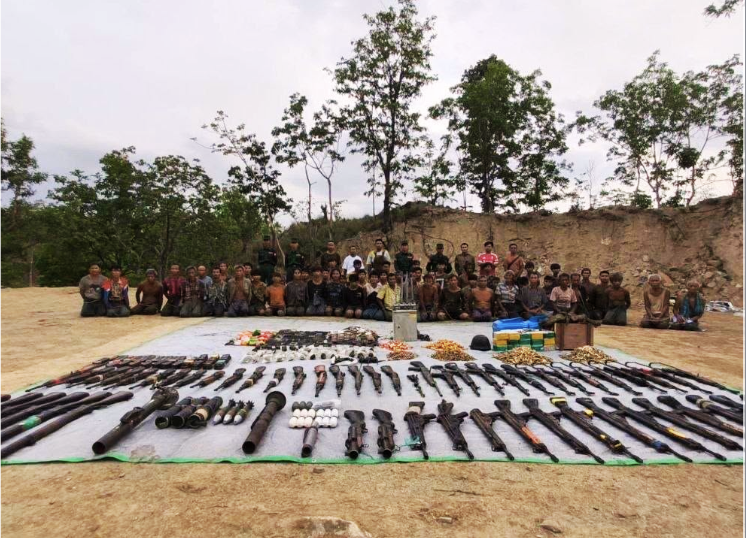
The security landscape this month was characterised by an escalation of armed conflict in north-western Magway Region and the Kalay–Kabaw area of Sagaing Region, alongside increased tensions between National Unity Government security forces and local resistance groups, particularly the People’s Liberation Army in southern Mandalay Region. In Magway Region, sustained pressure on military positions was observed particularly across north-western Magway. The local resistance forces announced Operation Su targeting frontline military posts in Seikpyu, Pauk and Pokokku townships. The resistance groups announced that they had captured Pyu-Saw-Htee militia members and Tatmadaw soldiers while taking control of Kokkosu Village in Pauk Township. Resistance forces also claimed to have shot down a military helicopter during operations in the region. In Pakokku Township, near the Tatmadaw’s Light Infantry Division 101 headquarters, resistance groups reportedly seized the Myit Che Police Station. Similar attacks targeting police station in Saw Township were also reported. In Yesagyo Township, the People’s Defence Team of Yesagyo launched an attack on a Tatmadaw unit on the outskirts of Yesagyo Town. In Natmauk Township, resistance groups reportedly captured the Padauk Ngote Pyu-Saw-Htee outpost. Guerrilla attacks were also reported in Taungdwingyi and Seikphyu townships.
In the Kalay–Kabaw area of Sagaing Region, Tatmadaw launched a major offensive and reportedly regained control of Khampat Town, which had been under National Unity Government control since 2023. Fighting continued throughout the month as Tatmadaw ground forces advanced along the Kalay–Tamu corridor in an apparent effort to re-establish control over the strategic road linking Kalay to the India–Burma border trade zone at Tamu. The renewed offensive triggered significant displacement, particularly from Yarzagyo Village and Khampat Town along the India–Burma Friendship Road. A Tatmadaw column under the Monywa-based Northwestern Regional Military Command launched operations against resistance strongholds in Chaung-U Township. Clashes were reported as the military advanced through the area. Following the fighting, Tatmadaw forces reportedly burned approximately 250 houses in Sin Myay, Nga Lone Tin and Hman Cho villages after suffering an estimated 20–30 fatalities in engagements with resistance forces.
In Mandalay Region, resistance activity remained concentrated in the southern townships of Natogyi, Myingyan and Taungtha. The People’s Defence Team of Natogyi Township announced that it had attacked a Tatmadaw column conducting village raids in Natogyi Township. Inter-factional tensions among resistance forces persisted during the month. In southern Mandalay Region, National Unity Government forces reportedly raided positions held by the People’s Liberation Army in Taungtha Township, in what observers viewed as part of the NUG’s broader effort to consolidate command and control over resistance forces in central Burma. Similar tensions were reported in Sagaing Region, where NUG infantry battalions reportedly raided bases of the People’s Security Team in Monywa. Separately, Pale Maung, a battalion commander of the NUG, was reportedly shot dead by the Personal Assistant to Swan Thu Maung, the District Commander of Yinmarbin District.
Justice and Human Rights
In June, Tatmadaw’s atrocity crimes were recorded in several townships, such as Myit Che, Chaung U, and Pakoku among others. In Mandalay, the column of Tatmadaw forces from Infantry Battalion 415 based in Nyaung U has reportedly raided the villages in Myit Che, since May 12, according to local sources. Over 20 people, including women and elderly were extrajudicially killed after being arrested. The dead bodies were found, even hard to identify who they were. In addition, attacks on civilians and religious buildings were reported in Chuang U township, Sagiang in mid-June 2026. After a week of fighting with local resistance forces, the artillery attacks and airstrikes of Tatmadaw forces are continuous and intentional. Our investigation has confirmed four deaths, and twelve injuries. Among the deaths, three are above 58 years old, and sick people who suffer from chronic disease. Last but not least, regardless of international humanitarian law’s provisions, the destruction of a stupa over 200 years old was recorded in Sin Myay village. The patterns of burning houses where resistance stronghold areas are highly targeted in O Yin village, Pakokku township, Magway.
Amid widespread and systematic conflict-related abuses, women and girls remain highly vulnerable to rape and other forms of sexual violence.
Access to justice continues to be limited due to insecurity, weak law enforcement, and constraints on judicial institutions. One reported example is the case of a perpetrator accused of raping and murdering a 13-year-old girl in Saw township, who was reportedly convicted and sentenced to death by a National Unity Government administered court but later escaped from detention while authorities were reportedly attempting to secure his custody. This reported escape highlights the ongoing challenges in ensuring accountability and enforcing judicial decisions in conflict-affected areas. On the other hand, civic protests and resistance activities continued in several townships across Central Burma. On 18 June, strike groups in Butalin and Kani launched the “Rose Campaign” to commemorate the 81st birthday of Daw Aung San Suu Kyi. The initiative encouraged public participation through symbolic acts, including wearing or carrying red roses and engaging in online solidarity campaigns, reflecting the continued use of peaceful forms of political expression despite the ongoing conflict.
Related Articles
16 September 2026
1 September 2026
31 July 2026
17 July 2026
Share via:
 English
  Myanmar