
Myanmar’s Conflict Is No Longer a 20th-Century Revolution
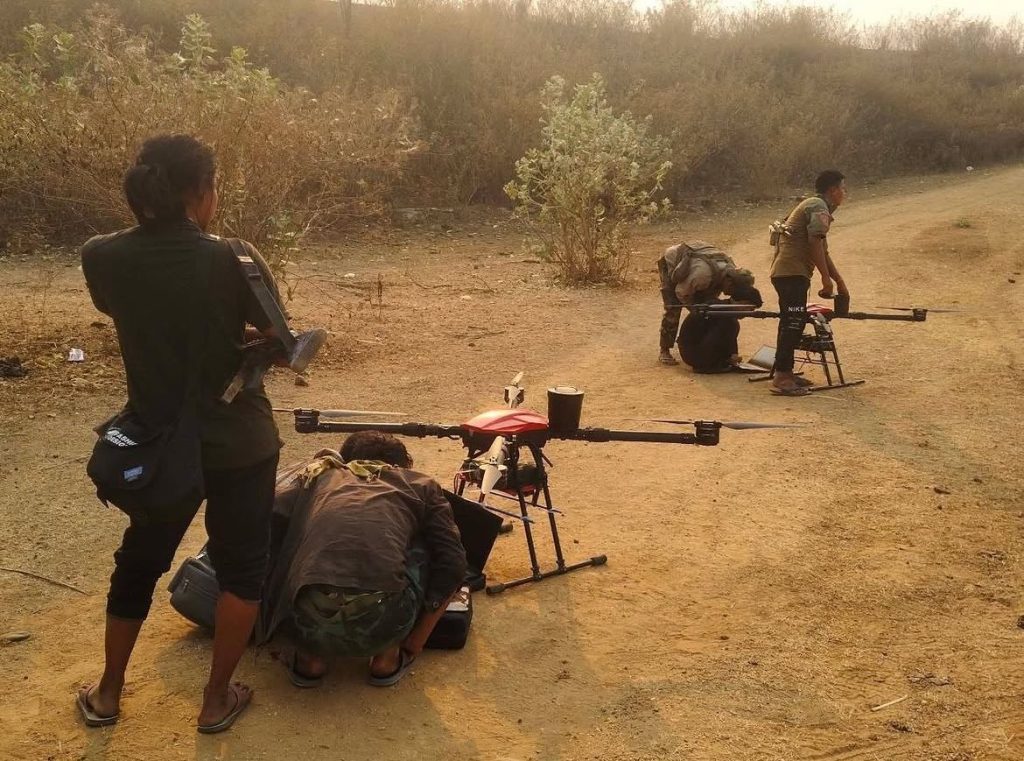
PDF Fighters in Magway (Photo: Thanlwin Myanmar Media)
The recent diplomacy between the United States and China should serve as a wake-up call — particularly for many of Myanmar’s institutionalised political and civil society elites who continue interpreting the country’s crisis through outdated frameworks rooted mainly in identity politics, symbolic advocacy and old political binaries. Myanmar’s conflict has already evolved into something far more complex: a hyper-modern war economy shaped by trade survival, logistics control and technological integration. The battlefield today is no longer determined only by ideology or ethnicity. Increasingly, it is shaped by who controls trade routes, financial circulation, resource corridors, and technological infrastructure. Across Myanmar’s conflict landscape, from EAO and PDF to Pyu-Saw-Htee militias, BGF and the Tatmadaw, the survival and influence of armed actors ultimately depend on their ability to contest and control these key sources.
A quick examination of the conflict reveals that control over ammunition, medicine, fuel, internet access and food supplies is just as important as control over territory. None of these essentials can be sustained without functioning financial and trade networks operating across multiple levels—from northern Shan to Mandalay and from central Burma to the country’s western frontier. Without these systems, territorial control remains nominal rather than substantive.
This explains why some of the fiercest battles are fought not merely over symbolic locations but over strategic trade corridors, logistical hubs and resource-rich areas. In contemporary conflicts, authority is measured not only by who holds territory, but by who can govern, supply, finance and connect it. The ability to sustain economic and administrative systems ultimately determines whether military control can be translated into durable political authority. To put it simply, modern revolutions are not won through political narratives alone. They are won through the capacity to govern, mobilise resources and maintain functioning systems that sustain both resistance and society.
Border Gateways and Resource Corridors
The fighting across northern Shan, Karen, Kachin, Chin and the borderlands adjoining Thailand, India and China is deeply intertwined with the control of customs gates and cross-border trade routes. Whoever controls these gateways controls taxation, revenue generation and ultimately, political authority. The recent developments in Kutkai illustrate this reality. The MNDAA reportedly moved against its long-standing ally, the TNLA and dismantled the latter’s administrative presence in the town. Kutkai is not merely a military objective; it sits on the strategic trade corridor linking Mandalay, Muse and China.
The significance of such locations lies in their economic value. Trade flows through these corridors generate substantial revenues that finance administrative structures, public services and military operations. Whether under the control of ethnic armed organisations, resistance actors, or the junta, these revenues provide the resources necessary to sustain governance and project power. In many respects, the struggle for border crossings and trade routes is as consequential as the struggle for territory itself.
Similarly, many conflict zones overlap directly with strategic resource corridors linked to rare earth mining, crude oil and other critical minerals. The struggle over China-bound supply chains, Thailand-linked trade networks, India-linked illicit economies and extractive zones is not accidental. For example, fierce contestation across Kachin State is closely tied to access to rare earth mining areas that supply China’s high-tech and renewable energy industries. According to Global Witness, Myanmar’s heavy rare earth trade was worth approximately US$1.4 billion in 2023, while exports of heavy rare earth oxides to China more than doubled from 19,500 tonnes in 2021 to 41,700 tonnes in 2023.
A similar pattern can be observed in central Burma. Recent research by the Centre for Ah Nyar Studies highlights how contestation over oil and gas infrastructure in Magway has become increasingly intertwined with emerging governance arrangements. Petroleum fields, transport routes, taxation systems and local administrative mechanisms have become sites of competition between revolutionary actors and the junta. Likewise, competition over jade, gold, timber and border trade routes has long shaped the political economy of conflict in northern Myanmar, while battles around key crossings in Karen and Shan States remain inseparable from the revenues generated through formal and informal cross-border commerce. In many cases, the real strategic value lies not in the land being contested, but in the economic infrastructure that runs through it.
The Digital Frontline
Ethnic resistance movements have been among the greatest beneficiaries of Generation Z’s efforts to digitalise the revolution, from the use of drones on the battlefield to the mobilisation of financial resources. Like it or not, the Spring Revolution has fundamentally digitised Myanmar’s conflict. At the same time, digital infrastructure has become more critical than ever for the resistance movement, governance and, most importantly, the functioning of the emerging economy in resistance-held areas. Adding to this, Myanmar’s formal banking system has been severely weakened by militarisation, state surveillance, sanctions pressure, economic decline and repeated systemic disruptions. As confidence in formal financial institutions has eroded, communities have increasingly turned to mobile wallets, crypto-linked transfers, informal hundi networks and other decentralised financial mechanisms. Diaspora remittances, humanitarian assistance, procurement financing and even battlefield logistics now flow through hybrid financial ecosystems involving USDT, encrypted communication platforms, digital payment channels and cross-border transfer networks. In many respects, resistance financing has evolved beyond conventional fundraising models. It increasingly resembles a decentralised wartime fintech system, capable of moving resources across borders, circumventing state controls and sustaining both governance and resistance activities in contested territories.
Likewise, connectivity is increasingly moving beyond the reach of state control. Satellite internet systems such as Starlink enable communities to bypass internet shutdowns, communication blackouts and state surveillance mechanisms. Across Ah Nyar, particularly among displaced populations, connectivity is no longer simply a matter of communication. It has become a critical enabler of education, emergency coordination, access to healthcare, financial inclusion, documentation of human rights abuses and maintaining social ties under wartime conditions. More importantly, connectivity enhances resilience. Communities with access to the outside world are better able to mobilise resources, share information, access services and maintain links with diaspora networks. In this sense, digital connectivity functions as both social infrastructure and a form of civilian protection. A connected village is not only better informed; it is also harder to isolate, intimidate, or control psychologically and politically.
Beyond Symbolic Politics
This does not mean that questions of ethnicity, discrimination, gender inequality, or historical injustice have disappeared. They remain deeply embedded in Myanmar’s social and political fabric. Yet much of the country’s political discourse continues to approach these issues through frameworks of representation and recognition inherited from previous decades, often overlooking the profound transformation of the material conditions that shape people’s lives.
For millions living under protracted conflict, the struggle is increasingly about access rather than symbolism. Access to essential supplies, including energy and finance, has become as consequential as access to political representation itself. Communities are not merely demanding a seat at the table; they are seeking the capabilities necessary to survive, adapt and shape their own futures.
Beyond symbolic politics, Myanmar’s future will be shaped not only by political settlements, military outcomes, or constitutional arrangements, but by whether emerging systems can genuinely expand human capability. Despite all the discussions about trade corridors, digital finance, AI, drones, crypto systems and geopolitical competition, the central question should never be forgotten: How can human beings live with dignity, safety, and opportunity under rapidly changing realities? Access to education, healthcare, connectivity, finance, energy and security increasingly determines whether people can build meaningful lives. Ultimately, the success of any revolution should be measured not by the power it accumulates, but by the opportunities and dignity it creates for ordinary people.
Let Pan Ni is an independent researcher specialising in the social dynamics of Myanmar’s central dry zone (Ah Nyar). Her research focuses on bridging the gap between realities on the ground and international policy frameworks.
The views and analyses presented in this commentary are solely those of the author and do not necessarily reflect the positions of the အညာလေ့လာရေးစင်တာ.
Cite this Article: Centre for Ah Nyar Studies, (2026, June 10). “Myanmar’s Conflict Is No Longer a 20th-Century Revolution”. Op-ed, Centre for Ah Nyar Studies. https://ah-nyarstudies.org/myanmars-conflict-is-no-longer-a-20th-century-revolution/
Related Articles
Share via:
 Myanmar
  English