
What is Happening in Ah Nyar? May, 2026 [Issue 5/2026]
This month in Ah Nyar: A Quick Overview
Federal Unit Governments in Ah Nyar continued to consolidate interim governance structures and deepen political coordination amid the re-escalation of conflict in the region. These efforts reflect an ongoing attempt to institutionalise sub-national governance arrangements, enhance policy coherence among resistance-controlled administrations, and strengthen coordination between civilian and security actors. Prime Minister Mahn Winn Khaing Thann convened a meeting with cabinet ministers at an undisclosed location to review progress on the SCEF, governance and federal units.
The security and humanitarian situation continued to deteriorate. In western Magway, particularly in resistance-controlled areas west of Pakokku, the Tatmadaw intensified its “four cuts” strategy, restricting civilian access to food, medicine, and other essential supplies while deploying an estimated 2,500–3,500 troops, including newly conscripted recruits, to reassert territorial control. These developments are likely to exacerbate displacement and civilian vulnerability. Concurrently, the World Food Programme warned that 12.4 million people – one in four nationwide – are facing acute hunger, while 3.7 million remain displaced by the ongoing conflict.
Politics
Sagaing parliament and government released information on the finalisation of the transfer of administrative mechanisms from the NUG to the Sagaing Federal Unit Government. The process was presented by the President, Prime Minister, cabinet members, including Union Minister for HomeAffairs Lwin Ko Latt, as well as the Chief Minister and cabinet of the Sagaing government. The development marks a significant step towards operationalising devolved governance at the federal unit level. At the administrative level, the Sagaing government convened district and township administration teams to introduce the new governance structure and discuss implementation plans. Meanwhile, the Sagaing parliament continued deliberations on federal unit legislation and reviewed judicial appointments as part of efforts to establish the institutional foundations of the unit’s judiciary. Sagaing Parliament and Government engaged with the SCEF Secretariat, led by Dr Zaw Wai Soe and Salai Ram Kulh Cung, to explore avenues for Sagaing’s participation in the State/Federal Unit/ERO Representative Pillar of the SCEF. The discussions reflect broader efforts to integrate emerging federal units into national-level revolutionary coordination mechanisms. Sagaing parliament also announced the completion of a Security Council Bill, which signals continued efforts to formalise governance and security arrangements within the federal unit framework.
Magway parliament held talks with the CRPH on the evolving federal unit political landscape. Separately, the Magway Federal Unit Government engaged the NUG in Division of Competencies (DoC) discussions, with particular attention to the transfer of Magway administrative mechanisms from the NUG to the federal unit government. Magway Federal Unit met with the SCEF Secretariat team, led by Dr Zaw Wai Soe of the NUG Prime Minister’s Office, to discuss its representation in the State/Federal Unit/ERO Representative Pillar, one of the three pillars of the SCEF.
Mandalay parliament and the governing council held discussions with the SCEF Secretariat, led by Dr Zaw Wai Soe and Salai Ram Kulh Cung, on potential avenues for Mandalay’s participation in the State/Federal Unit/ERO Representative Pillar of the SCEF. The engagement reflects ongoing efforts to position emerging sub-national institutions within broader revolutionary coordination mechanisms and federal political structures. Separately, the Coordination Platform of Revolutionary Forces, commonly referred to as the “Mandalay Platform,” convened with representatives from the seven constituent blocs that form the MIGC, alongside members of the Mandalay Parliament and the governing council. The meeting is a political coordination room created by the Mandalay Interim Political Arrangement and serves as a forum for political coordination and consensus-building among diverse revolutionary stakeholders.
NUG announced, on May 21, that Prime Minister Mahn Winn Khaing Thann held an in-person meeting, at an undisclosed location, with several union ministers and deputy ministers on key political and military developments.According to the statement, the meeting focused on seven major areas, including the implementation status of the SCEF, interim public administration among federal units, strategic military operations, international relations, healthcare, education, and humanitarian affairs. The SCEF was formed on 30 March through coordination between the NUG, the CRPH, and several major ethnic armed organisations, including the KNU, KNPP, CNF,and KIO.
Resistance Movement
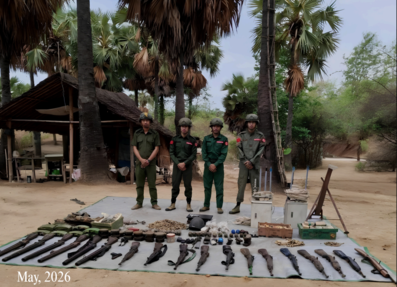
The resistance landscape during May 2026 reflected continuing territorial contestation and intensified military consolidation efforts by both Tatmadaw and resistance forces across Ah Nyar and the Magway–Chin corridor. Resistance forces captured Thayetkan village in Myaing Township, Magway Region, on 23 May 2026. The village, reportedly a stronghold of the pro-junta Pyu-Saw-Htee militia, is located approximately 13 miles from Myaing town. Meanwhile, resistance groups expanded offensive operations in Sagaing Region. The PDF Shwebo District Battalion No. 1 announced the capture of the Saing-Pyin police station in Depayin Township as part of Operation OTT. According to the statement, 11 Tatmadaw soldiers died in the battle.
On the other hand, Tatmadaw forces expanded continuous military operations following control over northern Chin towns, including Tonzang on May 19. Tatmadaw increased troop mobilisation, aerial logistical operations, and military reinforcements in western Magway, particularly around Saw and Kyaukhtu townships. On May 14, a column of more than 350 troops of Tatmadaw reportedly entered Saw town, where soldiers established positions in public buildings and monasteries, conducted inspections, and arbitrarily detained civilians, particularly young residents. The major expansion of troop deployment was observed on the main roads across western Magway connecting Chin and Rakhine. In Sagaing, Tatmadaw continued military operations across Salingyi, Yinmarbin, and Kani townships. On 17 May, junta troops reportedly launched an offensive along the road linking the Myanmar Yang Tse Copper Company Limited mining project in Salingyi Township and Yinmarbin town.The operation triggered the displacement of approximately 1,000 civilians from nearby communities.
Justice and Human Rights
Humanitarian conditions across Myanmar continue to deteriorate. An estimated 12.4 million people—roughly one in four of the population—are experiencing acute food insecurity, while 3.7 million people remain displaced by ongoing conflict. Against this backdrop, local sources reported that transportation routes from Pakokku to western Magway townships, including Pauk, Myaing, Myit Chay, and the Yaw region, have been tightly restricted. The restrictions have reportedly disrupted the flow of basic commodities and humanitarian supplies. This exacerbates existing vulnerabilities in conflict affected communities and further constrains access to essential goods and services. Local sources indicated that even small household items, such as bottled water, have been blocked by the Tatmadaw. Local sources reported that, during the first week of May 2026, Tatmadaw soldiers allegedly raped four women in MaYoe Kone and TheinYwar villages in Myingyan Township. According to local reports, the survivors have since fled their communities due to concerns over stigma, social pressure, and continued insecurity. In addition, the mentally disabled woman, about 34 years old from Ta Pyin village, Saw township, is reportedly raped and killed by the column of Tatmadaw that raided on 15 May, according to local sources.
Related Articles
16 September 2026
1 September 2026
31 July 2026
17 July 2026
Share via:
 English
  Myanmar