By:
Centre for Ah Nyar Studies
|
Published:
1 September 2026
|
Category:
Sitrep
This Month in Ah Nyar: A Quick Overview
- Sagaing and Mandalay formally joined SCEF, while coordination among the three federal units and with national-level institutions continued.
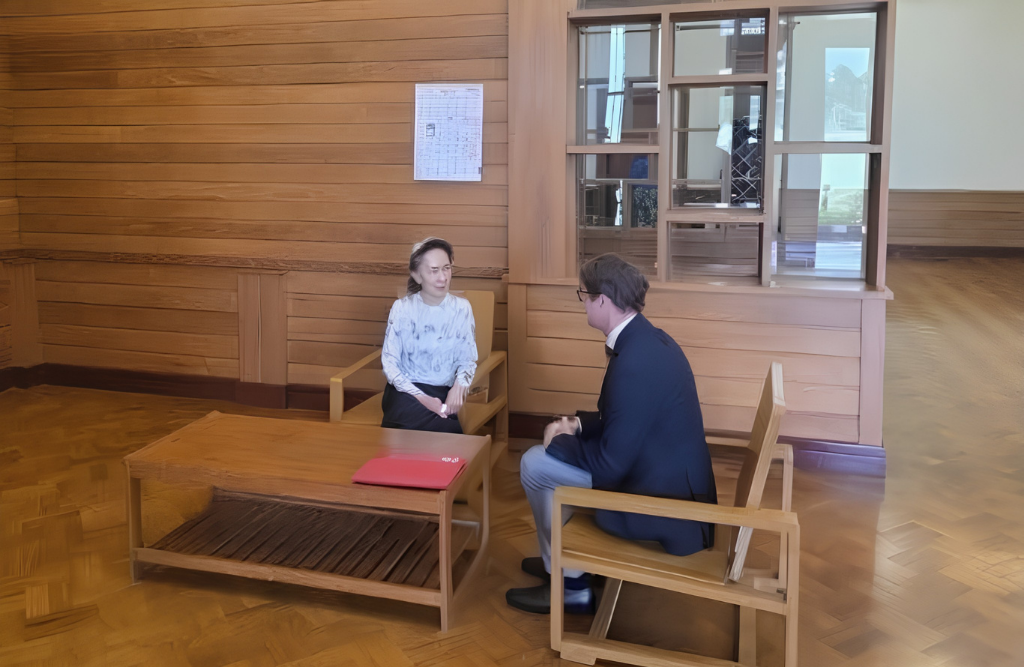
- ICRC Representative of Burma visited State Counsellor Daw Aung San Suu Kyi.
- Resistance forces expanded military coordination, while junta forces continued offensives, reinforcements and airstrikes to regain strategic positions.
- Airstrikes, village raids, arbitrary arrests, looting and arson continued across Ah Nyar, with civilians bearing the main burden of the conflict. The airstrike on a meditation centre in Myaung killed at least 16 people and injured more than 30, highlighting the continuing vulnerability of civilian spaces
- Sagaing flood directly affected at least 177,700 people in at least 10 Sagaing townships, while restrictions on relief efforts compounded the crisis.
Politics
With the rise of discussions around the Steering Council for the Establishment of a Federal Democratic Union (SCEF), political debate appears to have become more prominent than institutional building, in contrast to the institution-building processes observed last month across the three units of central Burma. These political developments also coincided with the recent visit by the ICRC Burma representative to State Counsellor and NLD Chair Daw Aung San Suu Kyi, during which the ICRC stated that the visit “included the opportunity to speak with Daw Aung San Suu Kyi in private.”
Following these discussions, Sagaing and Mandalay officially joined SCEF, a political and military alliance involving the NUG, KIO, KNU and their partners. Discussions with Magway remain ongoing.
This month also saw increased horizontal coordination among the three federal units, alongside greater engagement with the Committee Representing the Pyidaungsu Hluttaw (CRPH). This can be understood as complementary to the ongoing discussions on the Division of Competencies (DoC) with the NUG, particularly regarding future administrative transitions. At the same time, the continued negotiations point to unresolved questions over representation, authority, and the relationship between federal-unit institutions and national-level actors.
More consequential developments, however, may be emerging at the administrative level. In Magway and Sagaing, federal-unit governments continued coordinating with NUG structures and township administrations, while Mandalay openly discussed the division of competencies between the NUG and the region in higher education. These developments suggest that federalism is increasingly being negotiated through everyday governance and the exercise of administrative authority, rather than through constitutional and political declarations alone.
Magway’s federal-unit government also announced the establishment of a public complaints mechanism and the creation of a human rights department under the Deputy Chief Minister’s Office.
The central political question emerging from August is therefore not simply whether Ah Nyar is developing alternative institutions, but whether these increasingly numerous institutions can establish a coherent division of authority and a shared federal political framework without reproducing political and institutional fragmentation.
Security
The security landscape was characterised by persistent territorial contestation, increasing coordination among resistance forces, and continued military efforts to regain strategically important positions. The coordinated military column operating in Myaing and Pauk townships, led by LID 101 and LID 99, was reportedly reinforced by infantry troops from the 14th Military Operations Command based in Mong Hsat, eastern Shan State. The operation has been heavily supported by airpower, including aerial bombardment and fighter-jet strikes, as explored in our recent analysis of the situation. By 8 August 2026, the military column had reportedly raided at least 31 villages across Myaing and Pauk townships. More recently, reports indicated that a Tatmadaw column was approaching the Well No. 2 Oil Field near Kyauk Khwet village in Myaing Township, suggesting an ongoing effort to regain strategically important economic and territorial positions.
In response, the resistance alliance’s “Ah Nyar Tamar Operation” has continued to confront military forces in areas under the command of the Magway Federal Unit’s Ministry of Defence. Fighting also continued in Minhla and Mindon townships, where reported military reinforcements point to the strategic importance of the routes connecting Magway and Rakhine. The United States of Burma Army, which is active in the area, also reported armed clashes beginning around 20 August. Beyond these frontline clashes, August also saw targeted killings of resistance-linked actors. A central committee member of the Chinland Defence Force (Kalay, Kabaw and Gangaw), along with two other individuals, was reportedly assassinated by gunmen who subsequently joined a Tatmadaw military base in Gangaw Township. Separately, the commander of the Chin Defence Force–Asho was reportedly killed in an ambush by junta forces in western Magway.
Sagaing similarly experienced a mixture of resistance advances and increased military pressure. Resistance forces reportedly captured a strategically important military position between Indaw and Katha, while fighting and military restrictions continued in areas including Mingin, Yinmabin and Sagaing. The reported use of airstrikes during flooding, alongside arrests, forced recruitment and movement restrictions, further demonstrates how military pressure continues to extend beyond conventional frontline engagements. In Myaung Township, Sagaing Region, a junta field commander was reportedly assassinated inside the town, and resistance forces subsequently seized his mobile phone, potentially providing intelligence on the junta’s local operations and networks.
In Mandalay, resistance forces continued to target military positions around Myittha, Meiktila, Myingyan and Kyaukpadaung, including the reported capture of a military outpost in Myingyan. At the same time, military and allied forces continued operations against civilian communities and resistance-held areas.
On resistance coordination, four resistance groups, including the Rocket Fighter Column of the Magway Regional People’s Security Team under the NUG, formally announced the formation of a military alliance. At the local level, there were also signs of growing operational coordination, including joint operations among resistance groups in Mandalay and increased cooperation between different forces in Magway.
The overall pattern suggests a protracted contest rather than a clear military turning point. Resistance forces appear increasingly capable of coordinating operations and contesting military positions, but the military continues to compensate for territorial vulnerabilities through reinforcement, airpower and coercive control of civilian movement.
Human Rights
The humanitarian situation in Central Burma has further deteriorated as flooding and ongoing military operations place a double burden on conflict-affected and displaced communities. According to our monitoring data regarding floods in Central Burma, over 177,700 people have been directly affected in at least ten townships of Sagaing, including Ye-U, Khin U, Taze, Myaung, and Wetlet townships. However, Tatmadaw authorities have also restricted emergency relief and rescue efforts in flood-affected areas. In Sagaing, for instance, local sources reported that people has been stopped and checked from carrying relief supplies at the Sagaing Bridge (Yadanarpon Bridge), locally known as Hna Pauk.
Amid such natural disasters, multiple aerial attacks of Tatmadaw continue against civilians. NUG has stated that, from 8 August to 23 August, over 240 airstrikes occurred nationwide, in which Magway and Sagaing were mostly targeted. In Sagaing, during August, attacks on civilians were recorded in Chaung U, Kani, Khin U and Myaung townships, among others. Among deadly aerial attacks, the massacre case was recorded in Myaung township. Tatmadaw conducted airstrikes twice around 9:00 am on 21 August, targeted at Buddhist meditation centre located in Hswe Lae O village, Myaung township. Our investigation has recorded that the attack resulted in the deaths of 14 people at the scene, and over 30 were injured. Most are male elderly meditators, according to locals. Two people, including a 16-year-old boy, were dead with heavy injuries after the attacks. The attack may have been retaliatory following the killing of a Tatmadaw officer in Myaung on 17 August, although this connection requires further verification.
In addition, since early August, Tatmadaw’s on-ground operations have continued to expand in Magway, Sagaing and Mandalay. Common patterns of arrests, torture to death, hostages, looting civilian properties, and burnings are widely seen as junta strategy in frontline battles. Such forms of violations were recorded in villages of Seikphyu, Chauk and Myaing townships in Magway, the villages of Kani and Yinmarbin townships in Sagaing, as well as the villages of Nyaung U and Taung Thar townships in Mandalay.
In urban areas controlled by the Tatmadaw, local sources reported arbitrary arrests under the pretext of conscription in Kalay, Monywa and Salin. These arrests were followed by extortion, with families asked to pay money for the release of those detained, according to local sources. In Salin township, for example, 16 young men aged 25–35 were arrested on August 16 by Light Infantry Battalion (LIB) 253, stationed in Salin. Local sources reported that the junta intensified conscription recruitment for batch 28 that will begin in September.


 English
  Myanmar